Book Title: 23 Things they don’t tell you about Capitalism
Author: Ha-Joon Chang
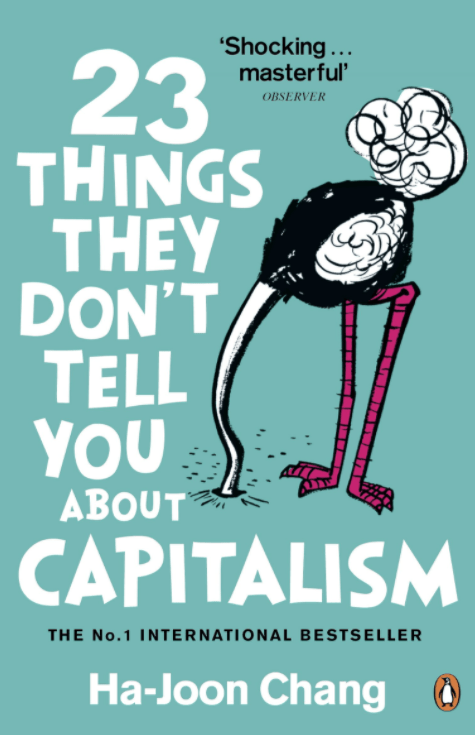
Immediately when you read the title you might think, wow, this person must be someone that doesn’t like the capitalism system, he must be supporting another system.
This is where I want to stop you, tell you to take a deep breath, and take the book back into your hands and start turning to the first page and start reading the book. The phrase properly fits that you shouldn’t ‘judge a book by its cover’.
Just like you feel obligated to protect your university whenever someone wants to badmouth it, we might be inclined to do the same with the system that is applied in our own economy. However, I wish to share that even Churchill (once the prime minister of Britain) said that it was also not a good system, but it was the lesser evil between Capitalism and Communism.
The book doesn’t criticize one system and promote the other system. It actually, in my opinion, just points out that even though the one system may be working better than the other, the ‘best’ system also has its flaws.
For anyone that wishes to get more insight on how Capitalism has its flaws this is definitely a good book to point some of them out to you, because it isn’t only just the other system that has its problems.
As the title suggests, it gives you 23 instances where the capitalism system has its flaws and for which we still need to find a solution.
What I really thought was funny about the book was that the author included a list at the front of the book of ‘7 ways to read ‘ the book. He suggests which of the 23 chapters you should only be looking at if you want one of those 7 questions to be answered. I followed the 7th way and wanted to read the whole thing, because I don’t think I would ever let it go at the back of my head that I never read all the chapters to the book. 🙂
At the start of each chapter he presents the scenario where the system is flawed, gives the reader some background of the theory/principle and then includes a real-life scenario to support the claim. I think it was well structured because he explains what theory he wishes to criticize and then gives the reader a real-life situation, where after then reader can then think about it.
To everyone that is open to accept criticism, this is a good book for you, and I believe that if you are open to learn and improve upon those flaws this can be a valuable tool. Otherwise, it is a good read for anyone that simply wishes to enhance their understanding of economics.
In conclusion,
The book gives valuable insight, and fruit for thought for the everyday professional. But also to the amateur economics enthusiast (like myself) who couldn’t resist to hear someone else’s views on economic theory. The boom does require you to be somewhat acquainted with some jargon, but with a little Googling this can be fixed quickly. I believe for the knowledge it hands out it deserves a strong rating of 4.7/5.
 MyBookReviews