Book Title: Unsafe Thinking (How to be creative and bold when you need it most)
Author: Jonah Sachs
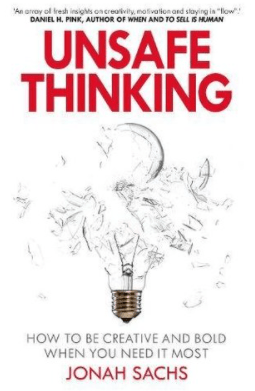
I have read this book just over a year ago, but I will definitely try my best to remember as much as is needed to give you a great idea what the book is about, and why I give it the rating that I did.
Before we start, let me throw some words at you, status quo, and creative destruction.
- Which of these sounds most familiar to you?
- And, which one do you believe is the most appropriate to describe how we have come to our living standards today?
The status quo (for those that are a little blurry with the detail) practically refers to something being done in a certain way for a certain situation. It brings in a sense of stability and certainty that there is a way of doing things, and won’t make us panic when we encounter a situation that we haven’t come across before.
- To give an example, when you drive and see the traffic light is red it means you need to stop and wait until it becomes green. Then you may proceed. There are rules in place for everyone to follow and when everyone follows those rules then the system should work and no one needs to panic.
- Whereas if, lets say you as a foreigner, went to an under-developed country where there are no traffic lights and everyone just drives where they find a gap. You automatically might feel less at ease and uncertain to carry on driving.
Now let’s go to creative destruction. It was a term used by the economist Joseph Schumpeter to explain how can we become more innovative than continuing the current system. If we had only done what our parents had done and never deviated from that, then (and this is only where you believe in the Darwinian theory of evolution) we might never have used the fire at all.
Luckily for us, our species always has been motivated to discover new things, and implement them should they prove more useful and assist with our probability of survival.
Now, let’s jump back to the book…
The book actually tries to convince us, rightly so, that we shouldn’t always stick to the status quo, and thus remain within the comfort zone. But actually motivates us to step outside and try something new. It tries to show that we can find a sense of satisfaction (be creative) in having tried new things, even when they didn’t result in success.
What counts is that we tried, and carry on trying to make it better.
However, just a disclaimer, in no way does it promote (and I also don’t promote) that we should break rules that would otherwise result in breaking the rules of law. It is a guide to become more creative within the legal boundaries of society, and should be read as such.
That said, it wishes to unlock the reader’s creativity and bring it back to life. It gives the reader six steps to follow to unlock their creativity in all aspects. The book also provides the reader with some real-life people’s stories and how the author sees them as having lived on the creative edge.
What I took from the book was that we are brought up in a society to conform to rules, and play our part, but we need to learn the skill of trying to always become and remain creative. This, I understood, brings somewhat more happiness or excitement to your life. Even when the creative spark didn’t pen out, at least you tried it and showed it doesn’t work for you. But you tried something new.
Also, I think it would be worthwhile to read the book once again to refresh oneself with the principles/steps as we tend to always fall back into our usual patters of status quo. We’re creatures of habit so it’s not easy to get around that.
In conclusion,
For bringing in some philosophical aspects, some real-life scenarios and a step by step guide that can be easily followed by any reader that becomes committed to the book, I want to give the book a staggering 4.9/5.
 MyBookReviews