Book Title: Nudge (Improving decisions about health, wealth and happiness)
Author: Richard H. Thaler and Cass R. Sunstein
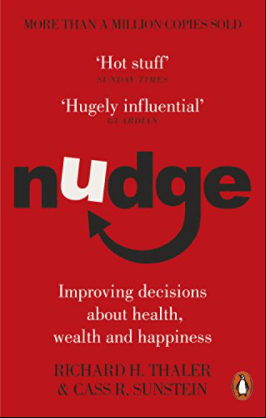
Take a moment and think about the word ‘Nudge’. What would you say is the meaning of the word? Asking for the meaning of the word on Google will give you the meaning of the word used either as a noun or a verb. The definition provided for the verb-use is “…prod (someone) gently with one’s elbow in order to attract attention…”. This is the picture I would like you to keep in mind when reading the book, as someone wanting to attract your attention for something.
Now, the book introduces the reader to a new phrase that you may have heard when used as individual terms, but not together as one term, before. This is ‘libertarian paternalism’. The word libertarian also shares the understood meaning that we (people) should be free to make decisions for ourselves. Whereas the paternalism aspect would suggest more of a guidance aspect to assist with our decision-making. So, how I understood the meaning of the phrase was that we still have the choice to choose as we please, however, there is a guiding force available to us to give us more context of all the available options, and wants us to make a more informed decision (that will make our lives better).
You might be thinking that if we include the guiding hand then we might not be making our choice without having been influenced. And, you are right to say that because if someone gives you advice it could make you choose differently than had you not received that guidance to begin with.
However, when you read the book then it becomes increasingly clearer that when it comes to us human beings, we make many wrong decisions in our lives. One reason for this is that we live in a much more complex world than before, with innovations happening all over, and there being many competing companies out there that try and persuade you that you ‘need’ to have their products instead of someone else’s.
So it makes sense why we all fall for the traps and buy things we don’t need. It happens to all of us, and it sucks, but that’s the best way we learn.
As much as it is important for us to make mistakes and learn from them, there are some decisions in our lives that are costly and should be avoided as best as possible in order to live a healthier and happier life.
That is where the book is trying to get to you. That with some decisions we need to get help (get nudged) by someone/something in order to make a more informed decision, and decide on the alternative that will allow you to live a happier and healthier life.
This book doesn’t only apply to your personal household, or a company, but can also apply to a whole government, as the advice it gives is not something that can only be achieved on a small scale, but can be directed to a larger target audience.
If we make an non-life example on a simple company of 500 people. The staff can choose which package of salary they wish to choose. Either A) take a package where the employer takes portions of the salary and contributes them towards the medical aid and retirement, or B) where the employee takes the full salary and makes them contributions him/her-self to his/her chosen medical aid and pension fund. ……These are the two packages offered to the staff….. Now, the employer informs the staff member that it remains their choice which package they wish to take, however, he lets him/her know that most staff have opted for package A because of the lesser administrative burden it places on the employee. …..Here, the employer nudged one option above the other, however, it was not to persuade the staff for malicious reason, but rather for a happier daily life they could live. The employee still has the choice, however he/she has received more information that will give him/her more to think about.
It is this kind of nudging the authors, in my opinion, want to promote. And I strongly support this because with the vast amount of choices out there for insurance packages, pension funds and medical aids out there (to name a few important areas) it is easy to become overwhelmed and make an ill-informed decision, whilst a broker is an expert and knows more that could have persuaded you to make a better choice.
Not only does the book set out this ideal theory that would be great, but it also gives multiple real-life example out there where this was already implemented, in multiple different industries. (When you bought your phone new and started to set some basic settings, it asked you a few questions, and even gave you options here and there – next to which some had the words “recommended” or “default” next to it). We are not experts in everything because there is just so much, so the seller gives you the choices, with a recommendation how the product can be used for optimal usage.
Rating:
The lesson the book wants to bring to the reader is very valuable, on a small and large scale both, and gives some real examples how it was already implemented effectively across different industries. The book definitely deserves a strong 5/5. 🙂
 MyBookReviews