Book Title: Leadership and self-deception (getting out of the box)
Author: The Arbinger Institute
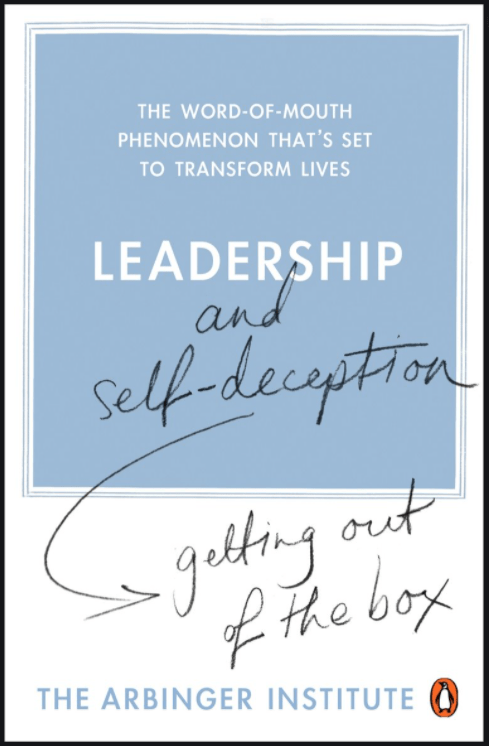
Another great addition to my book collection (yes, I’m building one, and suggest you should too 🙂 ) is this great book right here. One of the biggest trends we see in business these days is that we are moving away from closed-door offices, and more towards open office plans. If you don’t know what I’m talking about here, it basically refers to removing the walls between us in the offices.
I myself have worked in different business environments to see that the private sector businesses have already implemented this to a large extent, whereas in the public sector it remains relatively the same as the old way, ie. close-door policy. With this I’m in no way saying that it is a bad thing, I just think that in the private sector they tend to try and incorporate whatever they believe can improve the business and make the personnel more efficient,
Coming back to the book, you will have seen that the book’s author is the Arbinger Institute. If you don’t know who they are, or what they do, the quick solution to that question (which I read up on their website just now) is that want to provide training to shift the ‘self-focus of an inward mind-set to an outward mindset’. Basically, give training so that you work more effectively with other people and less by yourself. For more, you can read up on the following website: https://arbinger.com . Otherwise, you can just type in ‘Arbinger Institute’ into Google and you should find it there, for those that don’t like clicking links (guilty as well).
The book is relatively small, being about 170 pager. So it shouldn’t take you as long as some other 290 – 450 pagers that seem to take forever (especially if you lose interest in the topic somewhere in the beginning).
The writing style is one thing that is brilliant about the book, because it doesn’t try and give you the theory about the book only and some quick pieces of examples. Rather, it gives you the plot of an executive having a meeting/interview/discussion with one of its senior managers. Therefore, as you read every chapter of the book, it follows the progress of the meeting/interview/discussion of the parties.
Also, it teaches the methodology very slowly and clearly. Therefore, it makes sure that the reader properly follows the thread of the theory that they wish to convey to you.
To give a brief overview how I understood the theory, we encounter a scenario, we can act in one of two ways (act upon it, or not act upon it) and when we chose not to act upon it we have self-betrayed ourselves (because we feel that we rather should have acted upon it, so we start feeling guilty), but then, to escape this, we look for reasons that justify our in-action to be a valid choice (by seeing ourselves as being the victims and everyone else as the guilty party), and thus shifting our guilt away. At this point you have gone into the box.
Now, you may not completely understand the full message from my brief paragraph, but if it were simple to explain the book could have been much much shorter.
So, the book properly explains how we encounter these types of situations (in both the professional and personal aspects of our lives) and then shows us how we can get out of the box.
You don’t need to take my word for it, but, after reading the book, I started to think a minute longer for any situation I encounter, before I take action. I am now, more than ever, aware of when I get into the box, and how I can get out of it as well.
For anyone that is looking for a book that can assist with personal development, I would highly recommend this book to you.
Rating:
For the value that it gives to the reader, as well as the writing style the author uses to teach the theory to the reader, on my scale it definitely deserves a 6/5.
Happy reading !!!!!!
 MyBookReviews