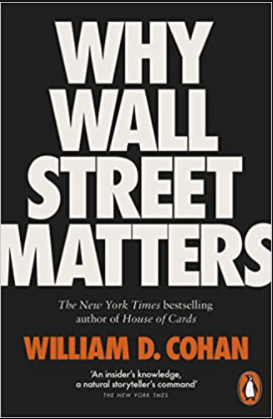
Book Title: Why Wall Street Matters
Author: William D. Cohan
At some point in everyone of our lives we would have heard the name ‘Wall Street’. If you only know it by name, but not what it is or what happens there, then let’s quickly fill you in. It’s a place in the United States of America where people buy stocks/shares in entity’s that have become public entities, or where people can put their money into a bank as savings, and the bank then loans those funds to others that wish to build a business, or expand its operations.
To give some interesting history about how the stock exchange arose, let’s go a little back in history.
Far back in our history, when kings ruled countries, kings (who in today’s equivalent served the same function as government) collected taxes to fund the basic services to keep the kingdom running effectively. Services included protection (soldiers), water from wells (water), infrastructure (streets in the kingdom, as well as walls) and food (from farmers that sometimes rented the lands around the kingdom), and many other activities. However, all funds collected from taxes didn’t solely fund those activities. They were also used to fund expeditions and wars.
The king was one source to collect funds in order to do something new. The other source was wealthy merchants who engaged in trade with other cities in order to trade goods between people in different cities. Because those goods were only obtainable from the merchant and not by a producer in the city, the merchant could charge high fees for his time and effort to bring them to the city via shipping and caravans.
Therefore, the main application of their funds was to keep the kingdom a good place to live in, and also to fund their businesses.
However, as you may have read, this was only accessible to the wealthy at the time. And they mostly only did business with those they trusted, or risked their funds with those they knew.
Then came a concept in the Netherlands around the early 17th Century (according to https://beursgeskidenis.nl ) where some of the middle class members could collect some of their funds, and then all those funds would be used collectively to fund an expedition or ship trade. When the expedition or ship returned, the goods they returned belonged solely to all those members who had contributed their funds to send the ship on its way. Thus, a new way of funding was born to let the middle class and poor to participate in a trade game that had previously been only open to the wealthy few individuals.
Different to the exchanges back then to the stock exchange today, they mainly got their returns when a ship returned, whereas today, we get our returns whenever we get some dividends, or when we sell our shares.
However, it is not just in a stock exchange that we give our funds to. We also give our funds to banks as savings, and then the bank loans those funds to other individuals/business to fund something else, in return for interest over the amount lent.
The stock exchange and banks fulfill the same purpose if you think about it carefully: accumulate funds from many individuals, and give those funds to another party. However, with a stock exchange you take the risk yourself to invest in the person, whereas through the bank, the bank performs analysis and risk assessment to determine whether it is feasible to loan the funds, and ensure that a return is highly likely to be generated from the business or not.
I think a got a little excited when I started writing about stock exchanges and the banks, that I lost the thread on what the book is about. Sorry for that.
Coming back to earth, and into the book, the book perfectly explains the function of the banks, as well as what disasters we have faced in the past (Mississippi bubble, Great Depression) that has brought about the establishment and function of the Central Bank in a country.
As exciting it is to earn money from an investment in a stock exchange, or interest on savings not actively utilized by many people, it does hold some risks, and events in our past have shown us the down side of these ventures. Thus, to try and ensure that something as drastic as The Great Depression doesn’t happen again, or that it won’t be as hard on the economy, the governments have put in stronger measures (Central Banks, and Stock Exchange regulators) to ensure that there is a little less risk involved.
The book brings this great into perspective to the reader.
Therefore, for anyone that has a few hours (or days, not judging) to read up on how the financial world works, or evolved, this is a good addition to your finance books.
Rating:
The book is a great teacher to everyone on what happens not just on Wall Street, but also in their own country’s financial system. It brings in history into the equation to fully understand how the financial system originated (specifically the stock exchange), and also its downfalls, and our regulatory measures to improve the stability of the financial system. My rating puts it at a strong 4.8/5
Enjoy it!!!!
 MyBookReviews