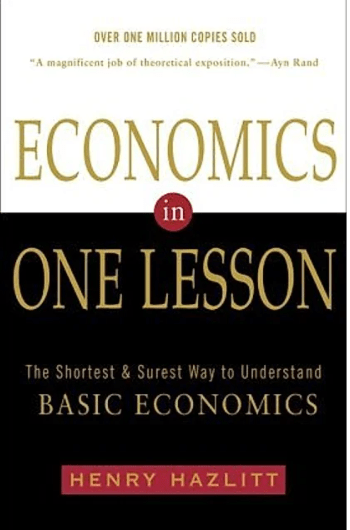
Title: Economics in One Lesson (The shortest and surest way to understand Basic Economics)
Author: Henry Hazlitt
Hi all,
I’ll be frank with you right from the start. It’s an economics book, so if you don’t really enjoy this topic, then you can ignore this review. However, I think you would get something great out of this book if you gave it a quick chance.
For this book doesn’t list and teach you about the different economic principles that have been introduced and implemented in the different centuries. It actually follows a different path. It criticizes many different economic policies that have been implemented for not following the basic rule (stated below) that would make an economic policy a good one to be implemented.
The central lesson of the book is that many policies are imposed by governments, and do generate a benefit, but these are always at the expense of some group. Therefore, what the author suggests that economic policy makers should do is the following, when they consider bringing in a new economic policy:
The are of economics consists in looking not merely at the immediate but at the longer effects of any act or policy; it consists in tracing the consequences of that policy not merely for one group but for all groups.
- Economic policies therefore only focus on giving an economic benefit to one group of people, without considering the long-term repercussions on the other players or industry
The book then takes a few economic policies that have been imposed by the government, and breaks down how the policy was supposed to benefit a special group, and then also discusses the other side of the consequences of the new economic policy, the side that is conveniently always left out when the new policy is introduced. The topics that are discussed are:
- Blessings of Destruction – The argument here is that when something in the economy is destroyed (usually from war), the government steps in and makes deficit spending to help build up the industry once more. However, if the country had not entered war, there wouldn’t have been destruction in the first place, and the government would not have needed to make deficit spending.
- Public Works mean taxes – Before governments became a much more active ruling body, it was only a small regulating body in the economy. However, as its service portfolio grew (services it rendered to the country) it needed to accumulate more funds through taxes in order to finance those public works. The argument here isn’t against government providing those services, but is against the government creating employment for the sake of filling employment, regardless of whether they are productive or not. So long more people are employed. Because, if those non-productive people weren’t employed, fewer taxes would need to be collected, which would give taxpayers more money to spend on goods/services that provide a productive good/service to the economy.
- Taxes discourage production
- Credit diverts production
- The curse of machinery – The topic that is taken under consideration here is whether machines taking jobs is a good or bad thing for the economy. Although it is argued that it is not good in the moment, in the long term it is actually to the benefit of the economy. The idea is that when the machine takes over the job of a few humans, the job can be done more efficiently, and the humans can take their skill to another part of the economy and help produce more output there as well, or become upskilled to help run the machines. The outcome is that the machines make the goods, freeing them to create additional output somewhere else, thus increasing total output in the economy, or taking on a more specialized skill, and become paid better for their higher skill.
- Spread-the-Work schemes
- Disbanding troops and bureaucrats
- The fetish of full employment
- Who’s protected by tariffs – Tariffs are levied on imported goods, in order to protect the local producers of the same/similar good from losing out market share, and thus ensure their footprint and existence is secured. However, tariffs levy a higher price on products, which means consumers will have less money to spend on other goods that they would have spent it on had they had that additional money.
- The drive for exports
- Parity Prices – The idea behind parity prices is that farmers have produce to sell, and need to buy specific equipment to assist them with their farming operations. When the prices of their produce falls then they won’t be able to finance the machinery to assist them with their farming activities, which will result in less output to be sold. To avoid this, the prices of their output is somewhat related to the price of the machinery. Thus, when the price of their output falls, the price of the machinery has to fall so they can still acquire the machinery. However, the impact of this would then be that only the farmers will always be hedged for whatever may happen in the economy, whereas everyone else would not be able to buy produce or machinery with their own (now fluctuating) salaries that might be losing purchasing power.
- Saving the X industry – The author argues for more laissez fair in the sense that he means that when a business is not performing well, and is not doing so for years, it should be allowed to ‘die’ and have its economic counterparts that are more efficient to carry on living. However, for some businesses government may intervene and provide it some funds (from taxpayers) to keep it alive. But when it never turns around and only gets bailed out over and over again, it is taking money that could have been spent on other projects in the economy, which could have yielded more economic output.
- How the price system works
- Stabilizing commodities
- Government price-fixing
- What rent control does – Rent control occurs when the government sets a price cap for the amount of rent that a landlord may charge for its tenant. The argument here is that when there is a rent cap, and construction costs of new buildings rise, then it is not seen as profitable to build more buildings since the investors don’t feel that they will generate sufficient returns (the cap rents) from its new investments because construction costs only rise.
- Minimum wage laws
- Do Unions really raise wages
- Enough to buy back the product
- The function of products
- The mirage of inflation
- The assault on saving – The important lesson here with inflation and deficit spending is that when the government spends more than it makes, and that deficit builds up, more money has entered circulation, making money thus less valuable than before. Inflation makes the value of the currency less valuable, and thus reduces the value of the debt that the government has incurred. Therefore, the amount the government has to repay is worth less. However, these actions have the effect that the money that savers held is now worth less, and they will struggle more financially to support themselves in retirement.
- The lesson restated
Some of these topics you may say the government is justified to bring in the economic policy, because it serves a good purpose. However, the reader is encouraged to think these policies through and see all economic impacts that the policy will have, and not just the one that is told to the taxpayer. For if more background is obtained, the policy could be criticized to be refined so its implementation would deliver better results.
Summary:
I definitely learnt something new on economics, and have gained more support on the importance of obtaining more background and a greater perspective on matters, instead of taking the word of others blindly. For a book that was written in 1946, it still holds truth even today, and would be a beneficial addition to anyone’s lives. I thus give the book a rating of 4.5/5
Until next time!
 MyBookReviews