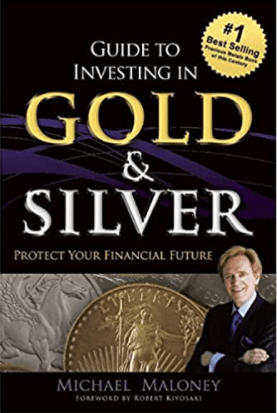
Title: Guide to investing in Gold and Silver (Protect your financial future)
Author: Michael Maloney
Hey all,
I know what you might be thinking….
Considering the last few books I have read in the last few months, you might get the feeling that I am starting to become distrustful in our monetary currencies, and that I am reading up on gold to invest my currency in that instead.
I’ll admit, I have started to read some books that sound a bit doomsdayish, but I’ll tell you the reason behind my recent collection. Perspective. Getting as much background on many different topics as possible broadens your view on many different topics.
You might have caught on by now that I have read a few different investment books, where the investors present their different investment strategies.
- One gives a strategy to be conservative and only invest in large and established companies (ie. blue chip stocks), and invest whenever you have money available to invest
- Another tells you his strategy of locating the companies that are valuable, and will be valuable in the foreseeable future, and then find the point when they are undervalued, so you can buy their stock.
- Another tells you to only have maximum 40% exposure to paper assets (ie. stocks, mutual funds, ETFs, etc.) and the other 60% in tangible assets (ie. cash, rent-producing assets, gold, other assets)
Just from reading this book’s title, you might be persuaded that this one is about investing a significant portion of your investable funds into Gold and Silver. You’re halfway correct.
The book is actually so much more than just an investing strategy. It also includes valuable historic background on the role that gold and silver played in history (2000 years of history), what is the relation between currency, gold and inflation, and why it is something that you should consider including into your portfolio.
1…History
The author notes that one reason why the greatest empires might be always failing is due to deficit spending. Think about it.
If there is a small community, and everyone has a fixed amount of gold to trade, for a fixed amount of services, then the community could not grow. When an individual becomes more efficient to produce his goods he/she will be able to produce more goods for sale. However, there is only a fixed amount of gold in the exchange, therefore, the price of their goods drop. Here, the value of our goods become cheaper, or, our gold becomes more valuable because it is able to acquire more goods for the same pieces of gold. They have a leader who makes sure everyone plays by the rules, but he/she doesn’t have too much power and everyone is responsible for their own well-being.
If we switch over to a larger empire that has a ruling class that has taken on the responsibility to a) protect everyone with a military, b) provide everyone with clean water, which system needs regular upkeep, c) will provide money for people’s retirement, and a few more responsibilities. To make all this possible they collect taxes. However, to help the country grow it needs more goods and services to be produced so it can meet its future obligations. These do not come cheap at the present moment, so, in order to make these services happen, the leaders create more money (ie. currency) to be able to buy the goods. Note, they created additional paper money, but the number of goods in circulation remained the same. Traders notice this, and they realize paper is no longer worth what it used to be, so their prices rise. The burden of responsibility on the ruling class grows, so they create more ‘new money’ and again, the traders realize, the money isn’t worth as much as before, the prices rise once again.
In both scenarios the gold actually on hand to support the currency didn’t grow. In scenario 1, the economic factors would find the new equilibrium where the Price and Supply would meet, the healthy way. In scenario 2, the ruling class brought in more money (which wasn’t backed by gold), and therefore everyone’s paper now was able to buy them less, because traders saw the demand grew, so they could increase their prices.
When the ruling class, in scenario 2, creates more and more paper money, people realize that their $100 is no longer able to buy the same amount of ounces of gold it used to, it now takes $150, so whatever they saved has lost value by 50%. When this gap between currency-backed-by-gold and currency-not-backed-by-gold increases too far, eventually there will come a revolt, and a new price of gold will be determined against the currency (say $250 p/ounce), which now means all currency is once again backed by gold. This is what deficit spending does, IF a country aims to have its currency backed by gold. If it’s currency is not backed by and tangible resource, then it only has value as long as people believe it has money = fiat money (ie. Euros, Dollars, Yuan, Yen all today are fiat currencies).
2…Inflation (the silent wealth killer)
From the example stipulated above, I hope you noticed that the quantities of gold remained the same, but in scenario 2 the ruling class brought in more currency (ie. paper money) into circulation (whilst the number of goods offered remained unchanged), which then leads to the paper having become less valuable, and thus taxing away your wealth.
3…The strategy
Taking all this into account, the author describes himself to be a cycle investor. He invests in a different asset, depending on the economic cycle we find ourselves in. When people are positive of the economic outlook, they generally demand more paper assets (ie. stocks) and resultantly the price for resources drops. He then acquires some precious metals, and sells off some stocks.
When the cycle turns, and people have a less positive economic outlook they switch to an investment into assets that are more ‘safe’ (ie. precious metals). Then demand for these spikes, which is when he sells, and then buys stocks in companies that have been undervalued.
When the market then becomes better, he does the opposite of what everyone else does, and in the process, gradually grows his wealth bit by bit.
4…Why having some precious metals isn’t such a bad idea
If you’re a new investor and don’t know where to start, the recommendation here is that it would be wise to have a small portion of your portfolio dedicated to precious metals (physical gold & silver, and not shares in a mine), because he argues that whenever our currencies are in trouble, the value of the currency is dropped, and the value of precious metals always gains.
Summary:
I think the way the book is structured (history of gold and empires, relevance to today and our recent history, inflation, and then considerations one should make before buying commodities) is perfect for anyone to start off learning what it means to invest in precious metals. It shouldn’t be bought because someone has advised them to do it, but the book lectures you well on the lesson so you can make an informed decision yourself. The book for me deserves a rating of 4.85/5
Have a good one everyone!
 MyBookReviews