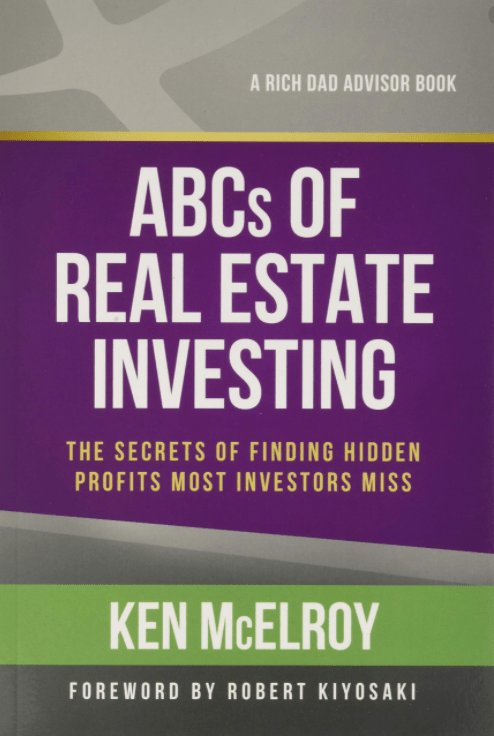
Title: ABCs of Real Estate Investing (The secrets of finding hidden profits most investors miss)
Author: Ken McElroy
Hi there,
I have watched a few of the videos that Robert Kiyosaki has posted on YouTube now and then, and that has made me change the way I think of investing. One of them was how I think about investing in equities. Before, I was fixated that it was simply a good investment option and it made sense. And before that I was convinced that keeping money in my bank account was safe, and retained its value.
As you read more and more, and hear more and more, you quickly realize that not everything is as it seems, and that it is beneficial to become more acquainted with the different investment products, and investment strategies.
One investment I always wanted to get in to was real estate investing.
My first step was to watch a Udemy course, and learn something of this industry. Afterwards, I went to the property sites and started looking for properties in my area, but then before I decided to go ahead, I thought about reading a book of a real estate investor as well, and that’s where we get to this book.
Before I get to the book, the central lesson I took was that you should not jump into this (or any kind of) investment before really getting your facts straight. If you rush this, you may suffer dearly with a financial loss.
Right, the book….
The book gives you general guidance what he would say are the steps you should follow in chronological order when you approach this type of investment. They are:
- Set your goal – before even getting started with research, you should establish the reason, why you want to enter this market in the first place. If you buy something but have no objective with it, then you are more susceptible to make a loss.
- Get a team of different skills – realize that you won’t know everything there is to know in this industry, so it would be advisable to get a few professionals together to assist you with your endeavour. Different people are suitably skilled in industries and would be a good start to include as consultants, since your own lack of experience could cause you to suffer financially if you make irrational decisions
- Engage in research – Before getting into investing, it is advisable to get to know the country/city around you. You want to invest in a property where people will still be living in the next 10/20/30 years, and not in a property where the location isn’t safe, or where more and more people are abandoning the area.
- Find your market location – Next, when you establish the country/city is likely to remain attractive (and even become even more so) then you’ll become more acquainted with the different suburbs where people live, and find locations that are for you the most attractive, and you believe can still be in the coming years.
- Find properties in that market – When you narrowed down your search to few districts, you can go ahead, and actually find some properties in those districts.
- Five steps to financially evaluate the property – Now, when you have found a few properties, you will want to choose those that you believe present the greatest potential to generate the most cash flow to you that is possible. You will now actually go into the numbers and see which properties provide the greatest returns (ie. net income)
- The contract – Once you found a property that has grabbed hold of your attention, you can likely take it another step, and write the owner of your intent of acquisition. However, he stresses here that you should only express an intent to buy, not the purchase agreement yet, because now you usually have the opportunity to dig much deeper and see more of the property, and confirm/disprove some of your figures that you estimated in your Five Steps earlier
- Make a due diligence before penning the deal – As mentioned, now you would go into depth and inspect the property, the numbers in the books so you can get a good picture of whether the net income that can come from this property is attractive or not.
- Finalize the deal – When the property value is within your valued price range (from the due diligence and five steps), then you can go ahead and take the contract to the next stage. However, should it happen that your due diligence found some matters that have reduced the estimated value of the property, you can always walk away and try again with another property.
- Now manage the property – Once you have committed yourself to buying the property, you now enter a different role, landlord.
I think I captured a lot of the ground work that was covered in the different chapters, however, to get more insight into each of the steps, it would be advisable to read up a bit more and become better acquainted (if you will, become an expert).
Summary:
The book is easy to read, gives clear steps and guidance, and also gives some of his own experiences that he encountered in his years of working in this field. The book for me deserves a well-deserved 4.25/5
Happy reading!
 MyBookReviews