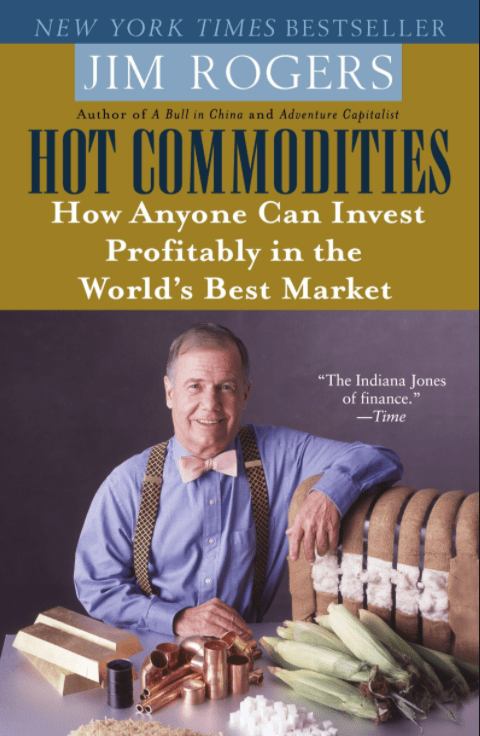
Title: Hot Commodities (how anyone can invest profitably in the world’s best market)
Author: Jim Rogers
Hey all,
I’m slowly getting through a few different investment books, each one making their case for their asset class.
I have already read on the following asset classes:
- Cryptocurrencies
- Real Estate
- Exchange Traded Funds
- Shares
- Options
- Commodities (only precious metals)
Now, I’m adding the asset class Commodities (all kinds) to the list. I’m not saying that I’m actively invested in all of these asset classes, but I’m gaining the background to what they are all about, and thereby identifying those in which I would like to take the next step and learn more to invest more effectively.
Now, you might ask why commodities?
I had shares in my portfolio for a mining company, then, the virus hit, and most of my shares’ value dropped, except for the gold mine shares. They were the only ones that actually went up. I had a chat with a former colleague to catch up, and also talk about how his investments were holding up against the current conditions. He confirmed for me the same had happened with him. His platinum mine shares had grown, whereas all others had dropped in value.
Intrigued, I thought it would be good to understand where this is coming from, and that’s where I stumbled on this book. I had heard of it before, but only briefly, and didn’t make much of it afterward. Then, with the intrigue, I ordered it and started to read up.
Just a disclosure, the commodities talked about here are all kinds of commodities, and not only one kind preferred by the author in particular. The reason for including all was to show the reader what is available out there to be traded, so should they wish to include some raw materials in their portfolio (to hedge or other reason) this would be a good point to start out at.
To start, the commodities are split into five broad classes of commodities:
- Energy
- Metals
- Grains
- Foods/Fiber
- Livestock
Different forms of commodities are then categorised below one of these categories. The author makes the recommendation to anyone wanting to start this journey, to focus their attention on one/two classes in the beginning, and then, if they want to, they can expand to other classes.
Next to advising the reader to start small he gives the following advice:
- Knowing your personality – What is your risk tolerance, what is your goal with investing in commodities, will you be strong enough to follow your investment strategy even when everyone else is doing some else?
- Picking the commodities class – After you have picked the commodities, you need to perform your own research and become an expert in the industry in order to make good predictions, and resultantly make good returns
Another great bit the author brings in is to explain the history behind how the Futures Market for commodities came about, and then also how it works, so it makes sense.
If that doesn’t sound like enough, there’s more….
He then dedicated a few chapters to individual commodities (oil, gold, lead, sugar, and coffee beans) where he in detail explains the different components of Supply and Demand, and how events in history (government actions, rebellions, terrorism, etc.) have influenced one side, and resultantly what was the impact on the other side.
- How terrorist activities in the Middle East cut one supplier from providing resources to the market (world supply drops) and resultantly the price grows (world demand increases).
- How a bad harvest of one edible commodity lowers the supply available for export (supply drops) and resultantly the price for the remaining goods being traded grows (demand increases)
- ….
The argument goes that if you do your research well, learn to understand how the market (local and international) work, and how events within those markets can influence either the Supply or Demand, work out (ie. predict) what the effects may likely be on the Demand or Supply.
Summary:
To gain perspective on different investment classes, whether to become an investor or just to learn something in addition to your current understanding of world markets, this book definitely has something to teach everyone. It also explains it well enough to any new investor who wishes to start up in this line of investment, by giving clear explanations and guidance how it works, and what everything means, just to get started. For that reason, the book will receive a rating of 4,7/5
Best wishes!!!
 MyBookReviews