Title: Why the Rich are getting Richer (What is Financial Education really?)
Author: Robert T. Kiyosaki
Hey everyone,
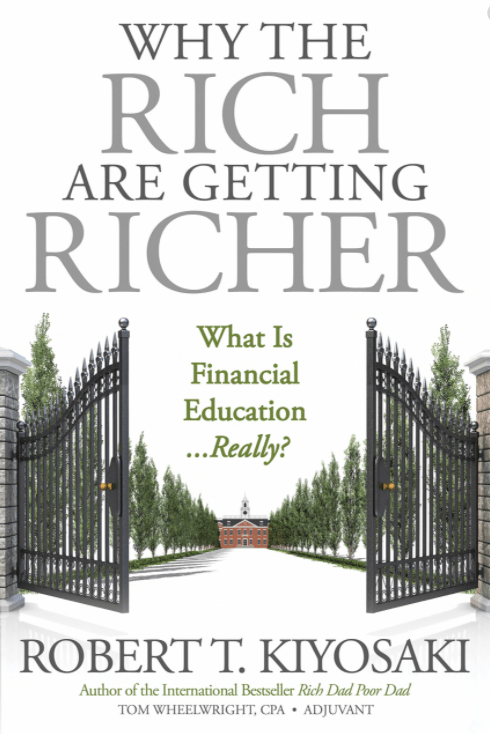
it’s time for another instalment of the Rich Dad Poor Dad books. In the book they describe the first Rich Dad Poor Dad book to be the entry level read, and this book is then the graduate level book.
The book goes to the next level after you were introduced to his main disruptive lessons about money in his intro book. The lessons are broken down into 14 chapters, and I will discuss a few of them below, which I believe hold the message that he wishes to teach:
Ch1 – What should I do with my money?
First, he will not tell you what to do with your money, because that defeats the purpose of his books. He will only tell you that the best thing you can do is to enhance your financial education, so your money may be managed better, grow, and be protected from those who are in control and lose other people’s money.
Ch2 – Why savers are losers
Never before the book did I learn the significance of this message as when I read his and others’ books about the history of money. When money was backed by gold there was a fixed supply of money and a fixed supply of gold. The only way to grow was for your country to increase its exports so gold from outside your country would flow in.
You were sure that your coins and paper were worth an amount in gold.
However, since 1971, the reserve currency of the world was taken off the gold standard, that last one to do so. Now, a country’s growth is not restricted by the amount of gold it holds to back its currency. Now, the country issues more money to people to use (ie. higher money supply, but no higher gold supply). And when the debt burden becomes too great, the currency hits a crash, and the value of your paper money in your account is debased, so paper in the bank becomes worth less.
All this is possible because those in charge have the say when more money needs to be printed to ‘help’ stimulate the economy.
Ch3 – Why taxes makes the rich richer, legally
What I first understood from taxes was that if you earned something, the government took a share so it could finance the basic services it fulfils to the economy that no one else wishes to undertake, or, that shouldn’t be subjugated to a monopoly (ie. water, energy, sanitation, safety, infrastructure, etc.).
The other tax they impose are on goods they do not see as basic necessities, but luxury (anything other than basic needs to survive). Another tax is to punish us for importing goods rather than buying locally since now money is flowing out of the economy, not in.
But then I learnt to see taxes from another perspective as well. As an opportunity. When you invest in the country they country generally permits you to obtain some tax benefits in the form of tax deductions. They don’t necessarily have all the resources to finance everything they wish to achieve. So, if someone comes along and is willing to invest money to finance something, they will be open to provide you with tax deductions that make the investment more attractive.
Ch4 – Mistakes make the rich richer
In school, was there ever a moment you felt alright that you made a mistake/s in your tests or sports or any other activity?
Probably not.
That’s because it doesn’t promote you to make mistakes and learn from them so you will do it right in future. Mistakes are actually essential components to learn lessons for the long term, because after committing the mistake, the lesson sticks much better. He also introduces you to the Cone of Learning, where the message is that the best manners to learn and retain what we learnt is not from reading, but more from simulations and real life experiences.
Ch5 – Why crashes make the rich richer
What happens in a crash?
Or, let’s rather ask the question as follows, what happens right before a crash?
Ordinary people hear about the new in-thing, invest in it. More people hear of the amazing investment and more want to become apart of it. The supply is limited, but the demand for it surges, thus, the price of the investment grows higher and higher.
- However, people forget to do their homework, and calculate whether the money they invest into the investment is worth it
- How long will it take for cash flow or appreciation to reimburse the investor for his/her investment
- As a result, the investments’ value grows higher and higher
- Eventually, some will realize that they paid far too much for it, so they start selling it
- The number of people wanting to buy at the current prices is low, so the sellers drop their prices, just to sell and avoid making a too big loss
- The investments crash, many people have lost money because they paid for these investments, which no one is willing to buy at inflated prices
Eventually the smart investors step in, and buy the assets at/below the investment’s real value. They invest when the value is a true representation of its worth, not when there is a hype for it.
Ch 6 – Why debt makes the rich richer
The lesson is that there are two kinds of debt, good debt and bad debt. Good debt means taking OPM (other peoples’ money) and investing it into an asset that makes you cash flow. Bad debt is taking OPM (other peoples’ money) and investing it into goods that do not make you cash flow, but rather represents a conspicuous consumption (ie. no productive value).
The message is that they know the difference between the two, and use OPM to buy/invest in assets that will make them more cash flow. They learn to use OPM productively so that it earns cash flow that they then use to pay for conspicuous consumption goods.
- Basically they will delay buying the same conspicuous goods, by first creating/buying/investing in something that will bring in additional income (which they didn’t have before) so that that additional income pays for the goods, and not your limited income from your first source of cash flow
Ch7 – What Financial Education is not
Ch8 – Are you financially illiterate
Ch9 – Why the rich play monopoly
The game he describes is investing in one property, then another, and then another. Afterwards, they switch those properties for another, bigger property that makes more cash flow. Then you start again, by investing in one, two, three properties, and switching it for more valuable assets.
Ch10 – Phantom Income: Income of the Rich
Phantom Income isn’t additional income like real physical money. It represents the benefits from taxes and debt that will result in more cash flow in the future.
Consider this example:
Investing in a property now vs. investing in a property in the future
Investing in a property now:
- You can earn income from letting the property to someone else
- As you hold onto the property, the value may be going up due to the economy becoming better, or the situation in the district becoming more favourable
- Potentially, there are tax deductions available for letting the property
- The net income you earn helps you pay off the property, and you gain an asset, so you use income from the property to pay off the asset, not your income from your salary
Investing in a property in the future
- You save money from your salary to buy a property worth xx today, in the future
- In future, your money will be worth less, the value of the same property is now xxx, so you would need to save even more to finance the same property
- You still don’t have an asset
The message is clear, that using debt and taxes wisely, you can end up with more assets that will earn you additional cash flow. However, I wish to give caution that you will need to learn and study to make this a success, because many things could go wrong by just diving head first into buying any property. As described in the “crash” scenario, you shouldn’t simply invest because others are doing it.
Ch11 – I-Quadrant: Masters of Money
Over time, as you take on more and more investments, the effort you need to put in to make investments is somewhat less of an issue, because you now have a good understanding what you need to do, and you do that.
Whereas, when you are starting off, you first need to figure out what you are doing, and what you need to do. Thus, with practice and experience you become better equipped to be a much better investor in the future. And in the future, it would be generous to help someone else on their path to learn to become an investor, who in turn should hopefully help another to become an investor.
Gradually, we educate more and more people to become better educators.
Ch12 – Do you have a plan B?
Ch13 – How to end poverty: Students teaching students
Ch14 – How a Porsche can make you richer
The lessons above cover the the main themes of the book, however, there are smaller additional lessons within each chapter that add a little more background to help make more and better sense of everything that the author is trying to tell you.
Summary:
The message is clear, and the structure of the book is written in such a manner that it explains each component of the message well on its own. And at the end the reader brings it all together and sees the bigger picture, and how each individual component fits into that picture. The book receives a rating of 4.75/5 in my opinion.
 MyBookReviews
