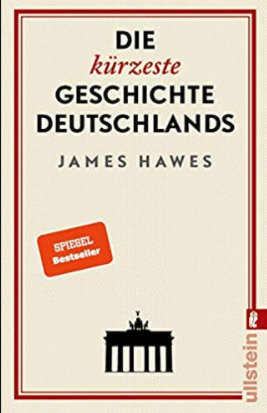
Title: Die kurzeste Geschichte Deutschlands
Author: James Hawes
Hi all,
I thought I might switch things up a bit and head into a different genre, history.
Do you know your heritage? Not just as far as your parents of grandparents, but maybe even further than that?
For some of us we know that our family always came from one country (Germany, Britain, Korea, etc.) and never really made any big moves. But for others, their families took some journeys along the way so that you need to do a little bit more research.
On our side, our families came from Germany and moved to South Africa when Germany was under Prussian rule at around the late 19th century.
Another inspiration for reading this genre was because I grew up watching the Asterix and Obelix cartoons, where they were the one remaining village in Gaul that the Romans had not yet conquered, and how they had adventures to protect their country from Ceasar.
I’ll be honest, I’m still not good with remembering dates and names, but the storyline in the book gives a good understanding how history in Europe in general (but especially in Germany) has developed over the centuries. The book breaks history down in four periods:
- 58 BC – 528 AD
- 526 AD – 983 AD
- 983 AD – 1525 AD
- 1525 AD – today
I cannot break down the whole history on a few pages, I will try and bring up some interesting parts of history that I thought were fascinating to learn.
Part 1 58 BC – 528 AD
- The name Germanic was first used by Ceasar when he described the people beyond (east) the river Rhein, who would pose a threat to his Roman empire.
- Trouble was building inside the Germanic country that many were fleeing the territories to the safer countries (Roman territories). Thus, the Romans realized if this would continue, they would soon be flooded with many refugees, so they decided to fight the forces in Germanic
- Because they struggled to conquer the people beyond that river, they decided to build a wall for defense (called the “Limes”), which defended their territories of Gaul (modern day France, Belgium, Netherlands), which stretched along the Rhein and Donau.
- Eventually the countries east of the river Rhein, but only until the river Elbe could be taken in by the Romans. They slowly learnt some of the customs of civilization as the Romans knew it. They were know to be a loyal and strong fighting force that even the Roman Emperor had his personal guard include be made up of their fighters
- A trait seem among the Germanic people, in contrast to the Romans, was that they wouldn’t let themselves be seduced by luxuries, which resulted in them remaining a strong fighting force
- Even today, you might say they don’t like flaunting their wealth, but remain conservative
- 4th century people from the east were moving west due to struggles and wars in the east, which resulted in the Roman empire being challenged once again with a refugee situation
- This eventually led to the Roman Empire being split between the Western Empire and the Eastern Empire (known as Byzantine)
- In the West, the territories were now mainly ruled by Germanic-descent rulers and peoples called the Franks
Part 2 526 AD – 983 AD
- Western Europa was defended by the Franks from becoming overthrown by a strong Islamic power, and the hero was Karl Martell in 732 AD
- His son, Pippin, started his own Frankish Dynasty, and also introduced something new to legitimize his rule, namely taking over the responsibility to protect the papacy, in 751 AD
- 754 AD the pope salved him, and his two sons, a symbol that legitimized their claim to the throne. One of those sons would have a larger impact, Karl the Great.
- Karl built the bride from the antique period to the new period, linking the Roman culture to the middle ages.
- He achieved something that the Romans had before struggled to achieve, namely conquer the Germanic countries beyond the Rhein completely and converted them all
- 800 AD he was crowned as the Roman King, and the regions he controlled were modern day France, Germany (up to the Elbe), Belgium, Luxemburg, Switzerland, Austria, northern Italy. The enemies to the east now were the Slawes.
- After his death there was a period of 30 years unrest of leaders trying to gain control of this empire for themselves. However, his empire was finally split in 842 AD between his grandsons Ludwig the German (east of the river Rhein), Karl the Kahle (today’s France) and Lothar (land between the two brother’s kingdoms, all the way down to northern Italy.
- However in 870 AD the brothers Ludwig and Karl split the third brother’s kingdom between them, which led to the creation of the power Westfranks (French) and Eastfranks (Germans).
- In the 10th century Europe experienced a rough period, which resulted in the kings being seen as not strong enough leaders in some cases.
- One such king was Ludwig the III and IV. When Ludwig finally deceased in 911 AD, the Greats of the Empire took a decision. That the right to being king wouldn’t automatically be passed on by birth to the son, but that they would go back to a Germanic tradition and choose their king, who they believed to be fit to rule. Their first king choice was Karl, Herzog of Franks.
- However, he died in 918 AD, and was succeeded by Otto the Great, Herzog of Sachsen, who achieved such success in securing their borders that he could ensure his son would be the next king to rule
- 936 AD he was crowned the King, and achieved a further success in 948 AD, by conquering lands beyond the river Elbe
- Even with his successes the countries were fixated with the ideal of a ruler being of legitimate descent. Otto went another way to secure his legitimate rulership, by taking on the responsibility of protecting the papacy, invoking translatio imperii. He was crowned as the legitimate ruler of the roman empire in 962 AD
- However, he started losing more power in his countries, and his son Otto II didn’t fare much better
- During this period, 983 AD, the Slawes of the east pressed the Germanic back, and thus ensured their continued existence in the east beyond the river Elbe
- The Slawes of the east Elbe (modern day Poland, Czech and Hungary) established their own independent kingdoms
Part 3 983 AD – 1525 AD
- Their next prominent king was Konrad II, after their prior ruler Ottoner Heinrich II died in 1024 childless
- While the kingdom was struggling through all this, Pope Gregor, a church man wanted to try and separate the link of the church from the kingdom, that the pope would not be pope if the king decided it, but that this decision would lie in the church’s hands
- King Heinrich fought back, but Pope Gregor then countered, by excommunicated King Heinrich, which effectively decreed that the church doesn’t acknowledge him being the rightful king to the throne
- Jumping ahead we move to 1147 when the Pope and his trusted advisor Bernhard von Clairvaux called for a crusade, but the crusade suffered many blows
- The region between Rhein-Donau and Elbe hat been in the Germanic hands since their forefathers, and thus they were the real owners of that land. However, the land beyond the Elbe
- 1152 Friedrich I, also known as Barbarossa by the Italians, was elected king, and was striving to be elected as the king of the roman empire. His son Heinrich VI in 1193 captured Richard Lionheart and forced him to submit and acknowledge the Kaiser as his king, and he his subject
- Friedrich II, Heinrichs acknowledged son, in 1229 reached the peak of his career, when he freed for Christianity Jerusalem. He was king over Germany, Italy, Sicily, Burgund, and Jerusalem, but he only remained in power as long as the Princes of the different German kingdoms accepted him as their king, and didn’t elect another. They were known as “Die Grossen des Reichs” (The Greats of the Empire).
- East of Poland there lived the Prussians, next to other Baltic states, which would be located in today’s Riga and Danzig
- The King of Poland had trouble with these people and therefore contracted the Roman-German King to help deal with them. Friedrich II appointed Der Deutsche Orden (the German Order – which included people from the fromer crusades) to conquer them. They were told that should they succeed they were allowed to rule the region, and only be subject to answer to the king of the German-Roman empire. However, they didn’t stop their ambitions there, and conquered a few smaller regions around them, much to the dismay of the King of Poland.
- All the way until 1413 they had regular clashes with local tribes, but that didn’t stop many adventurous knights from joining the ranks. With time they were seen to have become a problem as well, as they were slowly developing into a German state beyond Germany.
- One group of people that wanted to take benefit from these successful people were a crowd called the Hanse, an association of commercial cities. They were also close associates with Der Deutsche Orden. The Hanse enjoyed monopolistic advantage over other traders since their association with the Prussian state gave them access to the trading goods of the east, those which western states were desperately yearning for, an example is furs.
- These associations became so powerful that they could become lenders to other nations, even becoming able to convince kings that they would give loans for preferential taxes and other terms.
- 1241 the Mongolian hordes invaded eastern Europe, and came within 60 km of modern day German-Poland border. They were held at the border by a combination of German, Polish and Czech soldiers.
- Friedrich II died in 1250, and the territory was about to suffer through a difficult time
- 1257 Prince Richard, brother to Heinrich III of England was even elected to be the next king, but didn’t take the role well, visiting his kingdom very seldom, and then died 1272
- 1273 the Princes of the German states chose Graf Rudolf von Habsburg to be their next king, but not the king of the German-Roman empire
- The Princes of the kingdom also wanted to sever their bond with the papacy, that the legitimacy would not need to be determined by the pope, and they made this a rule in 1338
- 1348 – 1351 the black death (the plague) came over Europe. It is speculated that the plague first originated in Central Asia, and through trading routes was carried in to Europe. The spread of the virus happened through rats that were growing in large numbers. Europe was given a hard blow, as it lost one third of its entire population.
- It was at this time that the Slawes took their chance, and the alliance of the Polish-Lithuanian in 1410 disrupted the power of the German Order. The only strong remaining German kingdoms were Koenig von Boehmen, Markgraf von Brandenburg and Herzog von Sachsen-Wittenberg. They strived for stability in their western kingdoms.
- However in the east, in the east Elbe area, another group of people formed, the Junker (made up of young sons of nobles, a group of elite knights who lived in dangerous regions, and fought off whoever withstood their claim.
- In 1517 the heat between the papacy, the princes and the crown of the German-Roman empire reached another peak
- Kaiser Maximillian ruled over Austria, Netherlands, Belgium, Luxembourg, and western France
- His nephew Karl would inherit southern Italy and Spain.
- Not just Spain, but also the New World (Americas discovered by Columbus on his voyage to the West)
- Kaiser Maximillian was satisfied that the rulership should pass to his nephew so he could rule over this vast kingdom
- Franz I of France and Heinrich VIII (Henry) were opposed, and ran in the race to become the next Kaiser of the German-Roman empire
- Another candidate was Albrecht, Markgraf von Brandenburg, who planned to amass a large sum of money from the Fuggers (Bank Dynasty), so that he could contribute money to the church and declare him to be the true king of the German-Roman empire
- Pope Leo X had borrowed to his maxed credit amount with the Fuggers, was not done with his spending and wanted to build a new building, the Petersdom
- With these interests the following agreement was struck in 1516 between Albrecht, Pope Leo and the Fuggers; the pope would bless Albrecht as the true king, and a means would be found to pay for the Petersdom = enter the Ablassbrief (indulgence letter written from the church so that you can pay off your time you would spend in hell for all the sins you had committed)
- 1517 Martin Luther then nailed his 95 Theses to the door of the church, which would mark the start of the protestant reformation against the roman church
- His argument was that we couldn’t buy our entry to the kingdom of heaven through money, or through good deeds, but rather as a gift directly from the father himself
- Another thing that happened was that one kingdom separated itself from the shackles of Rome, and no longer being subjected by its rule but by the rule of the king himself. This daring first step was taken by Albrecht von Brandenburg-Ansbach, who was now the Herzog of Preussen, subject only to the King of Poland
Part 4 1525 AD – today
- 1531 other kingdoms followed the footsteps of the King of Preussen, and loosened their bonds to the church of Rome, and became protestants
- 1546 a Spanish infantry crossed the Donau river, in an effort to subjugate the people once again under the catholic religion. The different kingdoms joined forces and fought the invaders off, and in 1555 passed a paper that permitted the kingdom to chose which religion was permitted to rule in his kingdom
- From 1555 for sixty years peace between the two religious forms reigned in Europe
- In 1596 the catholic and protestants wanted to become free of the Habsburger rule, it regularly came to conflicts
- 1618 it reached its peak when upcoming Kaiser, Ferdinand II (catholic), wanted to reverse the agreement that his forefathers had struck in 1555, and this resulted in the Thirty Year War (1618 – 1648), with an estimated casualty number of one third of the populations.
- After this whole disaster, no one knew how the country was supposed to go on, or how it would go on
- The whole of France had now become a united nation of all its smaller countries and were under the rule of Ludwig XIV. The strong remaining powers of Germany were those of the East (Habsburger, Wettiner and Hohenzollern)
- Friedrich Willem ruled over the Prussian territories and soon became a much more powerful when he became acknowledged as a prince in 1657
- The smaller western German states wanted to avoid a strong Habsburger rule and therefore the rulers of Trier, Mainz, Cologne and Bayern entered into a bond with France
- The 18th century belonged to the French. Many German states brought French architecture and dressage and cultural elements.
- Friedrich the Great (1712 – 1786), King of Prussia, even made French the language of academia in Prussia
- However, patriotic Germans didn’t share the belief that the French culture shouldn’t take over their own culture
- Thus arose many different literary works from German authors, that promoted the German culture, among them Johann Wolfgang von Goethe
- The German culture experienced its comeback
- Universality (the idea that the norms and cultures apply to all) was denounced, and the search of the true German identity was found in Prussia
- The Prussians had retained their title, but the land they owned wasn’t rich and fertile, and thus the kingdom wasn’t rich. However, the men were a strong force to be reckoned with. When Friedrich stepped onto the throne in 1740 he took his strong forces and occupied Schlesien from Austria, and declared a war with Austria over Germany.
- Austria declared a unity with France and Russia, whereas Prussia was joined by Britain (mainly due to Britain had its differences with France) who sent money to support their war to Berlin.
- Austria (ie. Habsburg), France and Russia were fighting against Prussia (who occupied eastern Germany) and Britain over Germany
- The only possibility was for Germany to get back on its feet and offer a foot of resistance, which led to the crowning of Karl Theodor von Dalberg (1744 – 1817)
- During this period, the French Revolution came about, and a new leader soon emerged, Napoleon Bonaparte
- The King of Prussia was the first to sign a deal that acknowledged him as a rightful ruler
- However, their plans stretched to conquer the northern regions of Germany for themselves
- Napoleon managed to overpower the Austrian army and also the Russia army in 1805, to become the mightiest man in Europe
- When Napoleon forced Kaiser Franz II (of Germany) to abdicate, which marked the end of the Holy Roman Empire, and with it many of the nobles’ priviledge
- However, these plans struck a blow to the plans of conquering the northern German territory
- King Friedrich Wilhelm III issued an ultimatum to Napoleon, and when they engaged in war, the French came out as victors
- Napoleon allowed the kingdom of Prussia to stay in power, as a satrap of Russia, and had to hand over all territory it owned west of the Elbe.
- France had further conflicts with Britain and Russia, and only when France had truly lost their strength did Prussia step in and make active decisions alongside other countries against France. At the Vienne Congress in 1814 the Prussians requested to receive the whole of Saxony for their efforts of getting Napoleon sent into exile
- Russia was supportive of this request, but Austria and Great Britain weren’t and therefore they went into an alliance with the newly reformed France in case the Russians and Prussians wanted to start off a war
- Prussia gave in and accepted only half of Saxony. Next to that, a large German military force needed to be located along the Rhein river so they could fend off and protect any possible invasions of the French in future
- Napoleon came out of exile in 1815 and decided to take on the two forces Prussia and Great Britain, and it was then up to the Herzog von Wellington (British) and Gebhard von Bluecher (Prussia) to defeat him one last time. This was the famous war in Waterloo
- The champions wanted to restore the ruling style to the ways before the French Revolution. This meant, restoration of the French Monarchy, and in Germany, they would establish a German Bond (Deutscher Bund) with Austria as the overlooking body.
- Therefore, for 50 years the German politics was decided by the Prussian and Austrian powers
- One thing that these two countries had in common was their hate of nationalism; the promotional belief that the country should be ruled by the people rather than by someone who had inherited the throne. Together they and Russia signed The Holy Alliance (Heilige Allianz) to strengthen the position of the aristocracy, one of which reservations was that only high-borns were allowed to hold high positions in the military.
- Another thing the population was prevented to do was that they were not permitted to participate in clubs and organizations believed could be used for nationalistic purposes.
- Since this was not something everyone would want to be apart of many decided to leave to other countries where these reservations were not held in the country. One such destination was Great Britain.
- Since the victory in Waterloo the British and Germans were closer as nations since they realized that their languages were from the same Germanic tree. They wanted to convince Germany to put some policies in place that which would then make them their clear European ally
- Policy 1 – Prussia should implement reforms similar to the British reforms
- Policy 2 – German should be united as one country
- March 1848 it came to a revolution in Germany, by a small group of 300 protestors, who were inspired by the French Revolution. 18 March 1848 the protestors stood against the soldiers and were killed.
- When the King Friedrich Wilhelm IV heard of their deaths, he adopted their flag (Red, Black and Gold) as his own, and promised that Prussia would rise in Germany
- 1850 more people started to flee Germany due to the tensions in Germany coming from Prussia and Austria.
- 1853 the great powers of the West, Britain and France, stood up to the Russians plans of expansion to the Black Sea.
- In Germany the unity between Germany and Britain seemed to strengthen when Prince Friedrich Wilhelm and Princess Victoria wed. The German countries continued to look westwards, away from their Russian counterparts, and everyone started to believe that the strong power of Russia were maybe not as powerful as they thought.
- The Rheinland was the rich region of Germany but the ruling parliament in Berlin (controlled by Prussia) were in conflict because the Prussians wanted to increase the portion of the budget that was made available for military spending.
- The pressure was building, right until 1862 when the King Wilhelm I was thinking about abdicating the throne of the Prussian kingdom to his nephew Friedrich Wilhelm. The high ranking people saw that this move would result in their riches being exported to the West, and therefore quickly decided that they needed to instate a strong presidential candidate, and their candidate was none other than Otto von Bismarck (1815 – 1898).
- He was a Junker, and was set to retain the monarchist power of Prussian kingdom. The oversight of Austria stood in their way, and therefore they decided to wedge war so that they were one step closer to bring Germany under full Prussian control. Bismarck didn’t merely want to bring Germany under Prussian control, he wanted Germany to be prussianed, and therefore have the Prussian identity. Prussia had in 1860 mad significant steps by conquering the northern regions of Germany.
- The southern regions mainly remained independent. However, 1862, Bismarck somehow had the French ruler become built up with the idea that they wanted to invade Germany, and Germany wanted to become united so that they could stand together against the threat from the West.
- 1870 the whole of Germany finally became united under the German Bond (Deutscher Bund), which then became known as the German Reich. Germany now was in its second German Reich.
- Bismarck was sure that this unity would remain, because he was supported by the National liberals.
- The National liberals were for progress and freedom, but for them, achievement of progress was not to be achieved by individualistic freedom, but true freedom came from a clear functioning system of the state.
- This system was to be supported, worshipped by the people of the state. Further, progress was also achieved through being involved in war.
- Ultimately, the view was that progress was achieved via dictatorship.
- From 1876 a wave of Panslavic Socialists started coming to the West, which would threaten the current system of rule. Austria-Hungary thought it was in direct conflict with the Baltic states, and therefore made a unity with Prussia-Germany in 1879, because Bismarck wanted to protect his plans at all costs. This pact would ensure that when one of the countries went to war with the east, the other would stand in support. However, the deal was not good for Prussia-Germany because it was never under threat by the east.
- Now, the western kingdoms of Prussia-Germany needed to stand by and see how they became involved in struggles against the Slavic people.
- 1879 antisemitism movements started to take presence, and they started to grow strong in one political party.
- 1893 the party won 16 seats in the Reichstag (parliament)
- ….
- 1914 the Austrian royal Erzherzog Franz Ferdinand was assassinated by Serbian Nationalists, and resultantly declared war, and Kaiser Wilhelm II of Germany, who had once taken a pact, joined forces to fight war against the Slavic that Austria had recruited them for.
- Russia in late December wanted to call peace with Germany, but Germany didn’t want to take the offer, without receiving parts of the polish country.
- 14 December 1916 the Russians declared to continue war.
- 1917 the Russian Revolution was reaching its peak when the Bolsheviks party was gaining strong support to overthrow the Zar kingdom of Russia. Germany permitted Lenin to travel through Germany to get back to Russia from Switzerland where they had been in exile, and were hoping to get their terms agreed with the new Russian ruling party. They needed the east to sign peace since USA had now also entered the war.
- General Ludendorff of Prussia didn’t have enough that the Zar power was in shambles, but wanted the Zarist kingdom to become a serfstate to Prussia. This would have been Prussia’s second opportunity to turn the war in their favour by getting into good relations with Russia, and therefore free up more soldiers to leave the eastern front and fight on the west.
- In September 1918 the Prussian government could still finance its war expenses due to issuing bonds to its people, who still had faith that that Prussia might win.
- When the truth of the matter finally was realized, General Ludendorff told the king that the rule of the country needed to be given up and to the power of the people
- After the war ended in 1918 the newly elected chancellor brought in reforms that the parliament and president should be elected in the image of the US political system, and also that Germany should be split into smaller states, each with a ruling government.
- Later in June 1919, Germany was forced to sign the Treaty of Versailles, which detailed that:
- Germany was at fault for the rise of the war
- Germany would take on reparation costs of many of the surrounding countries
- all colonies outside of Europe should be given up
- regions around its borders were to be given up to neighboring countries
- reduce its military power to such a size that Germany wouldn’t be considered another fatal force
- In 1922 Weimar-Germany would agree to the amount of the reparation costs that Germany would pay. However, another political party within Germany was brewing up that they and the Red Army (from the Soviet Union) agreed to take and train people within the Russian territories, away from the eyes of the west
- The country was slowly making strides to recover, but then it was struck with a hyper-inflation. Germany wanted to not only repay the reparation costs, but also the large loans the state had taken during the war from its people. Therefore, they decided the best way to pay for it was to print money.
- This hyper-inflation resulted in the French having less faith in recovering their reparation costs from Germany through their weakening currency that they decided to occupy the Rheinland, which housed natural resources and would serve as assurance.
- 1924 the situation eased when the country issued a new currency called the Rentenmark, which was backed by resources
- People’s savings had been crashed, and there was a feeling of hopelessness and despair. One figure knew to use these feelings to forward his agenda: Adolf Hitler. His party, the Nationalsozialists.
- He followed the same ideal, as Lennin, that progress came through fighting.
- Hitler was close with Ludendorff, who taught him many things that he would later use to further strengthen his political party’s power. Ludendorff and Hitler tried to initiate a coup in 1923, for which Hitler was charged with treason and sentenced for five years in prison, during which time he wrote his famous book ‘Mein Kampf’
- After he was released, the world was about to go into the Great Depression, which would bring all the world economies to their feet.
- This time, Hitler stepped in again into the spotlight, and from here, the party had more success, and became chancellor. Gradually he grew his party’s strength, that he managed to have a ruling being passed in parliament that in times of crises he would be permitted to take the reigns and make decisions without requiring permission from the parliament
- …
- According to the Treaty of Versailles, Germany was not permitted to have military powers stationed in the Rheinland. However, Germany now sent troops to re-occupy the territory that France had taken away. None of the allied forces did anything, in the hope of avoiding breaking war in 1936.
- 1938 the German army occupied Austria, again, none of the allied forces made a move. Hitler’s goal was to unite all the German-speaking countries
- Finally between the 9th and 10th November 1938, he started to show his true colours, the night known as Crystal Night (Kristallnacht) when all establishments from Jews were damaged.
- 1939 Hitler negotiated the Hitler-Stalin Deal, which would split Poland between the two countries, and in return, no one would engage in war with the other.
- After these events the world got engaged with its second World War, in a span of only a few decades of the first one having ended.
Summary:
For anyone that wishes to attain an understanding of their heritage, start as far back, and move forward from there, as all the events that happen in between somewhat help to explain why things happened. For Germanic history, this book is a good reference. It gives enough detail on the happenings in a span of 20 centuries. From Germanic tribes to the Middle Ages kings, and finally to the World Wars and years following the wars. Therefore the book takes a rating of 4.8/5
Happy reading!!
 MyBookReviews