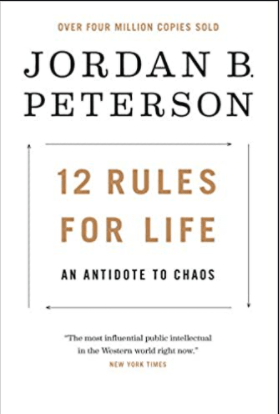
Title: 12 Rules for Life (An antidote for Chaos)
Author: Jordan B. Peterson
Hi all,
I know I’m due for another review and sorry for keeping you waiting, but to properly get a head around all the things that the book has to offer i decided to take my time and properly digest what each chapter has to offer.
If you haven’t heard of the author then I would suggest that you watch a few short clips on Youtube to get a real feel of who he is and what he teaches to his students. He asks some of the questions that many wouldn’t want to because it borders on sensitive topics that people wouldn’t want to get the wrong side on because we might be misunderstood.
The foreword argues that we need some rules (order) in our lives so that we may derive the greatest benefit the world has to offer. The argument isn’t to impose large amounts of rules, but rather to have some basic set of rules to navigate through this challenging world, and derive the greatest benefits and living a fulfilling life.
The rules are set out below, and the understanding I took is also included below each:
Rule 1: Stand up straight with your shoulders back
Just as in the animal kingdom, we also live in a dominance hierarchy. Some are positioned higher on the social hierarchy than others. Those who are positioned higher are more likely to be selected by ‘Nature’ to continue to exist and procreate. Those who are of lower rank will not be selected, and their lineage will fade.
Your primordial calculator (in your head) monitors where in this hierarchy you are positioned.
When your calculator measures you to be positioned higher than the average, then it seems that you won’t have trouble with continuing your lineage, or experience success in the future, and therefore your brain won’t throw serotonin in your system at every small success in large quantities, but will keep it at a steady level because the brain doesn’t foresee that there is an existential crises. Whereas, if you are in a lower rank your brain will pour more serotonin in your system because every small good thing might seem to be the best you will ever experience, and therefore you need to suck up as much serotonin (good feeling) as you can, in the short period of time that you have to exist here.
You need to work to get in an environment where you are confident in yourself and your abilities, where you feel you have meaning and can contribute to society. Here you tell nature that you are a valuable member of the environment.
Rule 2: Treat yourself like someone you are responsible for helping
A question we may ask ourselves is why we don’t take care of our bodies as well as we would help support someone else who is suffering?
- One argument brought forward is that due to all the bad things that we as humans have inflicted upon the world, we are not worthy of receiving care, but that we should instead suffer since that is what we deserve. The bad things referred to are not limited to the recent past, but the whole history of humanity. The wars, the epidemics, the racisms, genocide. In some way or another our ancestors were in some way involved in one of these things, while the rest of nature just lived its course as it has done before.
- Another argument i would like to bring up is that when we admit we need taken care of we expose that we are vulnerable and no longer able to be independent and self-sufficient. Here we, in a sense, would need to give up some of our freedom so someone can help take care of us. We lose some our sense of freedom. And freedom is the one thing that we cherish higher than many things we have.
We like to have control over everything we encounter and will encounter, because having control reduces/eliminates any uncertainties that may provoke that order. Therefore, we don’t like to be in situations where we might be vulnerable. However, ultimately we cannot avoid the chaos that is around our controlled area. And trying to avoid the chaos might expose us to greater harm, than when we confront the chaos, and keep an eye on it.
Therefore, the preferred and most suitable place to be in would be with one foot in the controlled space, and the other in the uncontrolled/uncertain territory. This is the place where you find meaning, because you are not only comfortable, but also exposed to reality, and therefore enhance your chances of survival.
One Freudian principle is: It is better to render Beings in your care competent than to protect them.
- What this boils down to is that parents wish to raise their children in a protective environment, and if possible, not expose them to the dangers of the outside chaos. However, this overprotection does more harm than when you raise your children in an environment where they are aware of the chaos that lurks outside. Raising them this way sets them up to deal with chaos much better than someone who had never known chaos to exist, and who might thus experience a mental break-down.
To close off, everyone holds meaning in their environment, and therefore we are obligate to take care of ourselves so that we can deliver our end of the responsibility.
Rule 3: Make friends with people who want the best for you
The best way to advance yourself is to surround yourself in an environment that supports your growth. If you surround yourself with negative influences, and live in an environment that doesn’t foster growth, then you will likely fall victim of the environment, and become one of its other victims.
Therefore, in order to advance to become the best version of yourself, you should live and surround yourself in an environment (and amongst people) who will contribute to you achieving that.
But the starting point for this to work, is to start with yourself. Making the decision for yourself what you wish to achieve, and then you can take steps to live in an environment that will support that dream.
Rule 4: Compare yourself to who you were yesterday, and not to who someone is today
We need to realize that we are all unique in our own way, and therefore comparing ourselves to someone else is not a proper means of comparison. It is like comparing apples with oranges. The only true comparison that is valid is comparing yourself to who you were the day before. That way you can determine if you have made progress from where you were before.
We all develop and progress at different speeds and in different directions, and are therefore unique to ourselves. The only true comparison we should use is who we were the day before, and use that to measure if we are making progress to our ultimate goal we are working towards.
- Since you are unique you have certain skills and strengths in a proportion that someone else doesn’t and to utilize your skills in the most optimal way, you should determine what goals to pursue and which not
- When you set your sights on a goal, you focus on seeing things that in some way are related to that goal, and intrinsically ignore all other things
- What is it that is bothering you?
- Is that something you could fix?
- Would you be willing to fix it?
You become less concerned with the actions of other people, because you have plenty to do yourself.
Rule 5: Do not let your children do anything that makes you dislike them
Your responsibility of the parent is to raise your children to be socially accepted by society. The society which has formed over centuries by people living together and developing traditions and culture. As much as it is important to let your children learn and explore by themselves, there are some actions they should avoid doing that will make them less attractive to society.
The argument here is that when they are accepted by the social group it is good for their mental well-being. Because, when they are socially excluded it affects their mental well-being, so much so that they retreat further from society, which worsens their mental well-being, and they become even more unattractive to society.
For such reasons it is important as parents not to shy away from disciplining and punishing their children when they have done something wrong.
Rule 6: Set your house in perfect order before you criticize the world
Many people are out to find flaws in others rather than admit those they themselves have. We should step away from this sense of wanting to judge people for their flaws and rather try and get our own house in order and pursue our greatest objectives.
When we are confronted for our drawbacks, there are four responses Tolstoy puts forward that could develp:
- Retreat into child-like ignorance , and believe that they have no flaws
- Pursue mindless pleasure , and therefore try and drink and sleep away the troubles
- Continuing to drag out a life that is evil and meaningless , and acting in such manner that makes it uncomfortable for others as well, so they suffer with you
- Destroying life , taking a extreme route and wanting to inflict maximum possible harm upon others so they may share his suffering
Therefore, work towards becoming socially acceptable, but retaining your identity, and living as your true selves
Rule 7: Pursue what is meaningful (not what is expedient)
The concept of delayed gratification is as old as when antique civilization started to grow ever large in size. The idea is that you have a goal, and make sacrifices now so that you may obtain the meaningful goal and life in your future. The sacrifice is your time and immediate gratification you could have otherwise attained.
Rule 8: Tell the truth – or, at least, don’t lie
Whenever we interact with other people they enhance their mental perception of us, who we are, and whether they will want to stay in contact with you in future. If you lie to get by then people may call you a negative influence in their lives, and deem you socially inacceptable.
- lies warp the structure of Being. Untruth corrupts the soul and the state alike
However, when you are true to them they know what to expect from you and whether you are in their best interest.
Live in truth:
- Act diligently towards some well-articulated, defined and temporary end. Make your criteria for failure and success timely and clear, at least for yourself (and even better if others can understand what you are doing and evaluate it with you). While doing so, however, allow the world and your spirit to unfold as they will, while you act out and articulate the truth.
Rule 9: Assume the person you are listening to might know something you don’t
We like to think that we know a lot of different things going on in the world. We like to establish ourselves in the social hierarchy. But, by giving the mic to someone else we believe it would reduce your status, and enhance theirs. We like to avoid this strongly, and therefore continue to do what we believe to be right, which fuels our ego.
However, no one knows everything, and we can save ourselves some trouble and embarrassment when we step back once in a while and listen to what someone else has to say. They would have also accumulated knowledge in their lives, and could serve as good sources for learning.
Rule 10: Be precise in your speech
When we look at the world, we perceive only what is enough for our plans and actions to work and for us to get by. For this reason we must be precise in our aim, and not vague or cause ambiguity.
When things fall apart and chaos re-emerges we can give structure to it and re-establish order through our speech. If we can speak carefully and precisely we can sort things out and put them in their proper place and set a new goal and navigate to see it.
Rule 11: Do not bother your children when they are skateboarding
The metaphor here for skateboarding is letting your children explore their surroundings on their own, and not be constantly held back by overprotective parents.
When ‘skateboarding’ they are entering unknown territory and new realms of risk. It is here they need to go on their own on some occasions so they can learn things on their own. They need to learn to become comfortable with being confronted with some un-controlled environment/event.
- Too much protection devastates the developing soul
Culture and traditions teach us the fundamentals of our society, but we need to have them experience something beyond that so they can learn for themselves what they enjoy
Rule 12: Pet a cat when you encounter one on the street
Summary:
All in all, a good book to summarize that we require order in a world filled with chaos, and that the best way to get through this is to learn a basic set of principles and use them as a foundation to navigate through our life. This book has definitely given me something to think about, and possibly incorporate some changes to my daily routine. For this reason the book will get a rating of 5/5.
Great read, and hope you will enjoy it as well!
…
 MyBookReviews