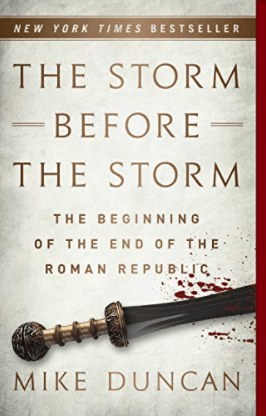
Title: The Storm before the Storm (The beginning of the End of the Roman Republic)
Author: Mike Duncan
Hi all,
I know this one took a while, but it was worth the wait.
After watching the series “Hidden Secrets of Money” from Mike MaloneyI became intrigued to learn more and understand why the Roman Empire came to an end. It had lasted for decades, even centuries, yet it came to an end. Why?
To answer this question I sought out to find a few different books, and then choose one as a good starting point. This one was well rated, and was therefore the starting point.
First off, the Roman story started on 21st April 753 BC. The first king was Romulus who founded the city of Rome. From there Rome was a small kingdom among many others, and remained such until 509 BC when it was overthrown by the Senators so that the kingdom could instead be ruled as a Republic by the people, and not a king. From here, Rome would grow its power and territory for almost 500 years when it have been completely changed to become a Empire, ruled once again by one single man, and not the people as a Republic.
The families that could trace their lineage back to the senators of the Roman king Romulus by custom and law controlled all political and religious offices and were called patricians. All other families, no matter how powerful were shut out of powerful positions and were called plebeians. For the next few decades the two classes would have regular conflicts, which became known as the Conflict of the Orders. However, Roman politics was largely defined by the networks that the Roman families established. These were client-patron networks whereby families of different classes had established their ties to one strong family, which then strengthened that family’s position, and also their network.
Further, they didn’t have a written-down conduct or law, but rather unspoken rules of social and political conduct. They surrounded themselves with unwritten rules, traditions and mutual expectations, collectively known as mos maiorum.
As they gradually started to show themselves as a force to be reckoned with they started to become involved in more and more conflicts with other people in surrounding tribes and communities. Thus, they started to be in conflict with the Samnites (communities in the South of Italy) from 343 BC, which became known as the Samnite Wars, and lasted until 295 BC, wherafter they became the masters of the peninsula. When they had conquered their first opponents, the next were about to give them trouble. The Carthagians (from North Africa) had expanded their territory to Sicily (island off the coast of Italy) and were expanding across Spain, and likely wanted to expand even further. However, the Romans were in fear of being run by a king once more, and therefore couldn’t let this threatening force overtake them. So, for the next hundred years the two forces would be in constant conflict , which would become known as the Punic Wars. The most notorious challenger from Carthage would be Hannibal, and who would only be finally conquered in 202 by Scipio Africanus.
After Hannibal was sorted, they took over the Spanish territory (Numantine tribes) and established it as a Roman province, next to Sicily and Corsica. Being a Roman province meant that the country would be run by itself, but the Romans provided administrators to run clerical jobs, and collect taxes.
After conquering Greek city states and Macedonia, one scholar Polybius was taken as hostage to become a teacher of Greek to one notorious Roman (Publius Scipio Aemilianus) and received a front seat to see how this political system of the Romans succeeded where other kingdoms rose and fell.
- They didn’t have a monarchy, but instead had two individuals who were in charge (called consuls) and who only served one year terms each. Both had the power to veto any decision that their colleague made, which reinforced to limit the power of one man.
- They didn’t have an aristocracy, but had a Senate, to act as a council of the State. They numbered 300 old men, and were advisors to the consuls.
- Their democracy element could be found in their Assemblies.
- Centuriate Assemblies, which elected the senior magistrates
- Tribal Assemblies, which elected the junior magistrates
- Plebeian Assemblies, which elected the tribunes, and could only be filled by Roman-born citizens.
- The reason this system worked well was because the assemblies had the power to enact new laws that were presented to them by the consuls.
By the mid-200s a new distinction emerged, and the prior distinction of patrician and plebeian had fallen away. This new distinction was between nobile and novus homo. A family that could trace their roots back to a previous consular would be known as a nobile, and everyone else novus homo.
To ascend to powerful positions in the political sphere, the path of honours (ie. “cursus honorum”) an individual needed to work in different roles of government, and advance in roles to become eligible for the higher position.
- First was the position of quaestor, who were tasked with the Republics finances, accounting, and record-keeping (ie. junior magistrate). Acting as an assistant to a senior magistrate. Every year the assemblies would elect 10 quaestors.
- Second was the position of aediles, who were in charge of public works and games. Usually they would take out large amounts of debt to finance large spectables and enhance their political career. The assemblies usually voted in four aediles per year.
- When a former quaestor or aediles reached his 40th birthday, they would be allowed to run for praetor, and thereby would cross the border from junior to senior magistrate.
- Finally, after having completed these roles, an individual would become eligible to stand for consul, who was elected once a year with a co-consul.
The wars that the Roman Republic faced in the coming years were from within their borders as well as outside their borders. From within, the struggle was mostly caused by the politicians wishing to enhance their familial powers or to undo the wrongs done by previous corrupt politicians.
The wars include among others:
- 146 BC Carthage and Corinth are sacked
- 135 BC – 132 BC, the First Servile War (war caused by the slaves on Sicily on their Roman lords)
- 134 BC Numantia tribes (Spain) and King of Pergamum (Asia) dies and benefactors Rome as heirs, kingdom in the east
- 125 BC, Italian citizenship is proposed to be given to all Italian citizens, and a revolt from Fregellae is ended by sacking the Italian city
- 117 BC Jugurtha (Kingdom in North Africa)
- 113 BC a Cimbri tribe arrives in northern Gaul (modern day France) and wishes to find territory to occupy, and they clash with a Roman force
- 112 BC Rome declares war on Jugurtha
- 109 BC Return and demand territory, and end in a further conflict
- 108 BC King of Jugurtha pledges allegiance with another kingdom in an effort to fight off the Romans
- 104 Second Servile War on Sicily
- 102 Cimbri, Teutones and Ambrones battle with the Romans for territory to settle, and the Romans finally achieve their first victory over these tribes that marks the end of this struggle
- 98 King Mithradates IV from the Black Sea has power struggle with a neighboring kingdom over a border struggle
- 91 BC – 88 BC Social War (Romans between other Italian cities)
- 83 BC – 82 BC Social War (Roman between Italian cities)
- 81 BC Sulla reforms the Republic constitution to its former state
- 80 BC, Sulla retires his dictatorship and soon after dies.
Sulla tried to restore the Republic to the position that the Senate could control the Republic once more as it had done before. But, this domination was soon going to undergo reform once again. The reason was that the problems of the Republic were due to the powers the Senate had accumulated had only increased. Sulla had restored them their former power, believing that this was the right balance of power. However, it was this one-sided level of power that had actually caused the imbalance in society. The former balance of power between Senate, consuls and assemblies had now shifted more towards the senate alone.
Finally, 49 BC it would be Julius Ceasar who crossed the Rubicon river, after having managed to seize control of all Gaul, and took full dictatorial control. in 44 BC he would be murdered by the members of the Senate, and the next leader would assume the role of dictator. Formally, the Roman Republic ceased to be a Republic and now was the Roman Empire.
Summary:
Compelling and very interesting how the events shaped how the Republic was gradually shaped to become an Empire. All of the events considered individually are not enough to reach any conclusions of what the Republic has become, but the whole events clearly direct the path to the empire’s own destruction. Very well written, and the accounts all follow in chronological order, so the reader can follow all events well. The book definitely deserves the rating of 5/5.
If you wish to brush up on some history, specifically history to understand how a country slowly suffers to end up in shambles, then this is a great source to read up on.
You can also follow the author’s podcast to learn more.
Until later, happy reading!
 MyBookReviews