Title: Alexander the Great
Author: Philip Freeman
Hi all,
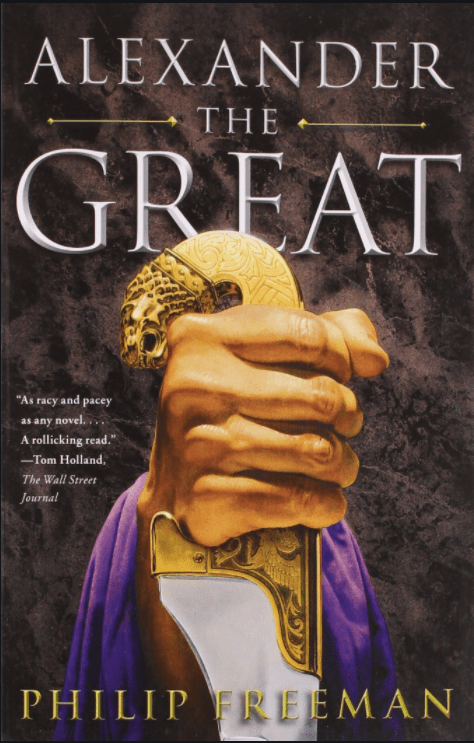
I can finally share my review of the story of Alexander the Great. I have started and stopped to read the book a few times and then finally pulled through this time around because I was in the mood for a story of an adventure and also had ancient history in the back of my mind.
The story starts by discussing how the kingdom of Macedonia started off, and finally came in the hands of Philip II, father of Alexander III. Much of what Alexander used in war tactics came directly from his father. His father had invaded Greece and had plans to conquer the eastern empire, the Persians. The Persian Empire stretched from the Mediterranean east cost, south to Egypt and then all the way to the Indian kingdoms. To the north it was bordered with the Caspian Sea and to the south it stretched over most of the northern-Arabian habituated terrain.
Quite big.
When Alexander’s father was assassinated, he was proclaimed to be the heir of his throne. He shared his father’s ambitions of conquering their foe in the east, but first had to settle affairs at home (i.e. Thracians to their east, Paeonians to the north, Illyrians to their west and Greece to their south). Most didn’t think he had it in him (as his father did) but he managed to show them that he was a force to be reckoned with. Finally, after overwhelming multiple rebellions from these kingdoms he could start with his journey towards Asia-minor (i.e. countries on the Mediterranean coast).
His journey to conquer the Persian Empire would take over 12 years to establish control and would be on the following road:
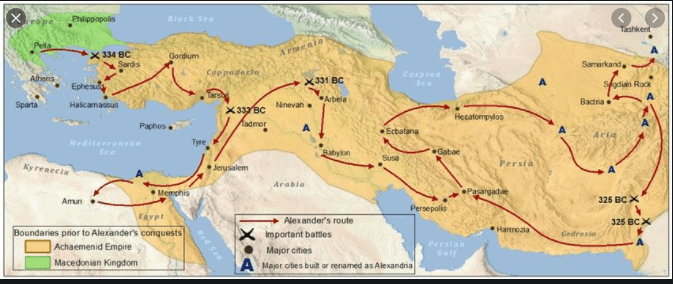
Thus, the chapters are aligned as follows as the journey of his conquests progressed:
- Macedonia
- Greece
- Asia
- Issus
- Egypt
- Mesopotamia
- Persepolis
- Bactria
- India
- Babylon (return journey)
Throughout his journey he would be faced with multiple different opponents and challenges from the newly acquired kingdoms, but with which he dealt with like a king would. Sometimes by sheer diplomacy, and sometimes through war.
The book is told from the perspective as if one is a follower on this campaign and suffers the challenges with the people as they progress from kingdom to kingdom.
In each of the chapters the writer has taken the liberty to give some context how some of the different kingdoms were established (i.e. before the Persian Empire) and how they then became subjected to the Persians.
- Before the Persian Empire became what it was between 560 BC – 530 BC (Cyrus the Great’s reign) the vast empire was largely split between the Medians, the Neo-babylonians and the Lydians. Before these kingdoms, there was the Assyrian kingdom that had control of many parts of these kingdoms.
- Cyrus the Great conquered these different territories and then formed the first part of his Persian Empire.
- His son Cambyses II succeeded him and ruled from 530 BC – 522 BC, where he added the Egyptian kingdom to its rule, but was then killed early in his reign.
- Speculations are about as to whether the following ruler Darius I (522BC – 486BC) was or wasn’t part of the royal bloodline. Most suggestions are that he wasn’t, however, he would go on to expand the kingdom a little further before attacking the Greeks in 490 BC at the battle of Marathon.
- The line continued and struggled in the years following Xerxes I (486BC – 465BC) since administration and borders needed to be strengthened. Thus, the invasion of Greece after Xerxes I was put on hold.
- Finally, the crown reached Darius III (336BC – 330BC) who once again had a strong empire in his hands and wanted to deal a blow to the Greeks. Mostly because the threats from the Macedonians could not be tolerated.
Who knows how our history would have been today had Alexander not managed to strike such a significant blow to the Persian Empire, or if he had lived for a few years more. The thought gives a prickling feeling at the top of one’s fingers, but alas we shall never know whether a different reality would have been better or worse.
What we do know is that the journey did not just bring conquest, but also Greek thought and ways to other parts of the world and would change their societies. Greek thought would help philosophers, mathematicians and great thinkers from Arabia, India and other parts of the world to all contribute to the vast knowledge that we share today. For me, that is one significant benefit that we are able to reap today.
Summary:
The book is well written and offers the reader to be swept off their feet and feel as if they are accompanying Alexander’s campaign. The historic background offered of the other kingdoms are also helpful to understand where these kingdoms fit in before Alexander’s and the Persian rule. The book thus receives a rating of 4.8/5
Have a good one!
 MyBookReviews