Title: The Ascent of Money (A financial history of the world)
Author: Niall Ferguson
Pages: 447
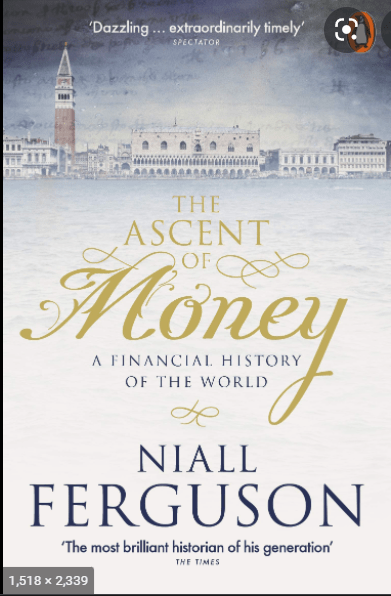
Hi all,
If you have been following my blog you would have come across a few finance or economics books for which I have written a review. Although sometimes, some books explain a similar topic (for example investment advice), each one offers at least some piece that makes it unique. It is these unique pieces of advice that I add to my itinerary of wisdom to guide me for future decisions.
In buying this book I hoped to acquire the same benefit. The advantage I had was that I had read another book from the author before (Civilization: The West and the Rest). Thus, having searched for goods books on the history of money, I have found a keeper in this book. It not only explains its origins, in one chapter, but also explains how different financial innovations rose in different parts of the world and how those innovations shaped the modern world.
Therefore, if you were hoping to get a book on history of gold and silver and other commodities alone, I would need to suggest another book. However, by reading this book, you will learn about:
1) the earliest forms of money;
2) bonds issued by governments/ kings/ modern institutions;
3) the rise of corporations and the stock market;
4) insurance;
5) homes as safe investments;
6) the relations between America and China (dubbed ‘Chimera’);
7) the descent of money;
8) the slight depression; and
9) from Euro to Ethereum
Therefore, you can see that the author covers quite a few financial innovations, which most of us are familiar with today, as well as what he has seen in 2018 already being some of the new innovations that became more important in the financial market in the last decade.
Before I go into the individual chapters, there is a crucial message that a reader should bear in mind throughout:
- It is those countries/kingdoms that were open to adopt new financial innovations into their country that allowed them to reap the benefits before the others, and thus evolve to another level. The other countries/kingdoms that refused suffered because they continued doing this the old way, even when they were less efficient.
- One example that comes to mind is that the Western countries undertook voyages across the Atlantic, which allowed them to find another country full of resources acquired cheaper than from the East. Though this didn’t come without tragic consequences, the idea to find another way to become less dependent one trading partner was a crucial step.
- Another example is that Asia missed the Industrial Revolution that was taking full swing in the Western economies. This allowed the Western countries to mass produce more items and less importation from the East, or even export more to other countries.
- A more recent example is that China has made significant progress in multiple technologies due government incentive/support and slightly less regulation than in the Western counterparts. Not just in financial technologies, but also others. If this sets the stage of how the modern economies will look like in 10 years, then China already is a market leader. The question is, how long will they dominate, or will other countries make other innovations that are even better?
Without further ado, the chapters are listed as follows:
- Dreams of Avarice
- One financial innovation was gold and silver as money
- Over many centuries/millennia, gold and silver became and remained the choice means to perform trade with others. This was because it possessed the following qualities:
- It is a medium of exchange (eliminating the inefficiencies of barter);
- It is a unit of account (facilitating valuation and calculation);
- It is a store of value; and
- It possesses the following features:
- available in limited quantities;
- available in limited quantities;
- affordable;
- durable;
- fungible;
- portable; and
- reliable
- available in limited quantities;
- The first true coins were minted in around 600 BC in the region of Lydia (modern day Western Turkey)
- Trade had been going on between kingdoms and the West and the East for long periods of time and had been facilitated through trade caravans and ships.
- Increasingly more things were bought from the East than were sold to the East, which resulted that the Western kingdoms of the 2nd millennium running out of gold and silver coins. Reasons for this include many, but one aspect is that when a kingdom forges war he spends more than trades.
- While the Eastern countries were holding large quantities of Gold and Silver the West were willing to undertake/support initiatives that could offer some high returns. One such risk was for the Spanish Crown to support Christopher Columbus to sail west in order to reduce dependencies of the expensive trade routes to the East. This resulted in the discovery of the Americas.
- In the subsequent decades, one of the resources that was greatly exported was Gold and Silver, which ended up in Sevilla. More ‘money’ allowed the crown to spend more on wars and trade, and increased the supply of the precious metal into Europe.
- However, an unintended consequence was that as the supply of coins increased, the prices of local goods also increased, because the supply of goods didn’t increase by the same factor as the newly imported coins.
- Over many centuries/millennia, gold and silver became and remained the choice means to perform trade with others. This was because it possessed the following qualities:
- Another financial innovation were the Arabic/Hindu numerals, used for trade
- Up to the 12th century, the Roman numerals (I/II/III/IV/etc.) were still widely used in Europe for financial matters. This would have made calculation of fractions quite a difficult task at the time.
- Fibonacci learnt of the Hindu numerals (0/1/2/3/4/etc.) and in his publication proved that they would be much more efficient to the current Roman numerals to perform all kinds of calculations.
- The next financial innovation was credit, which took roots in Italy
- After the Roman Empire’s (Western Roman empire) collapse in 450’s AD, individual kingdoms were taking root throughout all of the lands. One thing that had also remained with them was their religion. Christianity was the religion of the Roman Empire and was still so for more than a millennia.
- One thing that Christianity prohibited one from doing was to lend money to someone and earn interest when it was repaid. This was usury and would be punished harshly. Equally, for the Jewish community, they were not permitted to earn money from lending. However, there was a loophole in the Old Testament. It prohibited earning usury from a brother, but earning such from a stranger was permitted.
- Therefore, a Jewish community was able to find success in Venetian ghettos. However, the price they paid was social exclusion.
- A famous story that portrays this well is “The Merchant of Venice” from Shakespeare
- Another three financial innovations came from the Medici family in the late 14th and early 15th century: money market, bills of exchange and success through diversification
- A family that stands out is one that also has its roots in Italy, the Medici. This time from Florence.
- Since the business of usury was not permitted they found another business opportunity. At the time, trade was going on between multiple merchants of different kingdoms, each with their own currency.
- Thus, their services were to act on behalf of two parties to exchange one currency for the other so that payment could be facilitated at the desired currency.
- The next innovation came in the early 15th century. When one trader owed another trader money, but couldn’t settle it until the conclusion of a certain transaction in the future, a bill of exchange would be written against the borrower. This bill could be sold on to another party, who could then collect the amount from the initial borrower.
- Since trade was not as safe from default as they are today, lenders could risk their whole position if they lent only to a few individuals. Thus, to make a success from lending, the family made sure to spread their risk by lending to many people, to ensure their defaults were less sever.
- Though, the idea of diversification and other innovations existed before the times of the Medici, they managed to implement it so successfully in relation to their peers that they could make a success of it
- During the 17th century, three countries (Netherlands, England and Sweden) implemented the next great financial innovation: central banks.
- Amsterdam Exchange Bank
- With multiple currencies around the bank offered the service making settlement easy for merchants
- The merchant could either provide the other trader with a cheque or he could arrange a debit transfer with his bank to the account of the other trader.
- However, the bank only facilitated this service and thus held nearly 100% reserves
- Stockholm’s Banco
- This bank took the next step by also offering lending services to its customers. Thus, it introduced the concept of fractional reserve banking, whereby the bank no longer held 100% reserves of all deposits.
- Bank of England
- The bank was initially established so that it could offer finance to the crown to pay for its wars
- It then ended up receiving the priviledge of becoming the sole issuer of bank notes to be traded as legal tender
- Amsterdam Exchange Bank
- The Italian model of banking became widely adopted amongst the Northern European countries since they all had a low reserve in precious metal monies. The only nation not to adopt this model was the Spanish kingdom since they ruled the Americas, which supplied them with gold and silver reserves. The Spanish crown then believed that in order to advance one needed coin. Yet, its neighbouring countries proved that (thanks to the advancement of credit) progress is not dependent on coin.
- One financial innovation was gold and silver as money
- Of human Bondage
- After the creation of credit by banks, the next step in financial innovation was the bond.
- About the Bond
- Bonds were a means that allowed the king (then later governments and corporations) to borrow money from its own people, with the promise of repaying the principal amount lent, plus an annual fixed interest.
- Since the repayment term was usually longer than one year, holders of those bonds could sell the bond to another individual should they be in need of some liquidity.
- The power of the bond market cannot be underestimated, because it is the place where people judge the credibility of a country based on its fiscal and monetary policies.
- History
- During the 14th and 15th century, many of the Italian kingdoms were in constant wars with each other. However, rather than have their own people fight, the king could also hire a contractor, who in turn hired people (mostly mercenaries) to fight the war for the king.
- The problem was that wars were an expensive thing. Even during peace the government/kings were running deficits. Thus, it was spending more than it was taking in from tax revenues. Where could it acquire the needed funding?
- The answer was, from its own people. A new scheme was developed (and mostly only rich individuals could join since they had the funding needed) whereby a promissory letter would be issued to the holder which entitled them to receive a fixed amount p/annum plus its principal after the lapse of a number of years.
- The aim was that, should the raid be successful, the king will collect sufficient bounty to repay its debts and have sufficient income stream for the future.
- Spread
- Not only the Italian kingdoms had this debt problem. Other Northern kingdoms also had their debt troubles and then soon adopted this new innovation themselves.
- You may be thinking that the annual interest payments fell under the definition of usury, which was prohibited by the church. However, the argument was that you weren’t earning an interest (usury), rather, you were buying an annual payment stream. Thus, it was something that the church could not prohibit.
- Rothchild’s
- Another benefactor from this innovation was the famous Rothchild family which significantly profited from this business, especially during the conflict between Great Britain and Napoleon.
- To finance their war the government could print bank notes and sent them to the battlefield to compensate the soldiers. However, payment for the soldiers was more desirable in gold and silver since the army under Duke Wellington’s command was not comprised solely of British troops, but of allies from neighbouring Germany and Dutch as well. Thus, the government had to find someone from whom they could buy the required gold to pay the soldiers at the battlefield. That someone was Nathan Rothchild.
- At the time, Nathan Rothchild lived in London working with textiles and shipping them back to Germany. Yet the British government turned to him in 1814 to acquire gold coins and ship them in secret to where Wellington was stationed.
- Why Nathan was their choice of man was because he had a network throughout most of Europe. His brothers were working in Frankfurt, Paris and Amsterdam. Thus, where the price of gold was cheapest they would buy the most gold and transfer it to the port for shipment. They rendered this service at a hefty commission since it was a risky business at the time.
- The British defeated the French troops and Napoleon was exiled to an island. However, in 1915 he was determined to revive the French Empire, and was thus on his way back to France. Hearing this, Nathan knew the British government would need to acquire a large quantity of gold once again to pay its troops for the upcoming conflict. He bought everything he could lay his hands upon.
- However, Nathan had acquired so much that he believed would finance enough for a long war. Yet, at the famed Battle of Waterloo, the Duke of Wellington with his allies managed to decimate the enemy in a short war.
- Thanks to his network, news of the victory reached Nathan before it did the British crown. Thus, he was sitting on more gold that was needed at the time. This was not something that would bring him any returns. He therefore made a bet that once the news reached the people of Britain the bonds would grow in value. He bought so many bonds he could to get rid of all the idle gold coins. The bet paid off, and he sold them soon for a significant profit.
- Bonds were issued in other countries and other times of war as well:
- American Civil War
- World Wars
- Emerging Markets (Argentina in the 1970s)
- Many many more, but these were the ones of interest in the book
- About the Bond
- After the creation of credit by banks, the next step in financial innovation was the bond.
- Blowing Bubbles
- It is from the Dutch that the financial innovation of the company (limited liability) and stock exchange originates.
- Before sea voyages were undertaken from West to East, transport of spices were transported via land. However, when the Portuguese discovered the route around the Cape of Good Hope (Cape Town, South Africa) the Dutch merchants saw an opportunity to make some profits from the spice trade.
- However, because such a voyage took an amount of time to complete, it was not an inexpensive venture. Therefore, the idea was developed that people would pool their funds, which would then finance the whole trip. After the ship returned, the goods would be sold and the company would be dissolved.
- Since the funds were pooled in the beginning to finance the venture, a financier couldn’t demand his funds to be repaid until the shipment returned (if it returned, and was not sunk or captured). Thus, a place was organized where shareholders could come and sell their share to someone else.
- The reason why this system worked so well, and practically no bubbles occurred was because there were a limited supply of shares and the central bank also didn’t create excessive amounts of credit either.
- The Mississippi Bubble
- John Law came from Scotland in refuge for a crime he had committed back home. He saw this financial innovation and believed that the system could be improved by creating more shares and growing the amount of money the central bank can create.
- He took this idea to other kingdoms and tried to convince their kings to adopt this innovation. None were keen to try it, especially since they knew he had a gambling background, that was a risky bet.
- He found success in the French Monarchy in 1708 who were happy to try out this new innovation. Why? Because the crown had suffered financially in the past as a result of defaults and the unnecessary wars of its kings.
- I won’t go into too much detail, but he introduced paper currency to the French, the central bank that could issue those bank notes, declared that taxes can only be paid in that legal tender (not gold coins) and issued shares in a company that enjoyed benefits as benefactor for trade in the New World.
- He issued more paper currency than was backed by gold, he issued excessive amounts of shares and the people were overwhelmed with the prospects of the company’s operations in the New World.
- In the end, they smelled a red herring and people lost faith in the shares and paper currency, and the bubble burst as the shares and currency became worthless once again.
- It is from the Dutch that the financial innovation of the company (limited liability) and stock exchange originates.
- The Return of Risk
- The idea of life insurance was developed by two clergymen from Scotland in 1744.
- The initial idea was to collect premiums from other clergymen, invest it and then pay it out to the benefactor (the wife and children) since they would suffer the most should the husband die early and they could not fend for themselves.
- This was then adopted by other peoples as well in the following decades.
- State of welfare programs
- Some governments decided to expand this concept of insurance to cover its people against all forms of risk. One significant player is Japan. Anything that the person would require which the individual cannot cover themselves, the state would pay.
- As you will realize, this would put quite a financial burden on a country’s balance sheet.
- In the 20th century many countries decided to adopt this system, and the result was that the governments often ran continuous deficits. This resulted in more money being printed to finance this burden, which in turn resulted in the currency becoming ever less valuable. Countries suffered and in some there were even revolts by the people since inflation was getting out of control as they could no longer finance their basic needs.
- Revert risk back to people
- One government decided to try something different.
- Milton Friedman explained to the Peruvian government official how they improve their financial position. They needed to stop being a welfare state and privatize insurance.
- The leadership in the following year gave their people the choice to continue to contribute into the government program, or to pay into a private fund, which would only cover that person alone. Many people decided to go private instead.
- The burden on the government dropped, which lowered the need of printing more and more money.
- This gave the proof Milton Friedman needed to convince other countries that making insurance private once more was in the best interest of any country.
- The idea of life insurance was developed by two clergymen from Scotland in 1744.
- Safe as Houses
- Another old saying is that a home is one of the best investments you can make. After all, no one can run away with it since it is immobile. As the Germans like to call it, it is a form of ‘beton gold’ which translates to concrete gold. Yet, nothing is safe from innovations that can prove to be ruinous.
- Collaterised Debt Obigations
- The government of US is the prime example of the Housing Bubble of 2008.
- The government had sought to implement programs / fiscal policy to make it easier for people who have been disadvantaged in the past to acquire a mortgage for their own home. Owning one’s own home was American.
- Thus, Fannie Mae and Freddie Mac were some institutions that were set up which were backed by the government to be able to finance mortgages. Other measures that would make this dream possible were low interest rates.
- The problem was that mortgages were now also available to people with very low income or no income, which would have difficulty in repaying should interest rates go up.
- All this made homes very attractive. Therefore, since homes couldn’t be built as fast, the prices for existing ones went up. Other companies also started to build new homes so they could sell them in the future at appreciated prices.
- The institutions that issued these mortgages could now only wait and receive the monthly repayments from the borrowers. However, others decided to do something different. They decided to move the risk of these subprime mortgages away from them by bundling them together, and selling shares of these bundles to other people.
- This worked well since the returns were considered steady monthly repayments
- The underlying asset was a home, which was appreciating in value
- Credit rating agencies gave these bundles high ratings (even for subprime mortgages)
- This way, mortgage providers moved the risk of default to other investors, who themselves didn’t necessarily as well.
- In the end, when the interest rates rose in the contracts, people started to default on their payments. Although defaults are not unheard of, this happened on a significant scale. The supply of homes on the market grew, which resulted in property prices dropping, and in turn the value of these CDOs.
- From Empire to Chimerica
- Foreign investing and globalization
- When the British Empire ruled over many countries peoples from all over Europe could invest their funds in pounds sterling with the London Stock. Their investments could be in ventures local as well as far off in foreign countries.
- The reason why investing with the London Stock was because when it was with a venture in a foreign country, the investment was backed by the British government. This means, the government had set up its own institutions (business) in those countries to perform the trade.
- When the locals gave them trouble the British crown would send a warship to distill order and would enforce its rule in that region.
- One example can be found in Hong Kong, where the British businessmen imported opium in the mid-19th century and sold it to the locals. The Emperor of China gave the order to one of his generals to confiscate and dispose of the goods since they were detrimental to his people’s health. Following this, the businessman wrote and complained to the crown, who send a British Warship and bombed the port. Thereafter, they took over the island and ruled there (under British rule and law) until its independence more than a century later.
- Future Contracts as financial innovation
- The innovation of a Future Contract came from the agriculture sector. Since prices of commodities were subject to change based on circumstances, farmers wanted to have some certainty for the prices their produce would bring.
- Therefore the idea came to light to enter into a contract between a buyer and the farmer. This agreement stipulated that the buyer would acquire all/some of the produce in the future at a pre-set price. This gave certainty to the seller that he would acquire a certain amount p/unit of output, regardless of the circumstances in the world.
- This would pose a risk or an opportunity for the buyer since he would acquire the goods for a price cheaper than what it is currently trade for in the market, or at a higher price. Regardless, some people are always willing to take on some risky venture in the hopes of making significant profits.
- Derivative instruments (Options)
- Two academics (Black and Scholes) found a method of calculating when an Option contract is of value to them, and then sell it for a profit.
- This business model proved to be highly successful.
- However, it went to ruins at the end of the 20th century since events around the world proved that the model had its limitations and couldn’t be used to predict and hedge for all eventualities. LTCM eventually went bankrupt. One reason was that their model, when developed, didn’t consider data from many decades of history, but only a few years.
- As we should know, history doesn’t repeat itself, but it does rhyme. Their calculations considered too little data for the model to work for all types of occurrences possible, which would have been better illustrated using data of many decades.
- Foreign investing and globalization
- The Descent of Money
- The Slight Depression
- From Euro to Ethereum
Overall, the book has delivered what it has set out do achieve. It explains not just the origins of money, but also different financial innovations that all shaped a more modern economy. The origins really go into detail what life was like during the time of the financial innovation and how its implementation allowed the users to advance themselves to new heights.
Summary:
The book was very informative, and explains very well how innovation came about, how and where it was implemented and how it evolved over the decades and centuries since its introduction. The book deserves a strong rating of 4.8/5.
I hope you will pick this one up, even if it only ends up in your collection. It is truly insightful and you will definitely walk out with a better understand of how things work (and also do not work) in the world of finance. Maybe you will even spot the next financial innovation and jump to profit with the opportunity.
Take care!
 MyBookReviews