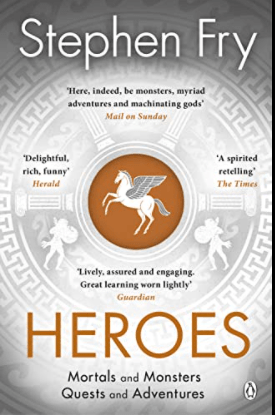
Title: Heroes – Mortals and Monsters. Quests and Adventures.
Author: Stephen Fry
Pages: 408
Hi all,
Today we return to the Greek world; this time much further back than the 1177BC book from before. However, the stories resemble myth closer than they do reality. Yet, we need to remember that for a long time some people believed these stories to be their history, not just stories, but their true history of origin.
The pleasure you get from reading these historical and mythological books is that you have the chance to explore a completely different world and go on an adventure with other people, which would not otherwise be possible today. Some other books that might interest you are those of fiction: 009-2019 Mythos, 018-2019 Song of Achilles, 019-2019 Circe and 001-2020 Odyssey; but also those that resemble somewhat closer with the truth: 014-2021 Alexander the Great and 004-2022 1177 BC.
Regardless, all books give you at least one thing that you will take with you.
My introduction, that led to fascination of the ancient Greece, was with 009-2019 Mythos, which gives an introduction of how the world came to be from the old Greek’s perspective. It tells the tales of the elementals, then the Titans and finally the Olympians. Since then we venture one step further to this book today which allows you to tag along with the heroes of the time when the Greeks worshipped their gods with all devotion and strived to lead a life that would please the gods. Mostly, but not always.
Some of the heroes named in the book may be familiar to you, but others may be completely new. Even for those heroes with whom we may be familiar with, their story may not be entirely known to us. This book offers the great opportunity to correct on that, and also go on terrific adventures with these Greek heroes. The heroes are the following:
- Perseus
- In this tale the King Acrisius of Argos receives the prophesy that “he will have no sons, but that his grandson will kill him”. As a result he locks his daughter (Danae) up in a bunker and strictly prohibits the entry of any males to her chamber. Her only companions shall be female so that the prophesy cannot be fulfilled.
- Zeus likes a challenge so he lets rain of gold fall over their land. Some of that rain makes it into the bunker and manages to impregnate her while she is asleep. Since no male companions ever made their way into the bunker, she believes her child to be the son of Zeus. After the birth of the child her father expels her and her child by locking her into a wooden box and letting her float out to see.
- They are caught by fishermen of Seriphos, and the captain Dictys takes them in as his own family, being without a family himself. His brother (Polydectes) is the king of the land and he a simple fisherman.
- Polydectes also fancied Danae so he makes a plan to keep Perseus, her son, busy and occupied so he may spend some time with his mother. He invites the young lads of the land to a feast where he proclaims that he wishes to land a marriage to a princess of another kingdom. The catch is that any suitor must race their king and win to be allowed to have his daughter’s hand for marriage. The young lads he hops them to offer one horse for his chariot.
- Knowing Perseus cannot match this offer he gives him the opportunity to offer something else. Medusa’s head. Thus, he takes it upon himself to journey to find Medusa and hopefully return successful. On his way he enquires to learn as much about her as he can. Some other gods (Athena & Hermes) even give him items that may aid in his quest.
- He locates her lair eventually and successfully slays her, and brings with him her head. However, one things that he acquires on the quest is the flying horse Pegasus, which is a child from Medusa and Poseidon.
- On his trip home he travels the wrong way and ends up in Ethiopia where he saves the princess Andromeda and marries her.
- Finally he makes the trip home where he learned that king Polydectes had arrested his parents and has sentenced them to death. Perseus takes out the head of Medusa and all that look upon it turn to stone. The parents become the new rulers of the kingdom.
- Perseus and Andromeda decide to visit his homeland and other kingdoms so he can see where his roots are from. During his travels he partakes in olympic competitions and manages to win most of them. At one competition he takes the discus and throws it much further than any other contestant ever has. It lands in the audience stand where it had hit one member vitally. That audience member is revealed to be the former King of Argos, his grandfather, who then dies of his wounds.
- Herakles
- Hera had told Zeus about one of her dreams/visions. This troubled him. Thus, he wanted to ensure that the descendant from Perseus should be a strong candidate that would assist the gods in the second fight that would ensue between the Olympians and the Giants. Three descendants were Sthenelus, current king of Mycenae, Amphitryon married to his cousin the beautiful Alcmene. Amphitryon had committed a blood crime (accidental killing Alcmene’s father on a hunting trip) that they went to Thebes where he was pardoned.
- He left to return home to discuss dynastic accession issues, which is when Zeus visited Alcmene in the shape of her husband and made love to her.
- The next day her husband returns, where she tells him of the night before, which he doesn’t understand, but they engage in a night of passion. Few weeks later her pregnancy is confirmed, but with twins. One child is from the god Zeus, whilst the other is from Amphitryon.
- Zeus had given the promise to his wife Hera that the first child born from the successors of Perseus would be the one to inherit the throne. Hera was not very keen on her husbands exploits (today we would call it adultery) she did everything to make sure that Sthenelus and his wife would bear the first child, Eurystheus.
- Alcmene also gave birth to two children, Alcides and Iphicles. Hera sent some snakes to their chambers and during the next morning the parents discovered that Alcides was the son of Zeus. This would not be the only time she would make his life difficult as she had never forgiven her husband for his misdeads. Therefore, to try and save his life they renamed him to Herakles (Hera’s pride), hoping that she might not try and make life his life any more difficult.
- He eventually grew up to be a fine man and married to have children. One day, Hera transformed his wife and children into demon-like creatures that engaged upon him when he returned home. He killed them for he believed they were out to take his life. When the vision returned he saw that in fact it had been his wife and kids he killed. He committed a blood crime.
- The punishment for a blood crime was to receive penance from a king or pythia or priest so that the Fates would not come for him in the afterlife. Thus, he was told to go to his cousin Eurystheus, who would give him 10 tasks to complete to cleanse himself:
- The Nemean Lion
- The Lernaean Hydra
- The Ceryneian Hind
- The Erymanthian Boar
- The Augean Stables
- The Stymphalian Birds
- The Cretan Bull
- The Mares of Diomedes
- The Girdle of Hippolyta
- The Cattle of Geryon
- The Golden Apples of Hesperides
- Cerberus
- Initially he had been give the task to complete each task unassisted. For two tasks he had been give some minor assistance or requested payment, which led him to receive two additional tasks. However, he managed to complete all tasks eventually, after which he was declared purified for the blood crime.
- During the completion of his tasks he had made enemies with some of the kings for whom he was required to perform a task. He then went on to punish their kings by killing them and installing one of their sons in their stead, which were deemed to be much better suitable for the role.
- However, when he had remarried and had house guests, during one of his drunken fits he accidentally killed another person whom he had as a guest under protection of hospitality. He broke the rule of xenia and was punished to be a slave to a queen in the eastern regions for three years.
- Eventually the battle broke out between the Giants and the Olympians and Zeus summoned Herakles to aid in their fight. During the battle the Giants tried to force themselves onto Hera multiple times, but it was Herakles that killed them all.
- Considering all the bad things that she had let happen to him, one could have thought that he would leave her to her fate. But he was not like that. And for this, she became a close acquaintance from here on out.
- Bellerophon
- Bellerophon was the son of Glaucos (king of Corinth) or Poseidon. He was raised as the prince and then heard of a horse that roamed the region. One with wings. He went off and wanted to claim it as his own. With the help of Athena he used the golden bridles and tamed it as his own. A small kingdom in the east, called Troezen wished to wed their daughter Aethra with him so they may make an alliance.
- Bellerophon, his father and brother were hunting for a boar before the wedding when the brother went to relieve himself. Bellerophon mistook a movement in the bush for the boar and threw his spear at it, only to find his brother struggling back. He had committed a blood crime.
- The wedding was called off and Bellerophon travelled to king Proetus of Mycenea to help with his purification. His wife Stheneboea took a fancy to him and secretly snuck into his quarters one night. He dismissed her for he knew he could commit such a crime as a guest. He would surely bring the wrath of the gods on him for committing xenia.
- The wife told her husband that Bellerophon tried to have his way with her so he sent him further away to the east to king Iobates, father of Stheneboea. Proetus couldn’t kill him since he would be committing xenia. Thus he sent Bellerophon with a letter to his father-in-law, hoping that he would kill her before he invoked the guest pardon.
- Iobates didn’t read the letter and hosted him as his guest. Only after a few days did he read the letter and regretted not reading the letter sooner. Thus, he devised some tasks Bellerophon could help him with that would help his kingdom greatly.
- Dealing with a Chimera
- Dealing with the cruel Solymi kingdom
- Dealing with the Amazons
- Dealing with the pirate Cheimarrhus
- Iobates became frustrated that Bellerophon only succeeded on his ventures and didn’t become overcome by the challenges. Thus he told his people that they should kill Bellerophon once he returned.
- Bellerophon noticed that he was not welcomed with open arms but that the people were out to kill him once he returned from another one of his quests. The group were scared of him and tried to attain his mercy, and he left the people alone. Seeing this, Iobates had his doubts whether his daughter Stheneboea had been telling the truth and believed Bellerophon instead. Bellerophon was given Philinoe, Iobate’s second daughter’s hand in marriage.
- Orpheus
- Orpheus was a magnificent musician. His father was Oeagrus, but many also believed that his father could be Apollo for his musical abilities. Orpheus accompanied Jason on his quest for the Golden Fleece and was rewarded for his bravery by the gods with the hand of Eurydice.
- They moved to a home in the country. On one of her walks she came upon Aristaeus who was a minor god for beekeeping and agriculture. He chased after her and she ran for her life, calling out for Orpheus to help her. Unfortunately she tripped and fell into a hole that housed a snake. When Orpheus reached her he pulled her out, but it was too late, the venom had already taken effect.
- He mourned her loss by not playing nor singing any music for a year. His god-father came to him one day and told him that he should stop mourning and continue living his life. Orpheus wouldn’t want to live his life without her since it wouldn’t be worth living. Thus Apollo told him that he should go to the Underworld and ask Hades and Persephone to give her back to him. For this he received a special lyre that would enchant and entrance anyone that listened to its tune.
- He made his way to a cave entrance and played his tunes to Cerebus (beast guarding the underworld), Charon (ferryman of dead souls), Hades and Persephone. They agreed to let her go with him on one condition. She should walk behind him 10 steps when they made their way to the top and he may not look back to her until they had completely left the entrance. Should he look back at least once before they had left the cave she would remain in the Underworld. ]
- They struck the deal and Orpheus walked 10 feet infront of Eurydice. Keeping in mind the whole way that he should not look back at any time he progressed well towards the cave entrance. As he neared he started to quicken his pace until he had reached the cave entrance. Thinking her to be out as well he turned and saw that whilst he had quickened his pace she had fallen behind the 10 feet. She was brought back to the Underworld and would remain there alone until one day Orpheus would rejoin her.
- Jason
- The story is quite complex since we follow different familial lines over multiple generations.
- King Athamas (of Boetia) married a minor goddess called Nephele, who bore him two children: Phrixus and Helle. Nephele took her place back amongst the gods and Athamas wanted to have a new wife.
- He married Ino, daughter of King Cadmus (founder of Thebes). She wanted her own children to inherit the kingdom and bore two sons: Learchus and Melicertes. Her wish was for the former wife’s children to be put out of the way and make the lineage to the throne evidently clearer.
- She persuaded the women of the farmers to ruin the seedcorn for next season’s harvest so that a famine might overcome then. Once this was upon them, she would send her husband to the pythia to hear the gods will. Beforehand she would have persuaded the pythia with her own message. The killing of Phrixus.
- When the day came that the word was heard from the pythia, Phrixus offered himself freely. His sister would come as well. They stood at the sacrifical altar and the ceremony begain. Only, Nephele sent to them a golden ram to which Phrixus and his sister Helle held on to and they flew eastwards. On their way his sister lost her grip and fell to the sea.
- Where she fell is called Hellespont, where Europe and Asia Minor meet
- Phrixus held fast and past through the Bosporus to come to the Black Sea. He landed on the far eastern shores of the sea in the kingdom of Colchis. He sacrificed the ram to Zeus and presented the golden fleece as a gift to the king Aeetes. He also married his daughter Chalciope.
- Coming to understand that Ino had mislead him, king Athamas killed his son Learches and Ino fled with her other son Melicertes, only to be caught at the cliffs, where they fell to their deaths.
- Now with no heirs it seemed the kingdom was in trouble. Only, Athamas had other siblings that wished to take the throne for themselves. Three brothers: Sisyphus, Salmoneus and Cretheus. Salmoneus had a daughter Tyro, who in turn had given birth to offspring with each of her uncles. Her eldest son was Aeson (from Cretheus) and Pelias and Neleus (from Poseidon). Aeson being the elder had the rightful claim to the throne. However, the sons of Poseidon believed their claim as half-gods was greater and therefore, once Cretheus died they laid siege on Aeson and his wife. The latter two believed they would give their child Jason a chance to survive and thus sent him away in secret. Meanwhile, Jason’s parents were inprisoned.
- Jason was raised by the centaur Chiron. Years later he returned to his homeland and would lay claim to his right to rule. Pelias agreed that he should be allowed to rule, but that it would be best if he returned the Golden Fleece, which would stake his claim.
- Agreeing to these terms he assembles a crew of other heroes (Argus shipwright; Idmond the seer; Tiphys, Augeas and Ancaeus helmsman; Nestor (later in Troy); Peleus and Telamon (sons Teucer and Ajax in the Trojan war); Herakles, Hylos page and Polyphemus brother-in-law; Meleager; Castor and Polydeuces; Palais and Zetes; Orpheus; etc.) and they sail on the Argos to the kingdom of Colchis. They meet obstacles on the way there but eventually manage to reach their destination.
- Once they reach their destination the current king Aeetes (the same who welcomed Phrixus) is still ruling and welcomes them to his home. When Jason explains his quest the king tells him that he may take the fleece if he manages to complete three challenges:
- Engage with two bulls that spit fire
- Fight a battle against a troupe of seed-soldiers
- Take the fleece from a tree, which is defended by a dragon-serpent
- Hera wishes for this quest to be successful and therefore engages with Aphrodite who send Eros to shoot his arrow at one of Aeetes daughters, Medea, to help Jason out. Eros being associated with Aphrodite means love is in the air, so he makes her fall in love with Jason.
- Jason successfully completes the task and they flee the kingdom before the king can catch on how he managed to succeed in his task. Other siblings of Medea accompany the crew since they have problems at home and see an opportunity to start a new life. After their journey commences the king is in their pursuit and so follows them towards the Bosporus. Knowing this they decide to sail northwards to reach the Danube river and follow it all the way to the Rhine river and from there turn south to sail around the Italian peninsula and turn east to return back to the Greek mainland.
- Atalanta
- Oedipus
- Theseus
- In Troezen the king Pittheus has his daughter Aethra show the current king of Athens Aegeus throughout their kingdom. It ends with them having a night of passion. He returns home to rule, still without a male heir and she ends up bearing a son called Theseus. Once he has reached age his mother tells him who his father is and he wishes to meet him. However, he doesn’t wish to travel to Athens and lay claim to a kingdom by birthright alone. He believes it to be more honourable to become reputable and earn the right to rule properly. Thus, he makes his way by foot around the Greek land and rids the lands of some of the bandits that lay there:
- Periphetes the cyclops
- Sinis the Pine Bender
- The Crommyonian Sow
- Sciron the outlaw
- Cercyon the giant
- Procrustes the stretcher
- He reaches Athens as a hero for his deeds to the kingdom. The king thanked him for his deeds and welcomed him to take a position in the soldiers ranks. His queen Medea had a son (Medus) with Aegeus and saw that Theseus was a threat to her son’s claim to the throne. Thus she claimed to her husband that the hero could do something for them, get rid of the Marathonian bull.
- One of Herakles’ tasks was to present the Cretan bull to his cousin. After he did, the bull was released and it settled in Marathon. Another kingdom (Crete) had their son visit the kingdom few years ago and claimed to be much better a soldier than any of their own. The king told him to prove his claim by slaying the Marathonian bull. The prince died and the Cretan king lay them under siege. Only once they submitted to his terms did he let them rule themselves again. They were to provide 7 males and 7 females every year as an offering to the Cretan king would would give it to his son, the Minotaur.
- Theseus challenged the Marathonian bull and returned home successfully. Upon his return Medea saw fit to poison him as the only way out. Her husband agreed, since he felt this intruder was a threat to his own reign, not to his son’s. However, when Theseus shows him the possessions his mother gave him of his mother, Aegus exiles Medea and Medus, who flee eastward.
- Next, Theseus plans to resolve the matter of tribute to the Crete’s by offering himself as tribute and finally killing the beast.
- He succeeds in this venture with the help of king Mino’s daughter Ariadne and the courts highly esteemed inventor Daedalus. They return home, but part ways. Ariadne is lost to an island and Daedalus flies off to another destination after losing his son Icarus on their trip.
- A further adventure follows, but I think we have seen quite a lot from Theseus.
- In Troezen the king Pittheus has his daughter Aethra show the current king of Athens Aegeus throughout their kingdom. It ends with them having a night of passion. He returns home to rule, still without a male heir and she ends up bearing a son called Theseus. Once he has reached age his mother tells him who his father is and he wishes to meet him. However, he doesn’t wish to travel to Athens and lay claim to a kingdom by birthright alone. He believes it to be more honourable to become reputable and earn the right to rule properly. Thus, he makes his way by foot around the Greek land and rids the lands of some of the bandits that lay there:
- Envoi
What most of the heroes have in common is that they were not wanted either by their parents or were in disfavor with one of the gods. Thus, they had to leave and be raised in a separate kingdom, or had to grow up under a different name. This situation of being unwanted/disfavored mostly was the result of the king being scared by a prophesy given by the Pythia, one god being unfaithful to their spouse by bearing a child with a mortal, or something similar.
Regardless, they managed to overcome the obstacles that were laid before them and rose to become favored by the people.
However, this is not where the story ends. Unlike those Disney fairy tales that end with “…happy ever after…” they mostly met their end in a tragic way. Just like us today, they had difficulties facing their lives that were not seen fondly by the other people. This is where you can connect best with the different characters because it shows that even though they had done such jaw-dropping things, they were also quite human, going through human problems.
Summary:
The book tells great stories in much detail so the reader can follow where exactly each character comes into play and how they also play a role in a different story. It also links up very well where their adventures took place, and where we could locate those places today. Further it explains why things were named after a certain person, and that such names of places are still called that today: Hellespont, Bosporus, Aegean, to name a few. The book deserves a rating of 4.4/5.
Have a good one!
 MyBookReviews