Title: A Global History of The Greeks
Author: Roderick Beaton
Pages: 462
Hi all,
Our journey into history continues. Though, this time, with a slight difference. Previously I have given a book review on Alexander the Great (014-2021) and a glimpse of Roman history via “The Storm before the Storm” (006-2021), which all depicted the history of a nation or person at a point in time. In 1177 BC (004-2022) I have then focused on the Bronze Age Empires just before they all ended, according to the historians.
This time we follow the history for one people from the Bronze Age up until the present day. Thus, they will be the index against whom we will see what happened to this group of people as the times changed around them and how their lives changed, or how they adapted to it.
There aren’t many groups of people of whom we have records from very long ago, even after being subjugated by another people. Another people that comes to mind are the Egyptians. Around these two (amongst possible few others) the kingdoms rose and fell and the group were killed, dispersed or sent away as slaves.
Thus, I think you will benefit from this book as you follow the story of one people (i.e. how they rose and fell as a result of internal and external influences) and how this fits into other tribes and kingdoms that existed around them.
The story of the Greeks is broken down into the following parts:
- Preface
- Greece never really was a political place/nation until 1821 when it staged a revolution against its Ottoman rulers to receive international recognition as a separate people and a separate state.
- The book is not titled the story of “The Greeks” but rather “The Greeks – A Global History” because the influence that these people had on history was not restricted to one geographical location. Throughout history, their ideas and language traveled with them as they set sail for new shores and start a new life. Not only that, different people who came across texts and records from these people sometimes adopted some of these ideas into their own culture or society, and sometimes even reshaped the current thinking of large groups of people.
- 1500 BCE-1180 BCE – Of Ledgers and Legends
- For some perspective, we have the Stone Age taking place:
- Old Stone Age – Paleolithic 2.500.000 BCE – 10.000 BCE
- Middle Stone Age – Mesolithic Age 10.000 BCE – 8.000 BCE (end of the Ice Age)
- Late Stone Age – Neolithic Age 8.000 BCE – 3.000 BCE
- Then we have the Bronze Age taking place:
- Early – 3.300 BCE – 2.100 BCE
- Middle – 2.100 BCE – 1.550 BCE
- Late – 1.550 BCE – 1.200 BCE
- One theory is that a group of the Indo-Europeans came around 2.300 BCE-1.900 BCE to the location where modern-day Greece is located and they merged with the locals. From this the Greek language emerged.
- Another theory is that as the techniques of farming spread westward (from the Fertile Crescent in Mesopotamia) one group of people settled on the location and the old Greek history starts off there, from the early Neolithic Age.
- Regardless of what the correct story of origin is, the earliest diggings suggest that from 1.600 BCE there were a group of people established there which would later on become a force to be reckoned with amongst the regional powers in the heyday (i.e. Minoans, Egyptians, Assyrians, Hittites.
- Though the other ruling powers had different names for this rising power, to us they have been known as Myceneans. To themselves they were known as either Achaeans (from Ahhiyawa as the Hittites knew them) or Danaans (from Tanaju as the Egyptians knew them).
- Their society was largely influenced by one of the largest maritime power of the time, the Minoans (or Crete) since lots of their decorations and other objects and building styles were adopted onto the mainland of Greece. The Myceneans had on offer mineral resources and fighting power to be able to afford those expensive imports. However, a change then occurred in the Mediterranean. At other locations, the decorations that were starting to appear more and more were those of the Myceneans, which suggests the local ruling class of the Greek mainland were expanding their influence.
- 1450 BCE there were significant fires that devastated the various small palaces on Crete. The place Knossos of the island was one of the last to remain standing, but it soon also fell due to a fire.
- At the time, the Minoans had had their style of writing (called Linear A) since around 1900 BCE. But when the fires hit Knossos, the clay tables found there were written in another style, Linear B (the style used by the Myceneans). Thus, the influence of the Myceneans was already significant in use then.
- The writing style was used by the appointed scribes to document all bureaucratic activity that the kings of the different Mycenean controlled.
- The vassal states on the Anatolian coast wanted to rebel against their Hittite overlords, and the Myceneans, in an attempt to further expand their influence, assisted them.
- 1200 BCE the ascendancy of the Myceneans came to an end. The palaces and fortifications they had built on the Greek mainland were severely damaged.
- ==> see Movie “Troy”
- Reasons offered for the collapse range from climate change, famine, invasions, plague, or a combination of multiple. Another theory that was suggested was termed *System collapse, whereby a system has grown so complex that the cost of maintaining it outweigh the benefits.
- After around 1180BCE it wasn’t only the Myceneans who had suffered, but many other of the Great Powers of the day. The only one to have survived was Egypt.
- ==> see YouTube clip “1177 B.C.: When Civilization Collapsed | Eric Cline”
- For some perspective, we have the Stone Age taking place:
- 1180 BCE-720 BCE – Homer’s World, Not Ours
- After the Bronze Age we leap into the Iron Age, though it is important to bear in mind the different ages occurred at different times for different groups of people since the metals weren’t brought into use by all people at the same time. Therefore, the timeline below represents the timeline for the Near East:
- Iron Age I – 1.200 BCE – 1.000 BCE
- Iron Age II – 1.000 BCE – 550 BCE
- After the devastations hit the ancient world the populations of these vast empires fell, people left the old cities for smaller settlements and many even left the peninsula for other islands to establish new settlements.
- All trade that happened between traders all over the Mediterranean had come to a complete halt.
- This would be the Achaeans’ first Dark Age.
- What happens during a dark age is that people change their lifestyles from a flourishing city to a settlement that focuses on its subsistence. Therefore, fewer records would be kept on daily life and activity and practically no literary works would be produced. In some cases where a group of people falls so deep the peoples even don’t utilize the written language and it then becomes forgotten completely.
- Around 800 BCE things started to turn around. People started to produce more than the bare essentials. New groups of people started to rise in power thanks to commencing their trading activities once again.
- Phoenicians on the eastern Mediterranean
- Etruscans on the Italian peninsula
- Not only that, but Greeks started to move to other parts of the Mediterranean in search of better opportunities. Greeks started to settle on the Aegean islands, on Cyprus, on the coast of Anatolia, as well as further north (incl. Macedonia). As the Greek population became fragmented across the different parts of the known world, so their dialects also began to change.
- In order to be able to communicate with further away Greeks for trade purposes the Greeks adopted the alphabet, which had been developed by the Phoenicians earlier, so that a Greek in one part of the world could still understand the other, even when their dialects differed. The step away from Linear B was because the prior language had only been learnt by few people and the writing system required some guesswork what was meant by a particular sign. Therefore, the switch to a simpler writing system was made.
- This would be a step towards their own Information Age
- This writing system was then also started to become adopted by other peoples as well: Phrygians, Etruscans and later Romans.
- With the writing system in place, literacy didn’t only become more widely available, but it would start to be used to record things that were intended to be kept on record for future generations, even stories. It is from this time that two poems came into existence that would deeply impact Greek and other peoples throughout different ages:
- Illiad – which recounts the story of the Trojan War. The tale where wife Helen of Sparta leaves with Trojan prince Paris to their kingdom. Husband king Menelaus goes to his brother Agamemnon to muster up a force to get her back. They organize a large fleet of a thousand ships and leave for Troy. There, they lay siege and battle for 10 years. The infamous hero Achilles battles the prince Hector. The Greeks finally break through the strong gates with their Trojan horse and lay waste to the kingdom.
- Virgil recounts that from this battle Trojans fled to seek a new homeland. Amongst them was Aeneid, who was the ancestor to the Romans.
- Odyssey – recounts the story of Odysseus, who has survived the Trojan war and struggles to reach home after 10 years at sea and being swayed from island to island.
- Illiad – which recounts the story of the Trojan War. The tale where wife Helen of Sparta leaves with Trojan prince Paris to their kingdom. Husband king Menelaus goes to his brother Agamemnon to muster up a force to get her back. They organize a large fleet of a thousand ships and leave for Troy. There, they lay siege and battle for 10 years. The infamous hero Achilles battles the prince Hector. The Greeks finally break through the strong gates with their Trojan horse and lay waste to the kingdom.
- The growth that was taking place around the known world would result in the next three centuries to become known as the “Age of Experiment”.
- After the Bronze Age we leap into the Iron Age, though it is important to bear in mind the different ages occurred at different times for different groups of people since the metals weren’t brought into use by all people at the same time. Therefore, the timeline below represents the timeline for the Near East:
- 720 BCE-494 BCE – Inventing Politics, Discovering the Cosmos
- People were continuing to leave the peninsula to seek better opportunities in lands that were yet untouched and offered prospects creating a better life. They didn’t leave to eventually return home. Their purpose was to leave for good. Thus it happened that people left for all parts of the Mediterranean:
- Around the Black Sea (eg. on the Dardanelles, Sea of Azov, Sea of Marmara, etc.)
- On Sicily
- On the Italian peninsula (eg. Naples, Taranto, etc.)
- On the French coast (eg. Marseille, Antibes and Nice, etc.)
- On Catalonia (eg. Empuries, Ampurias)
- North African Lybia (eg. Cyrene) and Egyptian Nile (eg. Naucratis)
- The Greeks were not the only ones who were busy with setting up communities across the seas. The Phoenicians and Etruscans also expanded across the Mediterranean sea.
- By moving away from their homeland they started new settlements. These settlements needed a new way to be run, and not like the tyrannical or oligarchical systems of the past. Since they had no guide from the past how such a settlement would be run differently, they gradually developed the system that would become known as the polis (translated to city-state).
- The urban space encircled an open space, called the agora (which was used to hold discussions amongst people)
- Around the urban space was the agricultural hinterland.
- Farming, trade and the spoils of war were the sources of wealth.
- In these polis, every state only had one city over which it could rule. Further, there was no individual group of people that exercised more power so that it could exercise its will on the rest.
- Because there was no one to guide them in this system, the people would regularly convene at the agora to argument for or against taking certain actions. This way, the people decided via argumentation. –>politics
- Thus, the citizens made the rules (i.e. constitution) under which they agreed to live within the settlement. To make these rules bound, the rules were documented in stone or bronze and were displayed in a public place for all to read. Even when foreigners entered these settlements they could read these rules, thanks to the widely adopted alphabet.
- Few places around the Greek mainland didn’t yet adopt the polis model but kept to the ethos model.
- This model was a form of tribal system, where one settlement didn’t consider itself to be a polis, but rather that it could control over other small settlements as well, like a tribal king.
- Particularly Macedonia had adopted this system.
- Two of the most famous city-states were the Spartans and the Athenians:
- Spartans:
- Ruled over the southern Peloponnese.
- Enslaved the local peoples of the regions, called them the helots. The helots were subjugated to perform all the laborious activities whilst the Spartans ruled over them.
- The Spartans ruled in a military state. All sons would become soldiers and dedicate their life in servitude to Sparta.
- Sparta was always ruled by two kings simultaneously.
- The peoples were very conservative and would stick to the rules that were set in the early establishment of their polis.
- Athenians:
- Athenians also had slaves who farmed the lands, but the Athenians were farming their own lands, as well as performs tasks of craftsmanship.
- Athens on the other hand had also shifted to adapt to the current system of rule in place.
- 800 BCE – 683 BCE monarchy
- 683 BCE – 550 BCE oligarchy
- 550 BCE – 509 BCE tyranny
- 509 BCE – onwards democracy
- 550 BCE Pisistratos took over control over the city state as sole ruler until 527 BCE.
- His son Hyppias takes over and leads the state the same way his father had done.
- 514 BCE a trady occurs, which leads to Hyppias hardening his rule over the people, which leads the people to rebel. Under the leadership of local aristocrat Cleisthenes they manage to overthrow Hyppias in 509 BCE.
- Cleisthenes then develops the first known form of a democratic state.
- Spartans:
- In general, the different city-states enjoyed the autonomy rule they had over their city, without any external rulership being imposed on them by other powers. However, occasionally, the city-states would work together and make a temporary alliance when a thread was considered significant to both their existence.
- The way that they would appeal to other city-states to make an alliance is either a) their shared ancestry, or b) their related dialects. This sense of being related gave them their first sense of identifying as Hellenes. Though they were from different parts of the known world, deep down they identified as Hellenes.
- Another change that came about was the strategies used in warfare. During the Bronze Age the warfare tactics applied was that the soldiers would come together to fight, but each soldier would fight on their own. The new warfare tactics that would be applied here onwards was to group soldiers together and make them fight as a unit, and no longer as solitary soldiers.
- Another way that the Greeks were discovering themselves was by the development of new poems and visual arts, which then also lead to manufacture of new arts in pots and sculptures.
- Not only these changes came about. Since some of the Greeks established their settlements on the Anatolian coast (known as Ionian states) they came into contact with the records/teachings of the ancient Babylonians and Egyptians about their studies of Nature and the stars. Hence, they decided to perform their own experiments. Whilst the ancients had seen these elements of nature (eg. sun, moon, stars, etc.) as having a religious position, the Greeks saw them as objects and sought out to understand how they worked in Nature. –>Physics
- As long as their settlements were not challenged by any external powers they managed to thrive. However, during 560 BCE a new power had started to make their presence known:
- King Croesus of Lydia (housed in Sardis) had started to expand his kingdom between 560 BCE – 550 BCE to encapsulate the whole of Anatolia.
- Carthage (former Phoenician colony) had become the new kingdom and started to eye the island of Sicily.
- The Persian king Cyrus the Great greatly expanded his reach over a 30 period rule from 560 BCE in the east and was edging closer to the western regions of the Ionian states.
- 546 BCE Cyrus had taken over the lands of the King of Lydia, and slowly took over the Ionian States on the Anatolian coast.
- His son, Cambyses II would contribute to this empire by adding Egypt to the empire after a brief rule himself.
- The only Greek settlement that took this new threat seriously was Sparta, who sent a delegation to the king in 540 BCE to inform him that he should refrain from his conquest. If not, they would intervene and stand up for their Greek fellows. The Persians paid no notice. Thus, Sparta began to expand its control in the Peloponnese until it had conquered most of the terrain, with the exception of Argos.
- It was during this conquest of Sparta that they assisted their Athenian brothers to expel the tyrant Hyppias in 509 BCE.
- Two years after Cleisthenes’ reforms were implemented, the Spartans had returned to Athens to demand the expulsion of Cleisthenes. After a year of resistance the Spartans finally returned home.
- 499 BCE, some of the Ionian settlements (who had been subjugated since 546 BCE) wanted to rebel and sent for support from the Greek mainland. Athens and Eretria sent a small contingent to assist. The locals and the assisting contingent set fire to the satrap state of Sardis.
- Then, the Persian overlord rounded them up, and the Athenian and Eretrians fled for their homeland. The local settlements continued with their rebellion for another five years, until Darius I finally ended the Ionian Revolt in 494 BCE.
- His rule being firmly established, he was now looking further west, closer even to those settlements that had sent support during the Ionian Revolt.
- People were continuing to leave the peninsula to seek better opportunities in lands that were yet untouched and offered prospects creating a better life. They didn’t leave to eventually return home. Their purpose was to leave for good. Thus it happened that people left for all parts of the Mediterranean:
- 494 BCE-404 BCE – The First World Wars and the Classical Age
- Whilst Darius I was tightening his grip on the Anatolian city-states, the Greek shores were also engaged in conflict with one another.
- Sparta was trying to consolidate the whole Peloponnese under its control, as it had commenced since 540 BCE. The last standing city-state the offered strongest resistance was Argos.
- Athens was in conflict with its neighbours Thebes in the north and Aegina in the south-west.
- As the year 490 BCE approached, these two powerful city-states were also suffering from internal conflicts in both cities.
- In Sparta:
- The current two kings were Cleomenes and Demaratus. Both were trying to have the other killed. Demaratus eventually fled to the Persian-controlled Anatolia. There he was treated well by The Great King. However, he would eventually die.
- In Athens:
- Since Hyppia’s expulsion he had found refuge and was well treated by The Great King in the Persian-controlled Anatolia.
- In Sparta:
- It was the hopes of both of these individuals that when The Great King took control over the Greek mainland, they would be the ones selected to control the lands as satraps to The great King Darius I.
- In 491 BCE Darius I sent envoys to the western countries of the Aegean sea, inviting them to accept The Great King as theirs, and to rule as satraps on his behalf. Most complied (incl. Macedonia), but not all did. Athens and Sparta were amongst those that didn’t.
- The expeditionary forces set sail in 490 BCE first for Eretria, which they defeated after a quick siege. Then, their next target became Athens. Their guide towards Marathon was none other than Hyppias. There, they faced an Athenian army, but by day’s end were chased back on their ships.
- Instead of returning home, they decided to set sail for Phaleron, the current port for Athens, since the city was undefended. However, the Athenian soldiers managed to return home before the arrival of the fleets, whereafter the Persians returned home to Anatolia.
- After the First Persian War had been a success both sides would have 10 years before the next attempt would be made for control over the Greek mainlands.
- The Spartans would elect two new kings: Leotychidas II (kinsman of Demaratus) and Keonidas I (married to daughter of Cleomenes). Not only that, they still had to ensure that the helots were kept in check and further attempts would be made to overtake Argos.
- In Athens the internal struggles still continued on. An innovation was introduced in the hopes of lowering these tensions. Every year the city would hold a vote of ostracism. This meant the people would write someone’s name on a piece of discarded clay and throw it into a pot. The person whose name appeared most would be exiled for 10 years.
- Not only that, somewhere outside of Athens a mine of silver reserves had been discovered. The people wanted to vote at the agora how the silver was to be spent. This was where Themistocles made his appeal to the public. They should fortify the harbour Pireaus and increase their maritime power so that if their local neighbour Aegina were to pose a threat, they could fight them off. They voted in favour of his proposal. All this was finally completed between 483 BCE and 481 BCE.
- Though this may have been his argument, his actual intention was to prepare Athens for the greater threat of Persia.
- In Persia, Darius I had died in 483 BCE. His son Xerxes planned to succeed and avenge his father by destroying the city of Athens.
- In 480 BCE The Great King once again sent envoys to the western Aegean to acknowledge him as their king. Most would do. However, those who did not decided to form an allegiance, led by Sparta. The allegiance was mainly made up by Sparta, Athens and Corinth. The Greek settlements on Sicily were suffering their own struggle against the Carthaginians and could therefore not offer support. The Persian forces moved through the northern lands until it reached Thessaly. From there, the only passage to the southern Greek lands was through Thermopylae. Here, a Spartan force of 300 (under the leadership of King Leonidas I) held up The Great King for a long time until they were eventually defeated, after a Greek local showed the Persians a hidden passage through to surround them.
- ==> see Movie “300”
- After this defeat the Persians could move straight for Athens, where they plundered the empty city and burned it to the ground. The Athenians had decided to flee, and harbor on the island of Salamis instead. Themistocles, through trickery, managed to convince the Persian to engage in a naval battle. The Persians sailed for the straights, but were ambushed by the Athenian fleet, which in turn decimated the too-big Persian ships for the too-narrow passage.
- ==> see Movie “300 Rise of an Empire”
- After the remaining fleet of the Persians sailed back to Phaleron, Xerxes sailed back to his empire, leaving Mardonius in charge to continue the war efforts during the winter. He himself would return when spring of the following year came about.
- The final battle was fought in 479 BCE on the area called Platea. Mardonius was killed and the remainder of the Persian forces sailed back to their homeland in Anatolia.
- The two individuals who wrote, and whose work has survived throughout the time, to tell the story of the Persian wars were Aeschylus (who himself had lived and fought in the two wars for the Athenians) and Herodotus (born in 484 BCE in Halicarnassus on the Anatolian shoreline).
- Aeschylus’ account of the events resemble those of a play, which were the common form for writing
- Herodotus’ account was not written to be recounted as a play but to research the events from different sources and capture an accurate account of the events to store for future generations –>history studies
- Between 479 BCE and roughly fifty years onwards (i.e. around 431 BCE) are marked as the classical period.
- During this period culture was sparking high interest and Athens was making every effort to become the cultural centre of the Greek world. Greek plays started to be produced in larger quantities. Decoration styles on pots, plates and cups also saw changes from 450 BCE.
- Under the leadership of Pericles (from 450 BCE) the Acropolis was rebuilt from 447 BCE and was to serve the permanent memorial of their victory. The Parthenon itself was finished after 15 years of building and was dedicated to the goddess Athena.
- Another leading figure at the time was Socrates, who was engaging with all kinds of people, improving and perfecting his new form of dialogue of argumentation. He had been born in 469 BCE and his dialogues would lay the groundworks for moral philosophy.
- The objective of the thinkers was to learn and understand the cosmos. Not simply trust in the gods, but through experimentation learning how the world worked.
- Another figure who lay the groundwork for another field of study was Hippocrates. he was engaged in studying the workings of the human body.
- –>Thus, during this century, the Greek world was increasingly becoming centred on the individual being.
- An alliance of Greek city-states had been made and fought multiple smaller conflicts with the Persians on the Anatolian coast to keep the Persians in check. Their centre was the island of Delos, and was thus known as the Delian League. However, as the public projects were commenced in Athens, Athens (the leading party) moved the treasury to Athens for safe-keeping. Though, some of the funds were used to fund social projects of rebuilding Athens.
- The Athenians became the naval empire, whilst the Peloponnese League was a land-based power.
- During 460 BCE the two leagues would clash with one another in their struggle to gain more territory, especially those which remained neutral from the two. In 446 BCE Athens signed a peace treaty for 30 years, gave up some of its gained territories, in order to ensure it would retain its naval supremacy.
- The Athenians from 460 BCE, as they saw their ’empire’ expanding, had changed their position to deserving more and be the right rulers for all the Greeks. For this reason they were inclined to take more risks, even engage in a war with the neighbouring Greek league. After the 446 BCE peace treaty, war broke out once again in 431 BCE. Pericles and the people of Athens held up behind their fortified walls. Their objective was to force the Spartans to a naval conflict. Whilst the Spartans couldn’t penetrate the walls, their ports would be well protected and could bring fresh resources from Egypt whilst the conflict went on.
- However, because the population was cramped behind the wall fortifications a plague that was imported from Egypt in 430 BCE spread through the city and killed a large proportion of its citizens.
- 421 BCE the two sides signed a peace agreement.
- By 416 BCE, when Athens had recovered, it would engage in two further campaigns. The first was in 416 BCE on the island of Melos, who were laid to siege and engaged in multiple dialogues before finally surrendering in 415 BCE. The men were killed and the rest of the population were enslaved.
- 415 BCE the second campaign was to be undertaken. Alcibiades convinced the Athenian Assembly that a campaign of 134 ships should be sent to overtake Syracuse, Sicily, which was a Greek settlement, Spartan ally and rich in food resources. Should this island be won, then this would shift the balance of power. The campaign set off and after two years had ended in tragic disaster. Alcibiades had fled his troops for the Spartans, believed to have been in line with them from the beginning.
- 413 BCE the Spartans set up fortifications in Attica and would hold out there to keep the local populace behind their walls.
- 412 BCE Spartan approached The Great King Darius II and signed a treaty with him. The Persians would offer their support in the defeat of the Athenians, and the Spartans would agree to hand over control over the Greek lands (Anatolian) their fathers had won back and liberated, to The Great King.
- In 406 BCE the Athenians fought a naval battle against the Persian fleet (led by Cyrus, son of Darius II (new satrap of Anatolia) and Lysander, commander from Sparta) between the island Lesbos and mainland Anatolia, known as the battle of Arginusae. The Athenians won, but, in a turn of events, storms erupted and some ships had been sunk. Surviving sailors in the waters couldn’t be saved, and the remaining fleet sailed homewards.
- In 405 BCE the Spartans and Persians fought another battle against the Athenians in the Aegean, located in Aegospotami. The victory came to the Spartans, who had now cut the Athenians off from their food supplies from the Black Sea Greek traders.
- 405 BCE – 404 BCE the city of Athens was besieged into starvation until at last they agreed to terms of peace. Their fleet was reduced to a mere 12 war ships and the big walls that fortified their city and port Pireaus were torn down.
- 404 BCE-322 BCE – Cultural Capital
- After the defeat of Athens Sparta installed a 30-man junta, known as The Thirty Tyrants, to rule over them. When the locals rebelled within months of its installation the rule of democracy was once again returned. In the coming decades Sparta would be in constant conflict with its former allies that helped them to overcome the Athenians: Corinth and Thebes. In Persia, The Great King Darius II had died in 404 BCE. The new Great King was Artaxerxes II, the brother of Cyrus who became the satrap of Anatolia in the previous years. Thus, Artaxerxes II’s rulership was contested by Cyrus and the Spartans (especially Lysander). This resulted in a contingent of mercenaries from multiple Greek city-states engaging in battle on the Euphrates River in 401 BCE, the result of which was the death of Cyrus. The Greeks fled over the Black Sea to their own Greek city-states, and some returned to their Aegean city-states. However, they would continue to engage in small conflicts against the new Great King for a few years. To put an end to this, the new Anatolian satrap sent envoys between 396 BCE and 395 BCE to all the Greek city-states offering them compensation to engage in conflict against Sparta, in the hopes that Sparta would end its conflict against Persian territories. It worked, Corinth and Thebes accepted the compensation. The battle (known as the Corinthian War) lasted until 386 BCE and was fought by Sparta against Corinth, Thebes, Argos and Athens, backed financially by Persia. When the attackers were gaining the advantage, Persia switched over to the side of Sparta. Finally, in 386 BCE, Antalcidas (Greek commander for a naval fleet in a battle on the Hellespont) met with The Great King in Susa, their capital, to negotiate terms of peace. –>known as the King’s Peace. This time, Sparta did hand over all the Greek city-states that had been ‘liberated’ on the Anatolian lands during the Persian War, a promise it had then not kept. The war was over, however, during the coming years the individual city-states on the Greek mainland would continue to engage in battle amongst each other. In 378 BCE Thebes had become liberated from Spartan control, and was gaining prominence under its democratic regime. Under one of their leaders (Epameinondas) they fought a decisive battle in 371 BCE against the Spartans. They decided to give an even more decisive blow to the Spartans. When they marched on the Peloponnese the urged the local helot population into a rebellion, which resulted in Sparta granting them their freedom. The once-mighty Spartans was its own city-state and had no slave population to work for their subsistence. Other battles were also being waged on the Greek mainland. Athens was slowly building up its naval military by entering into alliances with former Delian League states, as well as with Sparta and those allies from Sparta. They engaged in a battle in 362 BCE against Thebes and the new city-states that had been liberated on the Peloponnese. During these battles it was when Epameinondas would lose his life from an injury sustained during battle. 399 BCE (four years after the Thirty Tyrants were expelled) Socrates had been condemned to death by drinking hemloc. This was because he was charged for impiety and corrupting the minds of the youth. A scapegoat was found in him to lay blame for the Athenian’s loss against the Spartans. Two of his pupils were determined to perpetuate his legacy:
- Xenophon –>writing historyPlato –>laying the foundations for a philosophical foundation.
- His writing calls for all Greeks to lay down their differences and not identify their city-state as greater than the next. For a conquest should be undertaken by all the Hellenes throughout all territories against the barbarian overlord (in this case Persia) Isocrates thus makes clear that what makes Greek is not a matter of kinship or biological inheritance. Identity is to be understood as a set of values that anyone can aspire to attain.
- Politician Demosthenes argued that they were a barbarous people who sought nothing other than plundering and destroying everything the Greeks held dearIsocrates saw in Philip II that his brutal force may be what was needed by the Greek city-states to fulfil his appeal issued in 380 BCE.
- In front of the Athenian Assembly he would rehearse that the Macedonians are from the line of Herakles. Thus, the Greeks brought in a new distinction than simply us (Greeks) vs. them (barbarians). The Macedonians were somewhere in between. Not only that, the royal houses from the northern kingdoms had brought up their offspring in the Greek education, as well as giving them Greek names. In order to show that they identified themselves as Greek as well, the elites before had even engaged in building their settlements to resemble the Greek architecture. Artists from city-states were also lured to their kingdoms in order to build a culture that was similar to any Greek state.
- This border was considered a point of pressure for Athens since it was dependent on grain imports from other Greek city-states around the Mediterranean, including from within the Black Sea. By winning over this territory, Philip II could use this as a means to control decisions taken in Athens.
- A representative of each city-state was sent to a place in Corinth to attend a new military alliance, known as the “Common State of the Hellenes”. All states were represented in this council, but all owed allegiance to the Leader, the King of Macedonia
- Important to note is that the Greek city-states didn’t merely rise up against another kingdom or city-state to engage in war or to become the next ruler. The people were strictly proud of their autonomy and therefore, when an opportunity presented itself to gain it once more from another kingdom that was currently their ruler, they would battle for itOnce Philip II died, and later Alexander III as well the Greek city-states would once again rebel in order to attain their autonomy
- In 337 BCE a second council was called at Corinth where he informed them of his intention of sending an expeditionary course to the east to liberate the Greek city-states on the Anatolian coast from their Persian ruler.
- Alexander would undertake the conquest in his father’s stead, but it is very likely that he heard of this destiny from his father and believed that it was his when his father passed away.
- Before he would lead an expedition he made some last few alliances with neighbouring kingdoms in order to ensure that his kingdom would not be under threat whilst he was on campaign in the east. He would celebrate his seventh wedding at Aegae in 336 BCE, in the city’s stadium. Guests were packed in the stadium and were kept entertained until the final event would come about, the official marriage of Philip II. When he walked through the tunnel and entered that stadium he was first approach by a former body guard, Pausanias, stabbed and killed.
- It was his fourth wife’s (Olympia, daughter of the kingdom west, Epiros) son, Alexander III who was crowned as the new King of Macedonia, in 336 BC. He had been born in 356 BCE whilst Philip was on campaign. When Alexander grew up under the tutelage of Aristotle he had also once held the kingdom as steward while his father had been off on another campaign elsewhere, and thus had already gained some experience earlier on in the affairs of their state.
- After being crowned king he called for a meeting in Corinth to assert his rule over the council and that none of the states would gain their independence.
- Afterwards he was called to engage in conflicts against their northern neighbours, the Illyrians. When news reached Greek city-states in 335 BCE that Alexander had died. The states, under the leadership of the Thebans wasted no time and declared war on the Macedonians. Alexander had not died, and therefore gone south to engage with them in battle.
- Alexander prevailed, Thebes was sacked and Athens spared once again.
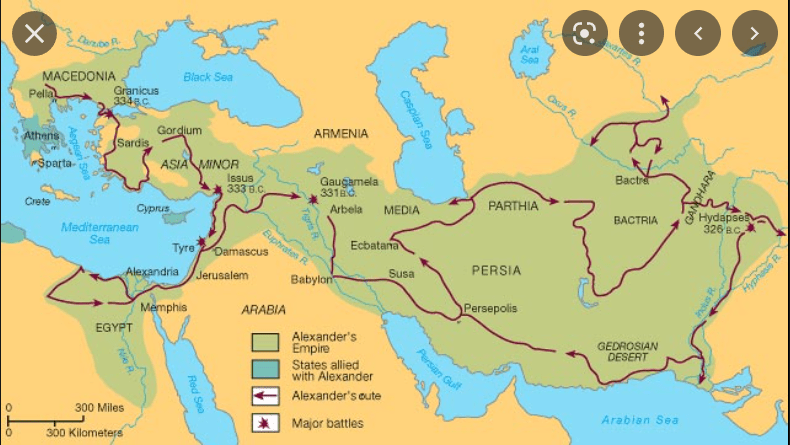
- 334 BCE the expedition to the east was ready and Alexander’s force marched for the Dardenelles, the crossing from Europe to Asia.
- Alexander’s troops made the crossing without being hindered by the late Persian force of King Darius III. Instead, they met the force at a river, Granicus, where the first decisive victory was won. They marched down the Anatolian coastline until they reached south, whereafter they turned inland towards the heartlands of Anatolia.
- After the defeat of Athens Sparta installed a 30-man junta, known as The Thirty Tyrants, to rule over them. When the locals rebelled within months of its installation the rule of democracy was once again returned. In the coming decades Sparta would be in constant conflict with its former allies that helped them to overcome the Athenians: Corinth and Thebes. In Persia, The Great King Darius II had died in 404 BCE. The new Great King was Artaxerxes II, the brother of Cyrus who became the satrap of Anatolia in the previous years. Thus, Artaxerxes II’s rulership was contested by Cyrus and the Spartans (especially Lysander). This resulted in a contingent of mercenaries from multiple Greek city-states engaging in battle on the Euphrates River in 401 BCE, the result of which was the death of Cyrus. The Greeks fled over the Black Sea to their own Greek city-states, and some returned to their Aegean city-states. However, they would continue to engage in small conflicts against the new Great King for a few years. To put an end to this, the new Anatolian satrap sent envoys between 396 BCE and 395 BCE to all the Greek city-states offering them compensation to engage in conflict against Sparta, in the hopes that Sparta would end its conflict against Persian territories. It worked, Corinth and Thebes accepted the compensation. The battle (known as the Corinthian War) lasted until 386 BCE and was fought by Sparta against Corinth, Thebes, Argos and Athens, backed financially by Persia. When the attackers were gaining the advantage, Persia switched over to the side of Sparta. Finally, in 386 BCE, Antalcidas (Greek commander for a naval fleet in a battle on the Hellespont) met with The Great King in Susa, their capital, to negotiate terms of peace. –>known as the King’s Peace. This time, Sparta did hand over all the Greek city-states that had been ‘liberated’ on the Anatolian lands during the Persian War, a promise it had then not kept. The war was over, however, during the coming years the individual city-states on the Greek mainland would continue to engage in battle amongst each other. In 378 BCE Thebes had become liberated from Spartan control, and was gaining prominence under its democratic regime. Under one of their leaders (Epameinondas) they fought a decisive battle in 371 BCE against the Spartans. They decided to give an even more decisive blow to the Spartans. When they marched on the Peloponnese the urged the local helot population into a rebellion, which resulted in Sparta granting them their freedom. The once-mighty Spartans was its own city-state and had no slave population to work for their subsistence. Other battles were also being waged on the Greek mainland. Athens was slowly building up its naval military by entering into alliances with former Delian League states, as well as with Sparta and those allies from Sparta. They engaged in a battle in 362 BCE against Thebes and the new city-states that had been liberated on the Peloponnese. During these battles it was when Epameinondas would lose his life from an injury sustained during battle. 399 BCE (four years after the Thirty Tyrants were expelled) Socrates had been condemned to death by drinking hemloc. This was because he was charged for impiety and corrupting the minds of the youth. A scapegoat was found in him to lay blame for the Athenian’s loss against the Spartans. Two of his pupils were determined to perpetuate his legacy:
-
- The second great battle, and the first where Darius III would engage in combat against the Macedonian and Greek forces was to take place at Issus in 333 BCE. After a devastating blow, Darius III fled the battle.
- In order to ensure that the Persians would not encircle them, Alexander decided to head south and take those Persian territories that remained on the Mediterranean sea coast.
- After taking over Egypt he moved back east and would now move towards Near eastern parts of the empire, which would result Alexander’s forces facing Darius III a second time in battle. This time in Gaugamela in 331 BCE. The Macedonian and Greek forces were less in volume, but with clever strategizing he managed to break through their ranks and almost reached Darius III, who then fled once again.
- He then made his way to Babylon and then to Susa, the administrative capital of the Persian Empire. Next, he headed to Persepolis. After some resistance, they managed to overcome the local forces and one evening the city was burned to the ground.
- One reason brought forward was that this was in retribution for the burning of Athens by Xerxes in 480 BCE.
- Another reason was suggested to be that by burning the city it was widely seen that the Persian empire has fallen, and that this not merely a loss in one battle
- In 330 BCE he left Persepolis for the next four and a half years and headed northwards to the Caspian Sea and East (modern Afghanistan) and then south to the river Indus to the local Punjab, where the final fourth decisive battle was fought with a local king (Porus, rajah of the Pauravas) in 326 BCE.
- It was his wish to continue to head east, until they reached the big sea of which they had been taught as young men, but the men were in stark contrast and therefore he agreed that they would head back west, to Susa, his new centre for the new empire in 324 BCE.
- He didn’t impose the Greek culture, speech, or other ways of doing things in the west on the local people. He would work with the local elite and thus rule through them. Everywhere he had gone and added another city onto his growing empire he installed a new satrap (oftentimes a local) together with Greek/Macedonian guides/overseers, in order to keep the satrap in check and not take the opportunity to build a kingdom of his own. Some of his followers on his convoys would also decide to settle in these new kingdoms.
- Thus, with the conquest, Alexander III and the people who followed the campaign were introducing Greek ideas, Greek ways of doing and making things and above all the Greek language far inland across the Asian landmass.
- Thus, Greek was taking root as a universal language of governments, commerce and culture.
- On 10 June 323 Alexander III took ill whilst home in Babylon, which would result in his death. He had not made an offspring yet, nor did he give specific instructions how his empire was to be run after he suddenly passed away.
- As a result, there was chaos that ensued since all the generals were trying to claim so of the territories as their own to rule. Some Greek city-states declared that they should rule over themselves once again, but the conflict they caused was soon stopped completely.
- ==> see Movie “Alexander”
- From this period onwards, the world that developed would be described as ‘Hellenistic’ (i.e. adopting Greek ways or becoming Greek) since many people of different ethnicities would also identify with Greek values and have those influence their civilization.
- 322 BCE-27 BCE – Becoming Greek
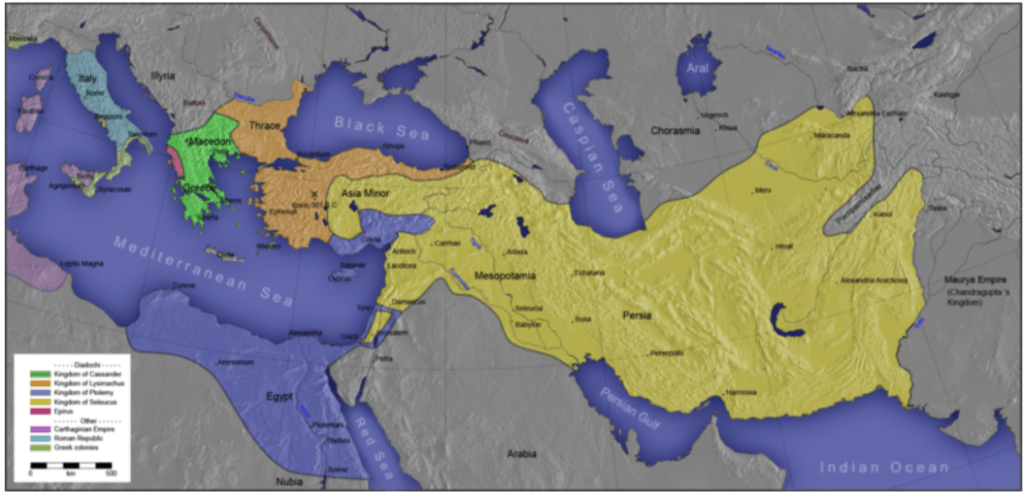
- For 30 years after the death of Alexander III died his former commanders fought amongst themselves to claim their own share of the empire and build on their own. From these emerged three that would hold some stability and run for an extended period of time:
- In Europe:
- The commander Antigonus established his realm, which empire would be known as the Antigonids.
- Athens, amongst the other city-states had initially tried to become separated from the Macedonian Empire, but had been successfully beaten. Athens still was considered a culturally important for the Greek speakers, however, times of flourishing were over.
- Thus, a new form of philosophy emerged during this time, which was designed to teach people how to make the most of their lives in the situations in which they found themselves: (–>both agreeing that the key to happiness and fulfilment lies in psychological attitude on the part of the individual)
- Epicureans – Epicurus taught that the secret was to make the best of life’s good things.
- Stoics – Zeno, on the contrary, would tell the audience how to minimise the worst.
- It was to be Stoicism which would ultimately be highly influential for the next eight centuries.
- In Asia:
- An empire that arose in the India subcontinent was known as the Mauryans. It would run for a time, but then in turn crumble and individual cities once again would be run by new petty kingdoms in the areas known today as Pakistan.
- In the Mesopotamian region the old kingdoms of Susa, Babylon and Uruk would emerge to run as separate kingdoms once again. However, they were all run under one successor, Seleucid I, who was crowned ruler in 305 BCE. The territory he ruled over was from Mesopotamia, westwards all the way to the Mediterranean, northwards to Anatolia and northwest to the coast to reach the Aegean coast.
- The language of the former Persian administration (Aramaic) was used alongside Greek for official purposes.
- An innovation that can be attributed to the Seleucids was the way in which timekeeping was changed. At the time, time was measured with the number of years a king ruled. When a king ruled for 10 years and then passed away they would start again, measuring time by the number of years all kings ruled. However, when King Seleucid I died, they didn’t start counting from zero, they instead continued counting from then. Thus, from taking over the Asian territories (in 312 BCE) the time would be counted for the next dynasties.
- In Africa:
- In Egypt general Ptolemy took the title of ruler in 305 BCE.
- Alexandria had grown significantly in size and its purpose was to become a haven for merchants as well as scholars from all over the Hellenistic worlds. Two famous landmarks were built to achieve these purposes: a lighthouse to guide the ships and a big library, where records were collected from every trader and scholar that came to the city and where all was recorded in Greek.
- Due to some stories and poems having variations in them, the scholars here collected all kinds of variations that were out there and they constructed the most accurate versions as they believed the story to have been told in its infancy.
- In Europe:
- For 30 years after the death of Alexander III died his former commanders fought amongst themselves to claim their own share of the empire and build on their own. From these emerged three that would hold some stability and run for an extended period of time:
-
- During this time, the Greek peninsula marked the western limit of the three Hellenistic kingdom that had come into existence after the death of Alexander’s conquests. Recalling from earlier chapters, Greek of the previous centuries had left the peninsula in search for better opportunities in both the east and the west. Thus, Greek settlements were also to be found on other lands on the western banks of the Mediterranean.
- One area of interest is the island of Sicily and the lower half of the Italian peninsula.
- Sicily
- During the Persian Wars (490 BCE and 480 BCE) it was unable to answer the call of the Greeks to support them in their battle. They were involved in fighting off their own enemy, the Carthaginians. During earlier centuries, the Carthaginians started off on the Near Eastern banks, Phoenicia, and then spread all over the Mediterranean. Carthage became their new kingdom/stronghold. From here they would spread their influence over North Africa and other European coastal regions.
- A battle with the Carthaginians led to a stalemate when the western lands were controlled by the Carthaginians and the east by the Greeks.
- Two influential people would be born from the main city Syracuse: poet Theocritus and inventor/scientist Archimedes.
- Italy
- The Roman would be the next power in this region of the world to become a significant power to be reckoned with.
- Historians wrote that Roman citizens finally expelled its last king in 509 BCE, whereafter the city was run as a republic. It was run thereafter by the Senate and the people (i.e. S.P.Q.R – Senatus Populusque Que Romanus).
- The city was run as a militaristic state and they strove for winning honours in battles.
- Rome first started its expansion on the Italian peninsula to absorb its neighbours, the Latiums, the Etruscans in the north and then finally the Samnites (Greek settlers) in the south (latter called the Samnite Wars). After that, its plans of expansion would reach the island of Sicily, where it collided with the other power Carthage.
- The wars fought between Rome and Carthage would be known as the Punic Wars and were fought between 264 BCE-241 BCE (with Rome claiming Sicily) and 218 BCE-202 BCE.
- The latter was the tougher one and found a formidable opponent in Hannibal from Carthage. He marched with his forces from Carthage westwards, sailed across to Spain, marched northwards along the French coast and over the Alpine passes so he could attack Rome at its rear. The Romans’ general Scipio Africanus attacked the Carthaginian capital, which resulted in Hannibal being recalled and the battle at home would end in their defeat (known as the battle of Zama).
- The Greeks of southern Italy and Sicily were made an alliance with Hannibal, because they were tempted by his offer of liberty in the event of success. Since Hannibal was defeated, they would share the same fate.
- Hannibal also made an alliance with the Antigonid king of Macedonia. The plan was to cut them off from trade and attack them from both sides. However, when the Carthaginians were dealt with the Romans marched into the Balkan lands to deal with this new enemy.
- King Philip V was decisively defeated in 197 BCE.
- The Senate now stood faced a historic decision. Take over the lands or walk away and let them deal with their own affairs. The Romans, after defeating the Macedonian king, decided to leave the Greeks to settle their own affairs.
- Sicily
- Five years after their departure (192 BCE) the Romans were back in the Balkans. The Seleucid king (Antiochus III – the Great) had seen an opportunity to expand his kingdom into the weakened Antigonid kingdom, and therefore crossed the Hellespond (from Asia to Europe).
- The Senate identified this threat as one that might expand even further and therefore engaged in a series of battles (under Scipio Africanus) and effectively pushed the Seleucids back to the Anatolian lands with an effective defeat in 188 BCE.
- The Antigonid kingdom had its final king in Perseus. He had ambitions to rebuild the Antigonid kingdom to a stronger force, similar to the one from his ancestor. Thus, he mustered a large force in 171 BCE and engaged in a series of battles with the Romans. The final battle was fought in 168 BCE and resulted in his defeat (battle of Pydna).
- The kingdom would be split into four subject states, all answerable to the Senate of Rome. To ensure good behaviour by prominent citizens who ruled the states, hostages were sent back to Rome.
- One such hostage was Polybius who would be housed with prominent general and serve as teacher of Greek and history to his son.
- After the Pydna War, a series of battles (known as the Syrian Wars) were fought between the Macedonian kings of Asia and Egypt. These ended with the defeat of Ptolemy VI at the hands of Antiochus IV. This would have resulted in the Egyptian kingdom (one of the three great kingdoms after Alexander’s death) to become part of the Seleucid kingdom.
- This would have resulted in their former enemy in becoming even more powerful (thus a stronger enemy in the future), which is what could not be afforded by the Senate. Therefore, a small Roman garrison was shipped to Alexandria, under the leadership of Caius Popilius Laenas, with a letter to be handed over to the Seleucid king, which instructed the king to give up the war and go home (modern phrase ->drawing a line in the sand)
- The Seleucid king complied and returned home. The Egyptian kingdom would from that moment on be under the protection of the Roman Republic.
- Once again trouble was boiling on the Greek peninsula. Some Greek city-states on the Peloponnese wanted to reclaim their independence and therefore formed an alliance (Achaean League). This was not the only trouble the Romans would be facing at the time.
- 149 BCE Rome engaged became engaged in its Third Punic War against the Carthaginians and sacked the city in 146 BCE.
- 146 BCE Rome also engaged in a final battle against the Achaean League outside of Corinth. The city was also razed to the ground, people killed or enslaved and prized artful and other possessions taken back to Rome.
- The Greeks hadn’t been aware of their Roman neighbours before, but the Romans had been aware of their Greek neighbours. Now that they had taken over large parts of former Greek territories they learned more and more of their culture and adopted some of its elements into their own.
- Elites became educated in the language
- Greek ideas (incl. philosophy) was adopted by intellectuals
- etc.
- On the eastern flanks the former Seleucid kingdom of Asia was breaking down into smaller kingdoms.
- Beyond the Tigris river a nomadic people (the Parthians) claimed the lands from the weakening empire. They would become a rival kingdom first to the Seleucids and later the Romans
- In Anatolia:
- North-east, the city of Pergamum became the capital of the Attalids, Macedonian and Greek speaking people
- East along the Black Sea, Bithynia region was now ruled by the Thracians
- Pontus region, would become ruled by a Persian family called Mithridates
- Inland and further south another Persian family ruled over Cappadocia region
- All these kingdoms (with the exception of the Attalids) were non-Greek speaking, yet the rulers learned and applied the Greek ways.
- Only in the Near East one people resisted the application of the Greek ways, the Jews.
- However, some elements of Greek ways were adopted. The rulers adopted Greek and Jewish names. Their coins were inscribed in three languages: Aramaic, Greek and Hebrew. For the next three hundred years the history of the Jews would now also be recorded and written in Greek.
- From the time when the Carthaginians and Achaean League were defeated in 146 BCE the former Hellenistic empires would steadily collapse, whilst the Roman Republic would expand its borders, but would also suffer more and more internal conflicts within its borders that would eventually lead to changing the Roman Republic from a republic to a Roman Empire.
- 91 BCE the whole Italian peninsula was subject to laws made in Rome, but only Roman citizens were eligible to vote. This lead to the break-out of the First Social War between Rome and its Italian allies (i.e. the remaining Italian peninsula states). This lead to the Senate passing the decision in 88 BCE to grant citizenship to those allies, together with some of the rights that a Roman citizen held.
- A greater concern for Greek states under Roman rule were the events that transcribed in the northern Anatolian region. King Mithradates VI ancestor had initially conquered the Pontus region from the Seleucids. He himself wanted to continue the legacy of his fathers and expanded the kingdom to include a multitude of Greek and other settlements around the Black Sea, and then went on to dominate the entire Anatolian subcontinent.
- The king sent messages to the individual settlements that ordered his troops to massacre all Romans and of Latin descent in that settlement
- This was of concern to Greeks since, on the one hand some believed in the possibility of attaining their individual freedoms once again and become an autonomous state. Others believed that they should not take the risk as some of their forefathers had sided wrongly and were severely punished. One city that switched sides was Athens, which was then laid to siege by Roman general Sulla until 86 BCE.
- By 66 BCE it was the Romans success to finally defeat Mithridates.
- Meanwhile, island powers were starting to take power and law into their own hands since the power vacuum in the Aegean was on edge.
- It would take until 60s BCE for Rome to regain the upper hand of the Greek-speaking east.
- Gnaeus Pompeius Magnus (i.e. Pompey the Great) was sent by the Senate in 67 BCE to establish order on the islands, and destroy the pirate bases.
- He also successfully went up to roll up what was left of the remaining Seleucid kingdoms of Asia in 63 BCE.
- Rome now controlled the southern Balkans up to the river Danube, the whole of Anatolia and the Aegean. In the east it had become embattled with the Parthians. In the west had spread to take in Spain (Iberia), Gaul (France, Switzerland, parts of Germany up to the west of the Rhine).
- The conquest of Gaul and the southern Britain had been done by Pompey’s rival Gaius Julius Ceasar.
- Civil war broke out in 49 BCE. 48 BCE Ceasar routed his army in Thessaly against Pompey, it was to Alexandria that he fled since he had maintained good relations with the patron king during his conquests in the east. The power struggle in Egypt was between Cleopatra VII and her brother Ptolemy XIII. Pompey was killed upon his arrival. When Ceasar arrived he backed Cleopatra as the favoured ruler and bore a child with her, called Ceasarian. Her brother had vanished.
- Ceasar claimed the title of dictator when he had returned to Rome, but was then killed by the Senators, leading the kill was nephew Brutus in 44 BCE.
- The civil war in the city was not yet settled as it took two years before the armies of Brutus and Cassius were defeated by Mark Anthony together with distant relative of Ceasar, Gaius Octavius.
- 32 BCE a new power struggle broke out between these two. Mark Anthony made common cause with Cleopatra VII (ruling Egypt with her son Ptolemy XV (i.e. Ceasarian), who hoped to improve relations with Rome by backing one candidate in 31 BCE.
- The decisive battle was fought at sea, close to the Greek island Actium. Octavius’ side won the battle, which led to Mark Anthony fleeing back to Alexandria where he and Cleopatra committed suicide in 30 BCE.
- ==> see Series “Rome”
- Egypt became a Roman province.
- Most of Greece also became a Roman province in 27 BCE.
- Finally, Octavian became the sole ruler of this vast empire and took on a new name and he was henceforth known as Augustus (i.e. Revered One).
- 27 BCE-337 CE – Rome’s Greek Empire
- The Roman Republic had become a Roman Empire, no longer ruled by the Senate and the people but by its own emperor, not king. The name had been deliberately chosen since the founding of the Republic and expulsion of the last king in 509 BCE they never wanted to have a king to rule over them again, but the responsibilities would have been roughly the same.
- The rule of the Roman empire can be broken down into different dynasties:
- Principate (27 BCE – 285 BCE)
- Julio-Claudian dynasty (27 BCE – 68 AD)
- Augustus (27 BC – 14 AD)
- Tiberius (14 AD – 37 AD)
- Caligula (37 AD – 41 AD)
- Claudius (41 AD – 54 AD)
- Nero (54 AD – 68 AD)
- Year of the Four Emperors (68 AD – 69 AD)
- Galba (68 AD – 69 AD)
- Otho (69 AD – 69 AD)
- Vitelius (69 AD – 69 AD)
- Flavian dynasty (69 AD – 96 AD)
- Vespasian (69 AD – 79 AD)
- Titus (79 AD – 81 AD)
- Domitian (81 AD – 96 AD)
- Nerva-Antonine dynasty (96 AD – 192 AD)
- Nerva (96 AD – 98 AD)
- Trajan (98 AD – 117 AD)
- Hadrian (117 AD – 138 AD)
- Antoninus Pius (138 AD – 161 AD)
- Marcus Aurelius (161 AD – 180 AD)
- Lucius Verus (161 AD – 169 AD)
- Commodus (176 AD – 192 AD)
- ==> see Movie “Gladiator” & “The Fall of the Roman Empire”
- Year if the Five Emperors (193 AD)
- Pertinax (193 AD)
- Didius Julianus (193 AD)
- Severan dynasty (193 AD – 235 AD)
- Septimus Severus (193 AD – 211 AD)
- Caracalla (198 AD – 217 AD)
- Geta (209 AD – 211 AD)
- Macrinus (217 AD – 218 AD)
- Diadumenian (218 AD)
- Elagabalus (218 AD – 222 AD)
- Severus Alexander (223 AD – 235 AD)
- Crisis of the Third Century (235 AD – 284 AD)
- Julio-Claudian dynasty (27 BCE – 68 AD)
- Dominate (285 AD – 602 AD)
- Tetrarchy dynasty (284 AD – 324 AD)
- Diocletian (284 AD – 305 AD) broke the rule up into four
- Constantine was one of those rulers who would unite the four components and eventually split it between the West and the East.
- Constantine dynasty (306 AD – 363 AD)
- Valentinianic dynasty (364 AD – 392 AD)
- Theodosian dynasty (379 AD – 457 AD)
- Puppet emperors (west, 455 AD – 476 AD)
- Leonid dynasty (east, 457 AD – 518 AD)
- Justinian dynasty (east, 518 AD – 602 AD)
- Tetrarchy dynasty (284 AD – 324 AD)
- Later eastern emperors (610 AD – 1453 AD)
- Principate (27 BCE – 285 BCE)
- By the time Augustus died around 14 AD, the Roman Empire stretched from the Atlantic coasts of Portugal, Spain and France in the west, to the Euphrates in the east and Aswan in the southern Egypt, including all islands in the Aegean. Small kingdoms that had broken away from the Seleucid empire on the eastern borders would be consolidated in the years to come.
- The empire would grow and contract due to conflicts with its neighbours, but it would reach its largest extent during the reign of Trajan (98 AD – 117 AD) and Hadrian (117 AD – 138 AD).
- Everywhere, the language of imperial administration and the highest courts of law, was Latin. But throughout the eastern provinces, Greek had been continued to be spoken or had been adopted as the normal medium for business, education and local administration.
- Roman rule over conquered cities was light, an absolute minimum of bureaucracy as possible. Thus, the Romans relied on the local elites of the cities and regions to do the business of ruling for them. These would do so because the Roman rule protected their interests and guaranteed their status in the community.
- Thus, increasingly wealth was becoming concentrated in fewer and fewer hands.
- During the first two centuries where the Greeks were under the control of their Roman overlords they enjoyed prolonged periods of peace, which brought about for their intellectuals and culturals to document more works onto records.
- One such writer was Plutarch.
- NB! – Far more of what they wrote during this period has survived us. Much of what we know about earlier centuries came to us through the perceptions of the Greeks who lived and wrote during this time.
- All this came at a price -> the Greeks no longer held their destinies in their own hands. City-states didn’t enjoy the liberty and autonomy their forefathers had.
- A couple of generations after Augustus had passed away, the Greek intellectuals in the east devised a curriculum that included knowledge of the ancient Greek history and culture. Students learned to write elaborate speeches in the manner of Isocrates (380 BCE) and Demosthenes (340 BCE), both from the age of Athenian democracy. These graduates became known as sophists and would tour the provinces and give performances to audiences. This had the effect on the elite (of Greek city-states) of wanting to imitate their predecessors.
- The elite of the Roman empire also attained a fascination of the Greek culture, history and language. Emperors would hire architects to build buildings emulating Greek architecture. Some of the building was even done at old Greek city-states as a tribute to their history, strongest contributor was done by Hadrian (117 AD – 138 AD).
- The view of Isocrates (… that it was not birth that made a man Hellene, but his participation in a type of education…) was now enjoying a vigorous revival.
- During Marcus Aurelius’ reign (161 AD – 180 AD) he had hosted most of the first of many upcoming defensive wars that would be fought around its borders. What attracted Aurelius most was Greek philosophy, in particular the ideas of Stoicism (from 322 BCE developed by Zeno (of Athens) in the 30 years aftermath of Alexander’s empire broke up into roughly three stable Empires: Antogonids, Seleucids and Ptolemy). These ideas had become widely adopted by the Roman elites, which made him decide to keep a private diary on his thoughts of some of these ideas.
- The newer philosophies of the Stoics and Epicureans had encouraged their adherents to think about the meaning and purpose of their own lives.
- For majority, philosophy would take one only so far.
- One could make every effort to reduce/remove the things in your life that caused unhappiness. But what if you still held fear in the meantime? This is where a new element came into play amongst the people. Something that would bring people to come at ease with their fears: Faith.
- Faith not only meant one believed, but also that one placed their complete trust in a divine force that could do something for one.
- Thus, alongside the official religion and public ceremonies, people began entrusting their welfare to new deities and cults devoted to them.
- Now, cults were proliferating.
- One of these groups that made a significant appearance would change the history of the Roman Empire forever since they had chosen to adopt one means of communicating their message of salvation to its public in Greek written form (because it was the language that was most widely used in the eastern empire). This was the group who would publish Jesus’ message as ‘The Good News’/ ‘Gospel’ (i.e. Evangelical).
- Twenty years after his death in 30 AD, his followers began to disseminate the message that he had taught.
- A Jewish preacher would then embark on a mission to spread the new beliefs beyond the geographical heartland.
- It was believed that at the time when Jesus had been alive, the language used at the time by the people was Aramaic (the language of the former Persian lords). Thus, in order to spread the message to different peoples the message had to be taught in a language that others would be able to understand. Thus, the message was written and recorded in Greek
- ‘Jesus had died’, the apostle reminds his readers, ‘for our sins, that he might deliver us from this present evil world’.
- –> In this message people at the time would find comfort when they were confronted with the new philosophical thought reintroduced at the time by the Romans.
- By 64 AD (Nero’s reign 54 AD – 68 AD) the Good News had spread all the way to the empire’s capital, Rome.
- During that year a fire broke out in the city, which lasted for nine days.
- To the people it must have felt that the prophecies from the Good News were being fulfilled. For this reason it may also be what inspired emperor Nero to lay blame for the catastrophe on the small Christian sect.
- In the years since Jesus’ death the different disciples would write their different narratives of the message. All of these, together with the letters would make up the New Testament.
- During the second century AD, Christianity attracted very little attention among the elites of the eastern empire.
- For the first two and a half centuries of its existence, the faith spread largely below the radar of the Roman authorities of the empire.
- Individual Christians would be imprisoned, tortured, and if they refused to recant, executed. for the public suffering inflicted.
- In the official eyes, Christianity was a mere superstition.
- From the second AD to the third AD in the east, there were more signs of convergence than confrontation between Christianity and the mainstream. Both Christians and non-Christians alike started to question ritual killings in the open in order to make peace with the higher power.
- When Christian writers came to compose letters, sermons and treatises where they set out their beliefs and argued over the interpretation of the Gospel they also brought their profound knowledge of earlier Greek philosophy (especially Plato – after death of Socrates in 399 BCE, but before Aristotle in 356 BCE) so that it became grafted onto the Christian tradition.
- After Commodus’ (176 AD – 192 AD) death, civil war and empire-wide chaos lasted, on-and-off, for almost a century.
- Emperors came and went, raised by the power of the legions they commanded, and oftentimes assassinated by the same. The legions became ever more important because the empire saw itself fighting on all borders in defensive wars.
- In 224 AD a new Persian dynasty, the Sassanids, came to power. Within a few decades they had taken over the Parthian kingdom, and had reconquered much of the territories which had been held by the Persian Empire and thereafter Alexander’s Macedonian Empire.
- In 260 AD emperor Valerian was even taken hostage at some point on a campaign against them.
- On the Balkan front a roving band of Goths crossed the Danube and laid siege to Thessalonica, and then went on to ravage the coast of Anatolia as far south as the river Ephesus.
- Another people, the Herouloi, from the area of the Crimea, sailed from the Black Sea into the Aegean and caused devastation to Athens and other parts of the Greek mainland.
- In addition, the empire was running out of money. Thus, in order to continue making payments to legionnaires, the empire decided to debase its currency (i.e. By reducing the amount of precious metal contained in its coins and mixing it with an additional cheap metal. This way, the coin had a slightly altered appearance, but the empire was able to create more and more coins in order to make payments).
- To make things worse, over the years, the debasement continued, which brought the monetary system to the point of collapse.
- As the Roman empire continued to suffer, different emperors tried different measures to turn matters around:
- 212 AD emperor Caracalla decreed that all subjects of the empire, excl. slaves, would be Roman citizens, in the hopes of raising the tax base.
- the profound impact this would have was that almost anyone who spoke Greek anywhere in the world was now entitled to be called a Roman Citizen. Greek Speakers would no longer think of themselves as ‘Hellenes’, but rather as ‘Romans’, as majority would do until the nineteenth century.
- Other emperors would try other extreme remedies, by turning the corporate mindset back to traditional religion. Thus began the first systematic persecution of the Christians, as well as others who fell foul with the Roman authorities.
- The first attempt was made by emperor Decius in 249 AD.
- After he died in 251 AD the persecutions eased.
- The new emperor Valerian was concentrated to confront the Persian Sassanids, and therefore decreed that all subjects should make animal sacrifices. In 258 AD he even went so far to have the Christian leaders executed.
- However, when he was subsequently defeated and died, the persecutions went into reprieve.
- 212 AD emperor Caracalla decreed that all subjects of the empire, excl. slaves, would be Roman citizens, in the hopes of raising the tax base.
- The crisis experienced in the Roman Empire only came to an end when emperor Diocletian (284 AD – 305 AD) instituted a series of military campaigns and economic reforms.
- It was during the his reforms as well as the close followers after him that the Christian faith would obtain great significance in the Roman Empire:
- One of Diocletian’s reforms was to split the Roman empire four ways, ruled by two senior and two junior emperors simultaneously, which became known as the tetrarchy (284 AD – 324 AD).
- The tetrarchy didn’t last. It was the son of one of the previous tetrarchs (Constantine) became co-emperor in 306 AD.
- In 313 AD the tetrarchy was reduced to a rule of two, Constantine and Licinius, who issued a joint proclamation that officially ended the persecution of Christians.
- One night, Constantine had had a dream, which would lead him to declare having found a new divine patron. What made this difficult was that his co-emperor Licinius in the east began a new persecution of the Christians. Thus, Constantine engaged in a series of battles, which would end with the final battle being fought in 324 AD on the Asian shore of the Bosphorus.
- Constantine had won, restoring the rule of the empire to one ruler, and stopping the persecution of Christians in the whole empire once again.
- When he was on his deathbed in 337 AD he had become the first Roman emperor to receive the Christian rite of baptism.
- However, Christianity was not yet the official religion of the Roman Empire. Thus, after having defeated Licinius in 324 Ad he had convened with Christian bishops to decide between the rival interpretations of the faith that was in circulation at the time. The intention of this was to quash dissent and form the official faith, which was known as the one from the Nicene Creed.
- Another decision that had been made by Constantine, was to found new cities and name them after Greek names. One city of historical importance was the one he founded on the site of battle he had fought against Licinius in 324 AD. On the opposite side of the battle (i.e. on the European side) there was a ruined Greek city, called Byzantium. This is where he decided to build his new capital for the eastern provinces. The city was refounded in 330 BCE and renamed Constantinople.
- 337 CE-630 CE – Becoming Christian
- The emperors were from the following dynasties:
- Dominate (285 AD – 602 AD)
- Tetrarchy dynasty (284 AD – 324 AD)
- Constantine dynasty (306 AD – 363 AD)
- Valentinianic dynasty (364 AD – 392 AD)
- Theodosian dynasty (379 AD – 457 AD)
- Puppet emperors (west, 455 AD – 476 AD)
- Leonid dynasty (east, 457 AD – 518 AD)
- Justinian dynasty (east, 518 AD – 602 AD)
- Later eastern emperors (610 AD – 1453 AD)
- Dominate (285 AD – 602 AD)
- When Constantine passed away in 337 AD most of his subjects were still pagans. Thus, Constantine and his three successor sons moved cautiously to impose Christianity on the empire.
- People were nudged towards the new religion by the exercise of high-level patronage (i.e. cash donations from emperors, generous tax breaks to Christian individuals and institutions, state funding to build churches, etc.)
- Even more important would be those religious pioneers who would embody to other subjects the purest expression of the Christian life.
- These individuals subjected themselves to ferocious conditions and privations, deliberately tormenting their bodies so as to perfect the soul within and prepare it for a better life after death
- During 361 AD the last surviving son Constantius II passed away, whereafter his cousin Julian proclaimed himself the new co-emperor. His objective was not just to suppress the new religion that had been introduced, but also to go back to the old traditional worship practices.
- However, in 363 AD, during an expedition against the Sassanid Persian, he passed away.
- The fights on the eastern fronts would drag on for another three centuries. Meanwhile, one the western front, the Roman empire was also forced into the defensive.
- Germanic tribes were crossing the Rhine into the former Gaul.
- In the Balkans, others were crossing the Danube and settling in Roman territory.
- 378 AD the Goths defeated the Roman legion outside Adrianople (Edirne), but didn’t continue to expand
- As the fourth century came to a close, it became ever more evident that the foundations of the empire could not be held together by the emperors.
- Therefore, the empire was formally divided when Theodosius I split the empire between his sons in 395 AD.
- Following this, the following events transpired in the subsequent periods in the two separate empires:
- West
- Not long after, the western front would begin to disintegrate.
- Rome was sacked by a Gothic army in 410 AD.
- It was then later sacked again in 455 AD by another Germanic invader, the Vandals.
- The western Roman empire would hold out until finally in 476 AD the last Roman emperor was deposed by a German.
- The western Roman empire was broken up into multiple smaller petty kingdoms.
- East
- Constantinople was on its own. its borders stretched from the Danube river in the north to the Nile of Aswan in the south, from the Balkan shoreline in the west to the Euphrates in the east.
- Under Theodosius II (408 AD – 450 AD) the city was able to accumulate large amounts of resources which were utilized to upgrade the fortifications of the city.
- The eastern empire was run in the Greek language and held the name ‘Greek Roman empire’. It was also on its way of becoming a Christian empire. The intellects of the day were trying to keep peace and guide the passions of the faithful.
- But there remained a sizeable portion of the population that were pagans who remained unconverted or actively resisted conversion.
- Under Theodosius I there was legislative ban on performing pagan practices.
- Under Theodosius II pagans were banned from serving in the highest ranks of the civil service and judiciary.
- There was never a policy of persecution of the pagan people, but there was little to prevent outbreaks of spontaneous violence against these individuals.
- In 415 AD mayhem ensued as a Christian mob targeted Christians in Alexandria, one of which most prominent figures was Hypatia
- ==> see Movie ‘Agora’
- In Greek culture the people generally enjoyed the Olympics, theatrical performances, etc. Now, with the Christian majority deeming these plays as inappropriate, the theatrical tradition came to an end. Play texts were read and studied for education, but never performed to an audience.
- The life of the people in the eastern empire changed in other ways too:
- Secular powers had been granted to the highest local authorities of the church, the bishops (i.e. overseer).
- Charity had become a civic duty
- The bishops preached the worth of every human being and preached the possibility of eternal salvation of the soul.
- Worship was moved into enclosed spaces, not as a public event, but as something between the individual and the divine power themselves.
- One thing that didn’t change was the crowds heading to the Hippodrome stadiums and view their favorite chariot riders face off against each other
- see Movie “Ben Hur”
- The Hippodrome would become more than a place where people gathered to watch chariot races. When emperor Anastasius died in 518 AD, he hadn’t borne an heir to take over as successor. The power no longer lay with the Senate to appoint the new leader (as had been the case in the Roman Republic) and the Emperor hadn’t named his new heir. One commander of the palace guard, Justin, took his chance and wooed the crowd in the stadium, and was hailed as the new emperor.
- When Justin passed away in 527 AD he had proclaimed his successor to be his adopted son, Justinian.
- He would be best remembered by having commissioned in 528 AD that all the Roman Laws should be codified so they were all clear and available in one place
- Legal systems today that were based on the Roman Law found their roots in the works of this codification
- Athens no longer was the learning centre. At Alexandria, the teaching of philosophy would continue for centuries more, but by Christian teachers.
- The power of the people in the Hippodrome was a force to be reckoned with since Justinian was almost deposed in 532 AD by the crowd. He had been saved by his empress wife Theodora and general Belisarius.
- To win favour with the crowds once more he had to win a war so he proved a capable leader.
- A current campaign going in the east against the Persians wasn’t going well. However, an opportunity presented itself in the west in 533 AD.
- Thus, he made peace with the Persians and sent Belisarius with a fleet of warships to North Africa. Former provinces were run by the Germanic invaders (the Vandals from 455 AD). Within one year of starting the campaign in Carthage the whole North African coast once again belonged to the Roman empire.
- In 535 AD the second expedition lead them to claim Sicily from the Ostrogoths, who controlled the Italian peninsula and parts of the Balkans.
- 536 AD a third campaign was made for the mid- to upper Italian peninsula. Rome was reclaimed and the Ostrogoths retreated with their remaining forces to their capital city, Ravenna, in the north.
- 540 AD Belisarius finally took the city after it had been under siege for three years.
- For all these victories Justinian decided to initiate a building programme, which resulted in the rebuilding of the Hagia Sophia Church in 537 AD, standing in Constantinople.
- All seemed to be good and well, however, climatic events would force new challengers to emerge from the eastern fronts.
- Volcanic eruptions in the East Asia resulted in ash and debris hurling into the upper atmosphere, which caused disruptions to the climate over large stretches of the world.
- Nomad horsemen from central Asia, who depended on the grassland ecology (called the Huns) had their lives disrupted by these events, and therefore decided (in 539 AD) to cross the Danube river. They crossed and devastated the Balkan lands all the way to the Greek mainland.
- ==> see Movie “Atilla the Hun”
- Farther east, the new king of Persia, Khusro I, aimed to strike westward to the Mediterranean. He set off on this campaign in 540 AD and sacked Greek cities on his way. Belisarius, who had just managed to claim victory after a prolonged siege over the Ostrogoths had been recalled to confront this new threat.
- The climatic events also possibly caused another catastrophe. Rodents near the Red Sea populations carried with them fleas into the cities. These rodents likely also traveled on those ships that carried foodstuffs to the city of Constantinople, as well as many other European cities in the west.
- Bubonic cases were registered in 541 AD.
- Estimated to have killed 20-25% of the populations.
- Known in history as the Justinian plague.
- 545 AD the Persians struck peace as they were also struck hard by this invasive illness.
- Over the next decade Justinian would go on to conquer the rest of the Italian peninsula, the islands, as well as a slice of the southern coast of Spain, held by the Visigoths.
- Justinian died in 565 AD, having successfully expanded the empire once again, as well as rebuilding trade routes that had been cut off.
- By 591 AD, further stretches of land were lost in the Balkans, however, lands that had been lost to the Persians half a century before had been slowly reclaimed by the conclusion of yet another peace treaty.
- The treaty was made possible by new emperor Maurice.
- His next objective lay in recapturing territories of the Balkans that had been lost. During the 602 AD campaign, much of the terrain had been successfully reclaimed. However, when winter came and Maurice wished to continue, the legionnaires mutinied under their leader Phocas, who led them instead back to Constantinople.
- The reign of Maurice came to an end when the emperor was deposed and showcased to the Hippodrome. With the deposition also ended the peace treaty he had concluded with the Persians, currently lead by Khusro II.
- Phocas wouldn’t obtain the full support of his subjects and therefore it came about that some civil unrest ensued in the coming years.
- It was in 610 AD when Heraclius was crowned as the new emperor and Phocas was displayed to the crowd in the Hippodrome.
- The reign of the new emperor would not be a smooth start as the cities in the near east were either sacked, or surrendered by the Persians. The situation in the Balkans was not any better since they were overrun by groups of Slavs, Avars and Bulgars. Only Thessalonica held out.
- Faced with these conflicts, the decision was taken to withdraw all forces stationed in the west and station them in the east only. However, this was not enough as the Persians sent an expeditionary force out in 615 AD to camp on the Asian shore of the Bosphorus, opposite end of Constantinople.
- The next decade the fortunes of war went to and fro between the Persians and the Romans.
- The Persians coordinated their efforts with the Slavs and the Avars on 626 AD, which siege would last only ten days. Both attackers had stretched their supply lines thin, set fire to their siege engines and retreated.
- The Romans attributed their victory to the Virgin Mary because a statue of her had been paraded around the city during the siege, and therefore must have been the reason for their success.
- This victory had brought the people together like never before in the identity as Christians. A new kind of warfare was developing in the background, a ‘holy war’, one that was fought not for power, but for the faith.
- Previously, wars had been fought to avenge the damage and destruction to the citizens and their buildings.
- Darius I wanted to attack Athens because they had assisted the Ionian States during their rebellion in 499 – 494 BCE.
- Xerxes wanted to continue his father’s legacy and successfully razed Athens to the ground in 480 BCE.
- Alexander III (during his conquests from 334 BEC – 323 BCE) successfully overtook the Persian empire. He then set fire to the Persian capital, Persepolis, to avenge their burning of Athens.
- However, when the Persians were attacking Heraclius, they weren’t attacking him, they were attacking Christian, they were enemies of God himself.
- 628 AD Heraclius entered Persia from the north and defeated the Sassanid Empire. The lands up to the Tigris river were now under the control of the Romans once again.
- When the Persians had come to take Jerusalem in 614 AD they had taken the trophy of the ‘True Cross’ back with them. Heraclius would return the cross to Jerusalem.
- Before he set out, he implemented a change to his title of the empire. The title of emperor was given up in favour of the title of king. The Roman Empire was now defined as a Christian kingdom by faith, and of Greek language.
- Previously, wars had been fought to avenge the damage and destruction to the citizens and their buildings.
- West
- The emperors were from the following dynasties:
- 630 CE-1018 CE – The Eyes of the Universe
- 632 AD the prophet Muhammad died. For the past decade he had been uniting the tribes of Arabia in the name of the new monotheistic religion: Islam.
- 635 AD, his successor Caliph Omar swept through the southern lands (of Syria) to conquer them under the new religion. Damascus was the first to fall. The following year an army was sent from Constantinople to deal with the invaders, but were unsuccessful.
- 638 AD Jerusalem had a new master.
- The old powers (Romans and Persians) had fought so much and so long they and were both weakened, which gave the opportunity to the new Arab power to claim so of their lands.
- 641 AD Heraclius passed away.
- By the next decade the whole of the Persian ruled-kingdom had submitted to the new Muslim Caliphate, together with the former Roman provinces on the North African coast.
- The Arabic language would eventually take the place of Greek in all the conquered Roman provinces in the south.
- In the Balkans the lands had been under occupation by the Slavs and the Slavonic language was becoming the predominant language used in the former Roman territories.
- In 680 AD a new group of Turkic-speaking Bulgars established their own state on Constantinople’s northern doorstep.
- In most of mainland Greece urban life disappeared.
- ==> considered Greece’s second dark age
- What emerged from this was that the Greek writers would focus their writing not on plays and poems of entertainment, but on writing devoted to religious topics (i.e. hymns, lives of saints and the Christian doctrine).
- ==> from this emerged a civilization that would be known as the Byzantines since a new Greek civilization was emerging.
- Throughout the second half of the seventh century the Arab caliphs kept up the pressure on the Byzantine Empire.
- 653 AD they once again attempted a siege on the Asian shore of the Bosphorus. This time, the attackers were better equipped because they could move by sea and land.
- However, it was only by an ‘act of God’ that saved them when the attackers’ ships were destroyed in a storm. They retreated.
- 667 AD they were back and laid siege until 669 AD, but the blockade of the sea lasted until 678 AD.
- By 700 AD the Byzantines had been forced back from the Asian territories to only hold on to its European hinterlands.
- It still controlled islands on the Aegean, Sicily and large parts of the Italian peninsula, on which it relied on for its foodstuffs.
- Emperors came and went, raised to the highest office by their fellow commanders, only to be deposed by them again. Civil unrest within occurred on multiple occasions.
- 717 AD another emperor was crowned in the Hagia Sophia, Leo III.
- The third and final Arab siege would commence five months later. The soldiers came by land and sea. An Egyptian force was landed on the European side, while the Arab advanced on the Asian side, completely surrounding the city.
- Leo III made an alliance with the Bulgar king in the north to ensure they would not ally themselves with the Arabs. Further, the Byzantines made good use of their secret weapon: liquid fire, to defend any attacks attempted from the sea.
- 718 AD the attacking force had run into supply troubles. Another Caliph had come into power was well and ordered the retreat from the siege back to his capital, Damascus.
- By the beginning of the eight century the south and the north were identified as rival empires, but by the rival religions.
- North would be marked by Christendom.
- In the west, Latin would continue to be the written language of the western kingdom, whilst in the east, Greek remained so.
- In the west, the bishops of Rome had begun to acquire spiritual authority, whereas in Byzantium the official title of the pope would not be recognized because the political role of the king continued
- Since its failure in 718 AD the Arabs still made raids into central Anatolia. However, in 740 AD the tides began to take a turn for Leo III.
- 726 AD the valcano beneath Thera exploded, similar to an eruption that happened during the late Bronze Age
- 741 AD an earthquake hit Constantinople and damaged large parts of the Anatolian lands, tsunamis swept through the Aegean and in 747 AD another plague outbreak reached the shores.
- Faced with all these problems at once, they leaders turned to experts for answers: the theologians.
- the controversy ‘iconoclasm’ (Greek for breaking images) was instituted
- this was instituted between 754 AD – 787 AD and then again from 815 AD – 843 AD
- throughout this time it was prohibited throughout the empire to produce or display images of Christ, the Virgin Mary, angels or saints in human form.
- to do so was to violate the commandment in the Old Testament against “worshipping idols”
- thus, churches could only be decorated with the symbol of the cross
- one reason brought forward how the theologians came to this approach was by looking how the Muslims were worshipping at the time and, apparently, didn’t suffer any of these natural catastrophes.
- thus, they believed they were doing something right (not displaying images of their Lord, his mother, angels or other figures in their holy places) and the the Christians needed to remove the images
- This policy provoked the first disagreement between the churches of Constantinople and Rome.
- Under Leo III iconoclasm was introduced to the empire. It continued under his son, Constantine V during his rule from 741 AD – 775 AD.
- During the latter’s reign, he managed to win back some territory in the east, as well as in the Balkans. These were all signs that things were looking up for the empire.
- When he passed away, his empress, Irene, took over the role as stewardship for their son Constantine VI.
- She decided to reverse the iconoclasm in an attempt to reconcile relations with the Roman church, but then also decided to take the throne for herself. To stave off any attempts her son made for the throne, she had him blinded.
- She was then ousted from her role in 802 AD, and the new emperor Nikephoros I was crowned.
- Under his leadership the empire managed to regain most of the Greek mainland back under their control. However, his rule was cut short when he was killed in a battle against the Bulgars in 811 AD.
- The new usurper, Leo V, came to power and had to consolidate his grip on the empire and therefore decided to reinstate the iconoclasm, which finally came about from 815 AD.
- He decided to take this route because he had seen what had been achieved by the prior emperor Constantine V when he implemented it with effect.
- By 827 AD, under rule of emperor Theophilos, Crete was lost to the Arab raiders of Spain. They were now eyeing the island of Sicily. The southern half of the Italian peninsula was falling out of their control, as was much of other territories.
- When Theophilos died in 842 AD his empress Theodora held the throne as regent for her son.
- This time a formal celebration was organized to celebrate the decision of ending iconoclasm for good.
- Followers recognized sacred images as a precious channel of communication between the worshipper and the divine, not as an idol being worshipped.
- In the empire successive emperors objective became to consolidate their existing borders rather than to expand them even further. Thus, since the empire had split away from its western counterpart it had learnt another way to deal with rival powers other than the obvious approach of war, via diplomacy.
- From the middle of the ninth century, ambassadors were dispatched in all directions:
- in the east they had dealings with the Chazars
- in the south they had the Arab Caliphate
- in Rome they had the Pope
- in the north-west they had the German king of the Franks, Charlemagne
- in the Balkan regions they made significant success in their diplomatic negotiations, which would eventually lead to them becoming converted Christian Orthodox
- the opposite approach was followed by Charlemagne when he forced the Germanic peoples to choose between conversion or their life
- In Byzantium the emperor Michael III and his heir Basil I things were looking well in comparison to the Caliphate.
- However, Michael III was not someone without his problems and therefore his public image was suffering. By 867 AD Michael III could see that Basil I was looking to grasp the opportunity, which resulted in the murder of Michael III and Basil I taking over control.
- Basil I began changed his rule stance to once again expand the empire. Their first campaigns would lead them to reclaim most of the Italian peninsula that had been lost before , in the 880’s AD. His forces even pushed east into Anatolia.
- Unfortunately he passed away in 886 AD. However, his successors shared his spirit and continued the push outside of their borders.
- Crete was recaptured in 961 AD.
- 965 AD Cyrus had also been reclaimed.
- Since the 930’s AD the forces had reached into Anatolian Syria.
- The cities of Antioch and Aleppo were reclaimed in 969 AD.
- The eastern frontier was pushed back to the old Roman line of the Euphrates river.
- North-east Beyond the Black Sea, Georgia and much of Armenia were enveloped.
- It was to the north that they experienced their greatest push-back from the Rus as well as the Bulgars.
- Though both rulers embraced Orthodox Christianity, both rulers would not accept Byzantine rule
- Its was Basil II (976 AD – 1025 AD) who would make it his mission to conquer the two independent kingdoms of Bulgars and Slavonic people. The campaigns were undertaken on and off but, the decisive battle took place in 1014 AD.
- By 1018 AD the whole of the Balkans, to the south and west of the Danube, had been brought back under the control of the Roman control.
- 1018 CE – 1204 CE – City of the World’s Desire
- Basil II died in 1025 AD, and he left a city that was considered the richest and largest in Europe.
- They controlled the land routes that led to Asia, which helped them accumulate wealth. This status was a magnet to soldiers and merchants from far and wide.
- The city could be considered to have been very cosmopolitan, with multiple languages (Latin, Persian, Georgian, Arabic, Slavonic, Hebrew, and Greek) being spoken in the city.
- Roughly 40 years after Basil II’s death (1060 AD), the city found itself in conflict with multiple enemies around its borders:
- East, the Seljuk Turks
- West, the Normans
- North, the latest nomad groups of Pechenegs and Cumans
- Fortunately by 1068 AD the empire had a military head on the throne in Romanos IV Diogenes.
- A campaign in the east was led during his reign. However, in 1071 AD he was captured by the Seljuk Turks. He was released after being detained for a while.
- Civil unrest ensued almost a decade, whereafter he would die.
- The Seljuk Turks pushed westwards and managed to capture the cities of Smyrna and Nicaea. Now, between 1071 AD and 1090 AD the centre of gravity began to shift.
- The Normans came a long way from their small kingdom in the north of France to become a powerful force in the Mediterranean as well.
- 1071 AD they conquered Sicily from the Arabs
- 1081 AD, led by Robert Guiscard they led a campaign into the Adriatic sea and conquered Epiros
- 1081 AD Alexios Komnenos, an aristocrat, led a coup d` etat to acquire control of the empire for his family.
- The empire didn’t manage to grow significant manpower needed to protect its own borders, which is why they increasingly started to hire mercenaries.
- This would put some pressure on the treasury coffers.
- By the 1090’s AD Alexios’ forces managed to beat back Guiscard and the Normans in the north of Greece, as well as the normadic people that had threatened the Thracian territories.
- It looked as thought by diplomatic means the pressures from the Seljuk Turks could be settled, but due to internal pressures on their side things didn’t work out that way and the Seljuk Turks would continue to hassle the transports that were heading to the west, which would cut deep wounds in the Constantine coffers since it lost trade profits.
- Alexios needed manpower to deal with this threat, but his restricted funds limited his abilities greatly. Therefore, he decided to claim manpower by another means: faith.
- He appealed to the pope of the Roman Church in 1095 AD to raise troops for “the defence of his holy church”
- Around the same time the western kingdoms were having anti-Muslim sentiment already since their Christian pilgrims often were harassed or plundered on their pilgrimage to Jerusalem, the Holy Land.
- Therefore, the call was made in the western lands to ‘liberate’ Jerusalem and the holy places of Christianity.
- The call was answered when noblemen and knights and multitude of soldiers were shipped to Constantinople. Before the campaign would start emperor Alexios extracted from each one an oath of allegiance which entailed that they would attack all the cities he told them to ‘liberate’ as well as that all the lands they conquered to be handed over to him as the rightful ruler.
- Thus, the First Crusade set off in 1097 AD and laid siege to the city of Nicaea, which they managed to take thanks to their superior siege engines. Next, Alexios instructed them to take over Antioch. It was captured after a year of taking in Nicaea.
- However, by now, the relationship between Alexios and the Crusaders was beginning to break apart when one Crusader, Boheman, took the city for himself and didn’t hand it over to Alexios.
- Alexios’ generals made their own campaigns against the Seljuk Turks whilst the Crusaders headed for the city of Jerusalem in 1099 and liberated it from the foreign inhabitants.
- It had become very clear to the Crusaders that Alexios, and the Greeks, were not to be trusted since his objective had never been the liberation of the cities, nor to fight for the defence of Christianity but only to enrich himself and expand his empire.
- After Jerusalem had been taken some Crusders took it upon themselves to establish new Christian states in the Levant region, but didn’t hand them over to the new emperor, John II, Alexios’s son who had taken over in 1118 AD.
- John II made up his mind (in 1143 AD) to take the Christian states by force. Thus, he made his way to their settlements, but before he could continue, he died during his trip over there. The new emperor Manuel I recalled the forces to his capital instead.
- These Christian states may have been safe from the Byzantine state, but not from the Seljuk-Turks. One such city (County of Edessa) fell in 1144 AD. This sparked outrage in the western kingdoms, which then organized to undertake a new campaign to reclaim it.
- This crusade would now be led by King Louis VII of France, and King Conrad III from Germany.
- 1147 AD the Second Crusade was under way, as they passed the city of Constantinople. The nobles were invited into the city before they continued their journey, but their soldiers were to remain encamped outside.
- 1148 AD they came back, having failed to reclaim the County of Edessa.
- It was during the reign of emperor Manuel that the relations between Constantinople and the western kingdoms improved from the devastations of the First Crusade.
- His diplomatic actions would result in the Crusader states in the east to finally acknowledging Byzantine supremacy in 1160 AD.
- 1176 AD the Byzantines suffered a terrifying defeat against the Seljuk-Turks.
- 1180 AD Manuel died.
- It was his wife that took over as regent for their son, however, fighting within the royal family would bring civil unrest for 20 years to come.
- In 1189 AD a Third Crusade was organized by King Frederik Barbarossa of Germany, King Richard (the Lionheart) of England and King Philip II of France in their attempts to reclaim the city of Jerusalem from the infamous Kurdish leader Saladin.
- ==> see Movie “Kingdom of Heaven” which takes place when Saladin claimed victory
- Current emperor of Constantinople was Isaac II Angelos, who didn’t prove to be a competent leader to the Crusader kings as they were hosted by him on their way to the campaign
- By 1200 AD aristocratic families had created their own fiefdoms in distant places from the empire (on Cyprus, Trebizond, city of Philadelphia in western Anatolia and the Peloponnese).
- The Slavs broke away to create their own separate kingdoms of Serbia and Bulgaria.
- At the same time (1198 AD), the pope of Rome in the west was trying to call for arms for a new crusade in order to attempt to reclaim the city of Jerusalem once again, to become known as the Fourth Crusade.
- Ships were provided by the maritime republic of Venice. It was agreed that the crusaders would board at Venice and from there be shipped to Egypt, from where the crusade would commence. However, the Venetian fleet merchants only offered their services against compensation.
- As soon as they set off (1202AD), under leadership of French Boniface of Montferrat, they soon realized they would not be able to compensate the Venetian merchants in full for the planned trip.
- Thus, a solution came about in the deposed prince Alexios III, son of Isaac II Angelos, who promised them to repay them what they needed if they would install him as the rightful heir of Constantinople.
- They arrived in 1203 AD in the city and soon realized that this prince was not well-liked by the populace of his city. There, the ships forced their ships into the straits of the Bosphorus and took control of the shoreline from the unexpecting Byzantine.
- The prince was crowned as the new emperor Alexios IV Angelos. The only thing that was due was for the new emperor to pay his dues. However, the prince hoped to avoid following up his former promises. He wanted to use his sway of diplomatic talks to remove them from the city instead without having to pay. The crusaders lost their patience in 1204 AD.
- The emperor was overthrown in 1204 AD and replaced with the new emperor Alexios V Doukas.
- The new emperor didn’t wish to make the payments his predecessor had promised them and instead issued them with the ultimatum to leave.
- Boniface and the other crusaders made the decision to take the city by force and succeeded.
- The remainder of the empire would now need to become used to being ruled by people who spoke another language from their own.
- 1204 CE-1453 CE – Hopeful Monsters
- After they successfully took over control over the city, they decided the best approach was to split the territories up between the victors.
- The Hagia Sophia and the ecclesiastical jurisdiction went to the Venetians
- A new Latin king (Count Baldwin of Flanders) was installed and ruled from Blacherna palace
- Boniface of Montferrat became king of Thessalonica
- In the coming years the Venetians went on to secure their hold on the islands as well as coastal territories
- Other islands and parts of Constantinople itself became part of Genoa
- On the Greek mainland, former leaders of the Crusade were installed as rulers
- The Peloponnese, later known as ‘Morea’, had been divided up between two French knights: Geoffrey of Villehardouin and William Champlitte
- Villehardouin would later oust his partner and found his own dynasty
- There, the stories of the ancient times were revived. Rulers and ruled alike found themselves role models from characters of the heroic wars fought long ago (i.e. Trojan War)
- Cyprus was taken over by the French
- 1180s AD it had broken away from the Byzantine empire
- 1192 AD it was claimed by the French crusaders
- Until 1489 AD it would be ruled by the French aristocratic family Lusignan
- The new rulers went in to install the western European feudal system on these newly acquired territories
- For the next three decades the countries on the western half of the former empire (western Aegean, the islands, from the Ionian Sea to Cyprus) would be ruled by a variety of kings from different languages (French, Venetians, Genoese, Florentines, Catalans, Aragonese, Navarese and the Knights Hospitaller of Saint John).
- In the east, descendants of a former royalty from the empire asserted their independence and set up its new capital at Nicaea.
- Theodore Laskaris was crowned emperor in his new capital in 1208 AD
- The objective of the emperor was it to recapture the lost capital. Therefore, in the coming years there would be regular conflicts.
- The final conflict was fought in 1259 AD between Michael II Doukas, of Epiros and Michael VIII Palaiologos, from Nicaea. The latter side won, and would be the last dynasty of the Byzantine Emperors.
- 1261 AD Michael VIII Palaiologos sent an expeditionary force out to Constantinople. The Venetians’ fleets weren’t in the capital but on raids. Therefore, the emperor took his chance an reclaimed the former capital.
- For the next two decades the emperor had the ruthless determination to rebuild the former empire and would even reclaim the Aegean in the same period.
- In order to undertake these ventures he would hire mercenaries from rival kingdoms since his own lacked the required manpower.
- This approach of acquiring manpower would prove to hold disastrous consequences in two decades
- Michael VIII even went so far to hold discussions with the pope from the Roman Catholic Church where he negotiated that the Christian Orthodoxy might acknowledge the papacy. This, he hoped, would halt the advances from western kingdoms to attack the eastern kingdoms since they were considered heretics, and he hoped that it might even lead to setting up another Crusade against the Muslim Turks in the east who had overtaken much of the former Byzantine empire.
- 1282 AD Michael VIII died, making way for his son Andronikus II to succeed him.
- In the meantime, more land was being lost to the Turks in the east. However, the Seljuk sultanate was under pressure by a new rival power from the east (the Mongols), which would result in the disruption of this dynasty, and the establishment of rival Turkish emirs.
- The efforts by Michael VIII to restore the former capital to its former state (after the Venetians neglected to take care of the infrastructure) as well as wars made and payments made to mercenaries was an expensive business.
- To save money, Andronikus II decided to disband the Byzantine fleet, and thus engaged with the Italian states to undertake the maritime business in their region as well.
- 1328 AD Andronikus II died, and the capital engaged in a civil war due to the weakened state of the ‘restored’ empire.
- For the first time, different regions started to acquire their own Greek dialects again.
- That which was left of the Byzantine Empire became whittled away steadily.
- The Greek mainland was under control between different Latins in the south
- The Greek mainland north came under the control of a Serbian kingdom
- The coastal region from Asia to Europe moved towards the control of the Thracians
- The next tragedy to make a significant dent was the Black Death plague that would ravage large parts of the populations, between 1346 AD – 1353 AD.
- The series of emperors that followed acknowledged the prospect that the territories lost in the south and east to the Turkish empires could, if not regained, then exploited for their mercenaries.
- Emperor John IV Kantakouzenos (who had claimed the title in 1347 AD) had a good relationship with Orhan, son of Osman
- The Osmanli or Ottomans territory included the entire south eastern coast of the Sea Marmara, and were thus the closest of all to Constantinople
- 1352 AD Orhan’s son Suleiman was summoned to help deal with a civial war dispute, after which he stayed in the region
- By 1394 AD the Ottomans controlled the Thracian territories (incl. city of Adrianople), as well as having overrun the Bulgarian and Serbian kingdoms.
- They would then lay siege to Constantinople under emir Bayezid
- 1399 AD Manuel II was the emperor, faced with siege. He thus resolved that the means to resolve this dilemma was to travel to European kings, in an effort to raise military support.
- His trip would take him three years
- He had found that the Crusader spirit in the west was no longer
- Reprieve came, fortunately, from the east, in 1402 AD. A Mongol army, under Timur-lenk, defeated the Ottomans and took Bayezid as hostage
- On Morea (i.e. the Peloponnese) during the 1430s AD a movement was started by a philosopher Plethon
- By this time the Frankish Principate of Achaea was gone and the Peloponnese was under Byzantine control and ruled from its administrative capital in Mystraunder a despot fro the Byzantine royal family
- Plethon pleaded to reinvent the Greeks situated on the mainland
- He would draw inspiration for this revitalization from the philosopher Plato
- His memoranda was to reverse the terms that had been presented by Isocrates in 380 BCE (i.e. it was language and education rather than ancestry that defined a person as Greek)
- Thus, he wanted to appeal to the populace that the region Morea should be ruled by a local from Morea, and that Achaean kinship was not defined by Language and Education in Greek culture only but also by descent.
- Neither the Morean despot, nor the Byzantine emperor took special notice of him
- By the second half of the 1430s AD the new emperor on the throne was John VIII Palaiologos
- The survival of Constantinople hung yet again by a thread. The only solution to save his kingdom, in his eyes, was the unification of the Orthodox Church with the Roman Catholic Church in the west, hoping to spur a crusade against the Turkish empires surrounding them.
- The discussions were held until a formal union was agreed in 1438 AD and solidified in 1439 AD in Florence
- The unification would result in a council of churches in the west and east being established, but not the acknowledgment of the supremacy of the papacy
- The same year the pope would call for a Fifth Crusade to be established, which would eventually set out in 1444 AD
- The expedition recruited from Burgundy and Venice in the west, and Serbia, Hungary and Wallachia in the east. The expedition was crushed by the Turkish forces, leaving Constantinople alone to its fate.
- There are two reasons why Constantinople would fall to the overwhelming power of the Ottoman empire: geography and gunpowder.
- Geography
- Ottoman reach was already far into the Balkan territories, as well as to the east, literally surrounding the small state of Constantinople
- Gunpowder
- New emperor Mehmed II (the Conqueror) used gunpowder from the east (China) together with cannons from the west
- Geography
- The siege began 6 April 1453 AD against the last emperor Constantine XI Palaiologos
- 21 May 1453 AD Mehmed sent an embassy to offer them the opportunity of surrender, which was rejected. After which the assault commenced.
- the city had been continually been reinforced by the Venetians and Genoans, but when the city was taken these took to their ships and fled
- During the morning the soldiers were allowed to pillage the city as they wished.
- By afternoon, the pillaging was stopped and the king Mehmed II entered the city. The church Hagia Sophia was converted to a mosque
- Under Mehmed, Constantinople was rebuild as a strong city, under the new name of Istanbul
- After they successfully took over control over the city, they decided the best approach was to split the territories up between the victors.
- 1453 CE-1669 CE – Between Two Worlds
- Survivors of the imperial family and other Byzantine elite fled westwards, mostly to the Italian peninsula or other islands that were controlled by the Latins.
- The Greek people that would make their mark in history at this point in time would not be politicians or soldiers, but scholars. It was through this gateway that the Greek language and Greek thought returned to western Europe.
- Greek ideas, manuscripts of ancient Greek history, poetry, philosophy and other texts were carried to the west with this retreat out of the Byzantine empire
- Before this, the enquiring in Italy had been seeking out the lost and forgotten arts and ideas of antiquity. With the movement of the Greek refugees access to this knowledge became possible. The intellectual and artistic movement that would rise out from this period would became known as the Renaissance.
- Men devoted to the clergy acquired an education in the Greek language and thus became able to read the ancient manuscripts that were recorded in Greek at the time of Rome’s occupation of Eastern states.
- Translations were made directly from Greek and Hebrew into their own language, and challenged the translations that had been made in Latin by their predecessors. This would result in the period of Reformation of the Christian community in western Europe.
- ==> see movie “Luther”
- Old scripts were translated included one written by Strabo, called “Geography’, which is what Christopher Columbus stumbled upon. Here he learned that the ancient scholar believed that traveling westwards should also lead to India, which thus prompted him to raise funds for such an expedition and would lead to the discovery of the New World in 1492.
- Back in the former Byzantine territories, the new ruler had subjected large numbers of new people who in majority numbers were not of the Islamic religion. It followed that in the coming years the people would cause unrest.
- In order to stabilize his kingdom Mehmed had to devise a way to have people accept the new status quo. The first thing he did was to remove Greek families from small conquered territories and gave them homes in the city of Constantinople in order to bring back life to the city. Next, he appointed the monk Gennadios Scholarios to take on the senior role in the Orthodox Church. He was quite outspoken against the Latins, and therefore someone they could count on to stave off any notions in the population for help from the west.
- The patriarch and his officials were given the responsibility of collecting and paying taxes from the Christian community.
- This strategy (i.e. not forcing your customs and values on other people, but letting them live their life as before, only now acknowledging a new king was applied as far back as the ancient empires of the Persians and Macedonians and worked well to manage people of different cultures in one empire).
- During the reign of Selim I (1512 AD – 1520 AD), the Ottomans were able to defeat the rulers of Syria and Egypt and managed to extend their empire to control the full Arabian peninsula, which then enabled him to claim the title of Caliph (supreme ruler over Muslims). This territorial gain would allow him to hold control over the trade route from the Mediterranean to the Middle East and far into the East.
- It was the next sultan, Suleyman I that ventured further to the west in the hopes of extending their borders into western Europe.
- Belgrade fell in 1521 AD. Hungary, Romania, Moldova and Ukraine followed soon after.
- In 1529 AD his forces laid siege to the Habsburg capital Vienna, but would not succeed in overtaking it. It would take them until 1683 AD before they made an attempt at the city once again.
- In other parts of the Greek-speaking world the Knights Hospitaller of Saint John were forced to surrender their stronghold on the Rhodes island in 1522 AD
- The Ottoman fleet grew in size that it began to outstrip the size of the Venetian fleet.
- 1565 AD Suleyman I died on a campaign in Hungary. This left the Venetian Republic as the only strong rival to the Ottoman Empire in the eastern Mediterranean. Their most-eastern controlled territory was the island of Cyprus, which they had acquired in 1489 AD after the last Lusignan king had died.
- It was on this island that the new sultan Selim II set his sights first. He set out a campaign in 1570 AD and conquered most of the island. His forces met with a combined fleet of Venice, Spain and the Papal States. The decisive battle was fought in October 1571 AD which would halt the Ottoman expansion, and left only the Ionian islands off the coast of western Greek mainland and Crete under western control.
- About a century after the first Greeks (imperial families and other Byzantine elites) had fled Constantinople other Greeks were now on the move as well, people of humbler trades than the previous expats.
- In a time when western Europe was on a verge of exploration and adventure, Greeks would be amongst them to find a better life for themselves in service to other kings.
- Trade in Constantinople was beginning to pick up once again and the city was becoming a centre of trade for the whole Mediterranean.
- The Ottomans had allowed the people their freedom to engage in trade, and they dominated the trade by sea for the city in relation to Ottoman traders.
- Since Greek families had moved across the whole of the Mediterranean ports trade networks were established between the families, which made them as traders unparalleled to any others.
- The vision of the Ottomans set its sights on Crete once again in 1645 AD and finally managed to overtake the island (with the exception of the port city of Candia) from the Venetians in 1648 AD. This island was a centre island between the east and west and was therefore considered to be of strategic value.
- The Ottomans, together with their new local subjects laid siege to the city and engaged in attacks for the next 21 years. Every attack failed. The Catholic Churches of the west rallied for this last outpost to be saved.
- Finally in 1669 AD two representatives from each side met to discuss terms. The western side was led by Francesco Morosini and on the east led by Fazil Ahmed Koprulu. The west was represented by a Scotsman and a Greek and the east was represented by a Turk and a Greek.
- The two Greeks translated for their representatives which resulted in the locals from the city leaving their city behind and settling on other Venetian territories (the Ionian islands). It was thanks to the strong Greek links all across the Mediterranean that allowed such diplomatic deals to be struck.
- 1669 CE-1833 CE – Greek Revival
- 14 years after their success over Candia on Crete the Ottomans made the bold attempt to conquer the city of Vienna in Europe. It was thanks to reinforcements that were sent from across the Catholic states that managed to send the Ottomans into a retreat.
- This loss, together a few additional losses in the coming decades would mark a turning point of the Ottoman fortunes in Europe.
- ==> See movie “The day of the Siege: September 11, 1683”
- ==> Also see music video “Sabaton – Winged Hussars”
- Venice took advantage of the recent losses and took control over the southern Greek mainland as well as the Peloponnese between 1685 AD and 1687 AD. The locals didn’t take well to their new overlords and therefore in 1714 AD Venice left the Greek mainland for good.
- On the side of the Ottoman Empire the period of conquest was over and therefore the rulers were in need of other skills in order to preserve their empire. Rather needing manpower with fighting and military skills, they were searching for men with other skills, skills not prized highly before.
- These skills were held by none other than the highest educated Greek elites from the former empire. Next to having a good education in an area of specialization (including the Greek language and possibly history) they also often knew several languages. Constantinople had once been a cosmopolitan city, and Greeks had established trade links across the entire Mediterranean, which is where knowledge in languages came in visible.
- These individuals were appointed to the new position of Dragoman (i.e. interpreter) and acted as diplomats for their Ottoman lords.
- Soon, other administrative positions within the Ottoman household were delegated to the Greek-speaking former aristocracy, and they would become known as “Phanariots’.
- In the coming decades these individuals increasingly saw themselves being sent to hold their positions in territories that separated the Ottoman, Habsburger and Russian empires.
- Other Greek-speaking individuals also sought out better opportunities in other regions, as they saw their opportunities to travel further afield from the Ottoman Empire becoming possible.
- Whilst the Ottomans and its western counterparts were experiencing prolonged periods of peace it was with their Russian neighbour that it was experiencing some troubles. These would result in one conflict being fought between 1768 AD and 1774 AD.
- During its conflict it successfully managed to annex the region of the northern Black Sea, together with its hinterland from the Ottomans.
- Russia introduced a new policy under ‘Catherine the Great’ whereby peoples from all over were invited to take occupation of the new lands, called New Russia, and farm it under the kings rule and protection.
- Greeks also took up the offer of farming but most switched their profession from farmers to traders on the coast and rivers and would allow the new lands also to flourish, thanks to their established networks across the seas.
- By the second half of the 18th century, Greek elites of varying size, wealth and political influence were established in Constantinople, in the Danubian principalities (Wallachia and Moldova) in the Ionian islands and in the southern Russi, alongside with multitide of western European countries.
- The 18th century saw a massive expansion of education aimed at the Christian population, which had been directed by the church, in urban centres. The language of education was Greek
- Those who were destined to become merchants, doctors, bureaucrats, priests or sometimes even high officials were taught to read and write in Greek.
- This was as true in the east as it was in the west.
- The 18th century was the era of Neoclassicism in the arts and of the Enlightenment in philosophy and the sciences, also called the Age of Reason. This was because new ideas that were promoted were systematically based on rational principles.
- The actual business of government in most of the large European states was conducted along autocratic lines, educated individuals began to exchange ideas about what might be the best and most rational form of government.
- This thinking brought them into conflict with the Catholic Church.
- Publications by Jean-Jacques Rousseau (The Social Contract) and Johann Joachim Winckelmann (History of the Art of Antiquity) would turn the people of the 19th century into a craze for Greek things.
- In other words, they began to develop an overwhelming fascination for the Greek history and the Greek ideas that shaped Europe.
- Thus, they wanted to shape their cities in its image since those ideas had proven to be proper.
- It also helped that publishing houses had taken full form in earlier centuries and that many individuals were educated in Greek. Thus, these ideas of Enlightenment could reach a wider audience than ever before.
- In this way, people of various nations began to shape their identities, whilst the Greeks still identified themselves as Romans. However, as they increasingly came across the publications from the west of these Greeks they sought out to reclaim their identity, not as Romans but the sons of Hellenes, sons of Achaeans.
- Orthodoxy Greek Christians began implementing a few changes in their communities, one of them being adoption of ancient names.
- 1776 AD the American expats issued their American Declaration of Independence.
- 1789 AD the French Revolution overthrew the monarchy and replaced rule with a Republic.
- 1797 AD a French expeditionary force landed on the Ionian Islands to take possession of the defunct Venetian Republic and offered the locals their equal rights and title of citizen (not a lower class than others).
- Amongst all these changes happening around them, Greek intellectuals were imagining the possibility that they might once run their own state as Greek citizens, not under the rule of an emperor.
- Family members located in other parts of the world sent them letters and pamphlets to rise up against their overlords
- The Greek body in the Ottoman occupied territories didn’t act on these letters for the duration of the Napoleonic Wars. However, it had awoken the spirit of a possibility for an independent state.
- Napoleon was first defeated in 1814 and then again in 1815 (after returning from exile), which battle came to be known as Waterloo.
- In the aftermath of this battle European powers came together to determine the future shape of the continent.
- The ‘Concert of Europe’, an alliance between autocratic states’ came to being. Their objective was it to establish a new international order, both on the American as well as European sides which had experienced rebellion in recent decades.
- Between 1811 AD and 1825 AD the South American colonial possessions had taken it upon themselves to reclaim their independence.
- During the 1820s the Greek rebellious spirit was stronger than ever before.
- 1821 AD all of the Danubian principalities (Wallachia and Moldavia) rose up in response to the call of rebellion.
- Ottoman reprisals came to stamping these rebellions out.
- In Macedonia, Thessaly and on the seaboard of Anatolia the revolts were also ruthlessly suppressed.
- Success was found on the Peloponnese, as well as some smaller islands, which boasted a large share of the Greek-owned shipping in the eastern Mediterranean. They even began achieving small successes against the Ottoman navy.
- Having successfully claimed their independence (for the time being) they lay the foundation of their new constitution, known as the Epidaurus Constitution. It also established for all time that the newly liberated realm was to be known by the ancient name of ‘Hellas’.
- 1823 AD the Greek Revolution faced its first political test as two candidates faced each other to lead the newly liberated state. On the one side was Alexandros Mavrokordatos (a consummate politician) deeply versed inn political theory and geopolitics of the day. On the other side was the warlord Theodoros Kolokotronis. It would come to an armed conflict in 1824 AD, with Mavrokordatos coming out on top.
- The government made its appeals to the other European countries calling them to recognize them as an independent Greek state. Greek natives as well as panhellenics (people not of Greek birth, but support for culture) lobbied their governments to action.
- 1823 AD Great Britain was the first to recognize Greece as a separate state. The USA followed soon after.
- Faced with these pressures, the Ottoman Empire in 1825 AD issued its counterattack. By 1827 AD the Ottomans had recovered everything that the independent Hellas state had gained from 1821 AD.
- 1826 AD the three Great Powers that had interests in the Mediterranean (Great Britain, France and Russia) embarked on a delicate series of negotiations. It was in all their interests that the Ottoman power should not be strengthened, neither was it in any of their interest that any of the other three powers should gain any geopolitical advantage out of this.
- This dilemma was to become known as the Eastern Question
- The three powers agreed to send joint naval taskforces into the Aegean in 1827 AD, forcing the two sides to make a truce. A small conflict was fought between the two sides, which caused significant damage to the Ottoman fleet.
- In the aftermath a provincial government was elected by the Greek peoples, together with their first Head of State: Ioannis Kapodistrias. The three Powers would still decide on the future of reece, but the preliminary appointment of this Head of State was accepted since he had good credentials with each of the members.
- It was not until 1830 AD that a protocol was signed on behalf of the governments of the Great Powers which officially declared Greece to be an independent State.
- Even then, the Great Powers had decided that the new state should be a monarchy, not a republic. In 1832 AD the treaty determined that Prince Otto (second son of philhellene king of Bavaria Ludwig I) would be their first king.
- 14 years after their success over Candia on Crete the Ottomans made the bold attempt to conquer the city of Vienna in Europe. It was thanks to reinforcements that were sent from across the Catholic states that managed to send the Ottomans into a retreat.
- 1833 CE-1974 CE – European State, Global Nation
- 1974 CE-2021 CE – New Ledgers, New Legends
- Epilogue
This has been my most daunting review I had ever written because it just covers so much from history, which absence might bring some confusion in later parts of the book.
Regardless, it was worth it to take the extra time.
I learned quite a few new things after reading a book from a single nation’s perspective, which helped me answer one question that I had held in me for quite a while: What prompted the people during the period of the Renaissance to suddenly do all these new things in their society and not in earlier periods? Sure, an influx of Greek educated class did perhaps spur them on to think of new ideas, but it doesn’t mean this is always a needed ingredient in order to set growth and change into motion. Also, if it’s true that Columbus read a book from an ancient Greek writer that would prompt him to undertake quite a daunting voyage, wow, that book must have made an impact.
Overall, the book is deeply informative to explain to the reader what were the geopolitical situations at every point in time, what prompted people to make certain decisions and why even the biggest empires don’t always succeed to establish a lasting legacy.
Summary:
Tremendous book, definitely a good idea for someone that wishes to start reading history books. Sure, it might be overwhelming, and one might lose track of what happened in different eras, but the trade-off is that one can see how other events of history fit into this group of people’s history, and thus gain an even more unique perspective.
The book deserves a rating of 5/5 for the knowledge one can absorb :).
I hope you will enjoy it as much as I have!
- Also, if you noticed, I did something different too. I added the names of a few movies in the review which I had seen before and thought would be a bonus in case you were wanting to watch something …
 MyBookReviews