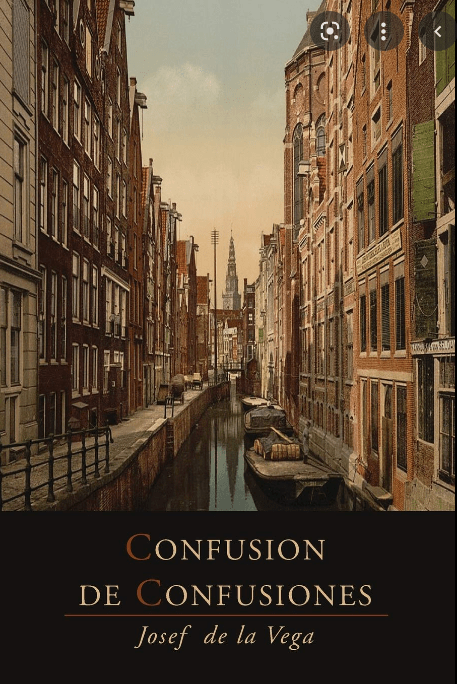
Title: Confusion De Confusiones
Author: Josef de la Vega
Pages: 42
Hi all,
Today we have a quick review to go through since the book was also relatively short.
The book was written around 1688 AD by a Portuguese Jew, originally in Spanish text, about his account of the Amsterdam Stock Exchange. In the introduction to the book you get a brief historical account how it came about that the author came to be Portuguese, wrote the book in Spanish of the Dutch Stock Exchange. A quick explanation is that former Jewish settlers lived in Spain. Then, the Spanish Inquisition took shape, which resulted in some of them immigrating to Portugal. Some years later, the Inquisition also took root in that country, which then prompted some to move yet again.
Why move? From what I understood of the Inquisition (in the Introduction) was that the local religion would force non-Christians to adopt their faith as well, or they would suffer consequences.
- One movie I found which told of this was “Day of Wrath”
In any case, some people didn’t want to convert and thus fled. They moved to Northern Europe, where they had opportunities to practice their religion freely, but could not live as part of the society without any restrictions. The guilds prohibited them from performing certain trades, and therefore these immigrants practiced those that were permitted, one of them being in finance.
Thus, our author would have had ample opportunity to encounter fellow members that came across the business of Stock trading, which then prompted him to write a book of the workings as he experienced it.
The book is written in dialogue form, whereby there is 1) a shareholder, 2) a philosopher and 3) a merchant. In four separate dialogues the author explains different aspects of the stock exchange, with the purpose of informing them how it worked and possibly also to warn them of the psychological traps one can fall prey to.
Dialogue 1:
- Discusses the origin of the stock exchange business in Amsterdam, especially the business of the Dutch East India Company as well as the Dutch West India Company. It also discusses who the players (the rich holders that own the stock to be paid out the returns, the merchants who hold shares to realize some gains over a few months, and the speculators that make frequent buy/sell transactions) are in the market and makes a brief introduction on some of the swindling maneuvers that are applied by some speculators.
Dialogue 2:
- This conversation explains why the prices in the market are not stable and what are the three sources that cause this price instability (1. news from the distant country, 2. news of local politics and economics and 3. the current opinion on the stock exchange).
- It also talks about how the language used on the market came to be.
- Finally, it also talks about the daily frenzy that you will come across at these places of trade and why the speaker advises against speculation.
Dialogue 3:
- In the third dialogue, the author goes into greater detail of the kinds of transactions that are performed at the exchange. The people didn’t solely trade in full shares, but also options, and ducats (fractional shares).
- It also explains where these transactions were performed, where the transactions were registered and how they could be settled (i.e. 1) transfer of the share, 2) only paying the difference, and not performing an actual share swap, 3) waiting for the outcome and at its conclusion only being required to settle at a later date, etc.)
Dialogue 4:
- The final dialogue goes into the final lesson that the shareholder wishes to warn the two listeners about. He uses one example how some crude speculators would take significant steps to have the share price drop so they could acquire them from a cheap price, only to sell them back at inflated prices once the crowd realizes that the actual returns brought by the ship were better than predicted and suggested by different market participants.
What is quite interesting to take away from the book is the fact that we can relate very well how the happenings at the stock exchange have not changed significantly from 1688 and today. Yes, many things have changed (forms of stocks offered, means to buy/sell shares, types of share products one can buy, physical shares vs electronic shares, etc.) but the tricks that are applied on the stock exchange to derive significant gains is still present today.
Thus, it shows that even with the abundant information and knowledge available to us today (at our fingertips, and not only through the acquisition of books or paying a fee for the services of an expert) we still are able to fall to the tricks of the speculators and broker traders.
Summary:
Quite interesting how a form of trade existed since the early 17th century and some of the tricks and mistakes made then are still done today. It is written in a style that is conversational and not feedback from a research study full of jargon. The reader acquires good understanding that speculation in stocks didn’t offer the greatest returns in the past and don’t do in the present. A lesson better learnt sooner than later. The book receives a rating of 4.45/5.
Have a good weekend, and stick to proper investing techniques! 🙂
 MyBookReviews