Title: The Downfall of Money – Germany’s hyperinflation and the destruction of the Middle Class
Author: Frederick Taylor
Pages: 359

Hi all,
I had bought this book roughly three years ago, started it and stopped and since then never come back to it. Since it started my policy to first read all the books I have before buying a new one I have now finally managed to get through this book as well.
A few years back I managed to read many books p/year. However, I have since slowed down, and I think it was worth it for the books I have read thus far, taking more time to really dig deep into the lessons they teach us.
Also, since we have been going through a few crises at the moment, I think reading of a dramatic one from the past would be able to teach me a few things some of our grand/great-grandparents went through. Though not all my readers may have a German background, some of the effects it suffered may have somehow influenced other countries as well (as China & US today are major influencers of most world-wide economies, when they sneeze the others catch a cold).
In order for you to really get more out of this review, I have done two things. I have added a timeline of the events that happened roughly between 1914 – 1925 and I have also shown in the chapters below to show which period we are covering p/chapter. My hope is that you can follow how the economic, political and other events all added to the subsequent events that followed.
Before we start with the book review, I will share with you my thoughts I had on the German government’s decision for printing of money, as well as what it is now, after reading the book.
- Initial thoughts – I follow Milton Friedman’s definition of inflation. Going through an inflationary phase now (with fixed salaries) is not a pleasant experience. Thus, I condemned the men that made the decision to print more money to assist Germany in rebuilding its economy and at the same time pay reparations to the Allied nations (i.e. France, Belgium, Great Britain, etc.).
- Subsequent thoughts – After reading the book, I understood that the ministers didn’t make the lightly. The country had just had a revolution (Nov 1918 – the country was confronted with supporters from the communists, from the far-right extremists and also democrats) and with an ounce of luck the newly elected officials barely held on to the crowd as a democratic government. Now, to tell people that the taxes would be increased and other reforms would be passed to be able to collect the needed funds for reparation payments (and no other country being willing to offer it a loan to assist them) they decided to let their currency suffer instead of the country being thrown back into rebellion.
- Yes, Germany would need to meet its commitments, but because the country was fresh out of a revolution and no one wanted to lend Germany a helping hand, letting the currency die was considered the lesser evil than letting the country head back into revolution and potentially end up being led by a worse form of government.
I hope you will be able to properly follow the events to see how delicate the political situations were back then and how quickly things can get out of control, especially when you have factions from different political backgrounds also rallying up the crowds even further.
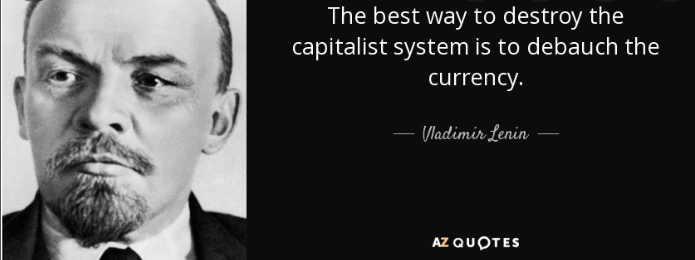
Before we get into it, I thought it appropriate to share two interesting quotes that came with the book:
- John Maynard Keynes – British Economist

- Vladimir Ilyich Lenin – leader of the Russian Bolshevik Revolution in 1917
The book is broken down into the following chapters:
- Introduction (pg.1)
- The book was written in 2013, at a point when the author asked himself what would happen today if we should lose trust in our currency today. Back then, we had come out of the Finance crises of 2007/2008 and governments around the globe were printing money in large quantities to get economies going once again.
- Gaining the hindsight what lead to the hyperinflation of a strong economy, what were the repercussions on its own economy and those around it is the first step. Then, using that, one can learn that the repercussions today would be significantly larger in Europe since multiple countries share the same currency.
- Whereas Germany in 1922 could print more and more money to pay for all goods & services and cover some reparations, that was one country’s currency. Today, few individual weaker economies in the EU could potentially hit many other member states hard if it decided to go its own way.
- Chapter 1 – Finding the Money for the End of the World (pg.7)
- Covers the period 1910 – 1914
- With the assassination of the crown-prince of the Austro-Hungarian Empire by Serb nationalists (July/August 1914), this was the beginning of The Great War (later to become known as the First World War).
- Germany was a strong military power in the world. It had multiple strenghts, but it also had weaknesses:
- Germany was allied to the Austro-Hungarian Empire, which was composed of multiple nationalities, and whose recent acquisition of the Balkan territories lead to the break out of war
- The Reich and its allies were essentially land-locked, susceptible to the British sea blockades which hindered external trade
- Germany was short of money to fight a war
- Germany would therefore not be able to be involved in a long-lasting struggle against the Entente (Russia, France and Great Britain) powers.
- Therefore, the Schlieffen Plan had been developed, which entailed 1) enter the neutral Belgian territories and then make a significant strike against the French powers. Then 2) Germany would focus its efforts on the Russian eastern front
- To remain within its means of paying for the war, the war was planned to last for less than 6 months if the tactics worked accordingly.
- With the plan in place, there remained the question of finance.
- The countries issued currencies mostly backed by gold. In Germany, the amount of paper issued could, by law, never exceed two-thirds of the money in circulation. The remaining third had to be backed by gold.
- The first step was the abandonment of the gold-standard for the duration of the war. Now, the Reichsbank could print more money than was initially gold-backed to pay for war expenses.
- The next step was to send out large amounts of propaganda to convince people that still held onto gold and silver to buy war bonds. More gold in the bank meant the Kaiser could use more to finance his war.
- By early 1915, the war had come to a stalemate
- The troops had managed to conquer only a tiny strip of Belgian territory
- The same went for much of northern France. However, they did manage to acquire industrial lands, which would end up being in Prussian hands for most of the war.
- Prussia repulsed a Russian advance on its eastern borders in the later 1914s, and then in the 1915s Prussia made significant acquisitions in the Baltic countries, as well as Russian Poland.
- Though they were starting to make good gains in surrounding territories, the financial situation was starting to look more and more grim.
- Thus, a new law was passed that made it possible for the issuance of new loan bureaux notes. These were initially set to be limited to 1.5 billion, the ceiling was raised to 3 billion three months later and continued to be raised as the months progressed.
- Chapter 2 – Loser Pays All (pg.17)
- Covers the period 1915 – 1918
- Germany already then relied on importation of large amounts of food. Since the commencement of the war, it had started to prop up its naval fleet, but they weren’t a match for the established Naval Power of Great Britain. When it became clear that the war wouldn’t be settled soon it set up a sea blockade in February 1915.
- The Entente’s intention was to bring about Germany’s defeat by a policy of deliberate starvation
- This policy had been applied against the Boer in the Boer Wars in South Africa around late 1890s
- Germany ability to trade in foodstuffs and other goods with the international market had been cut off. Not only trade in foodstuffs, but also with the external finance market.
- Britain and France were able to trade and attain loans from neutral America, as well as some additional troops from its then colonial territories
- Germany could only acquire funding by issuing bonds to its own citizens as well as through raising of taxes.
- The one thing both did have in common was the intention that when the war came to an end, the losers would be made to pay for damages incurred as well as welfare for its soldiers
- Especially France and Belgians would stand firm behind these compensation claims since it was mostly their territories that had sustained damages
- On the one side, Germany, if she won, had introduced to its government a memorandum in which it announced that it would reduce the power of the nations surrounding it, that they would not be able to raise a force in the future to stand against Germany and that they would depend on trade with it. It was a blueprint for a German Europe.
- On the other side, the Entente also made agreements with other countries.
- An agreement between by the Entente with Imperial Russia that it would acquire control over the Dardanelles and Istanbul (then part of the Ottoman Empire)
- Italy would gain chunks of Austria and the Aegean islands
- Then also the Sykes-Picot Agreement between the Entente and the Arabs. They encouraged the Arabs to raise rebellion against their Ottoman overlords and then would divide the Middle-East (Syria, Lebanon, Palestine and Iraq) between Britain and France.
- The latter amounting to efforts to expand their own imperial powers
- See movie “Lawrence of Arabia”
- March 1917 the first revolution against the Russian Tsar led to his expulsion and the instalment of a weak democratic government still confronted by an ongoing war.
- July 1917 the Russian army made a desperate offensive against the Central Powers (known as the “Kerensky offensive”) but which failed. This led the German forces to advance deeper into Russian territory.
- November 1917 a coup against the government was led by the far-left Bolshevik party (under leadership of Vladimir Ilyich Lenin).
- He had been in exile in Switzerland and permitted passage through Germany to Russia in the hopes of ending the war on the Eastern Front
- Negotiations on the Eastern Front led to a armistice in December 1917.
- The Germans lay out their demands.
- Foreign Minister Leon Trotsky stalled signing of the agreement, with the hopes that advances in the West would deviate attention from the agreement
- February 1918 talks broke down and the Germans continued their advances eastward.
- March 1918 the Brest-Litovsk treaty was signed
- Russia was forced to acknowledge loss of Poland, the Baltic lands, Finland, Ukraine and Belarus.
- Georgia became independent
- Parts of the Caucasus became part of Turkish control
- Inside Germany, the extreme nationalists were satisfied with the territorial gains, especially with the agreement signed with Ukraine who would supply Germany with much needed foodstuffs.
- Romania was brought to its knees in June 1918 and would henceforth provide Germany with oil.
- Chapter 3 – From Triumph to Disaster (pg.31)
- Covers the period March 1918 – November 1918
- Less than two weeks before the Brest-Litovsk agreement was signed, Americans started arriving in France to join the war effort
- The German leaders knew that they would be facing a stronger opponent (mostly because Germany’s people lacked proper nourishment and had already suffered large accounts of deaths). Therefore, it was considered pivotal to make a decisive strike against the enemy now.
- Since the war in the Eastern Front had ceased, those soldiers could now be relocated to the Western Front. Here, the soldiers made good gains, moving along towards the river Somme. The soldiers then crossed the river and made their way for Paris. However, this wouldn’t last long.
- As spring became summer, Germany was feeling stretched out. Mid-July 1918 the advances had come to a standstil.
- Back in Germany things were also looking unwell for its economy.
- Agriculture output had dropped since many of the hands were recruited for the war. Not only that, companies that produced goods for the war were booming with money, so they were able to pay their workers much more handsomely than what the educated middle class were being paid.
- August 1918 the British made a significant counter-attack that resulted in the Germans being pushed back
- October 1918 the Allied forces were making significant strides to liberate some of the towns that had been captured early on.
- In the face of this, the Kaiser reluctantly allowed for the formation of a more democratic government, under the new chancellor Prince Max of Baden. Under more pressure he then also submitted that the right to choose the chancellor be transferred to the Reichstag (i.e. government) and no longer in his own hands.
- 8 November 1918 the people were dissatisfied with the little changes proposed and made their voices heard that more drastic changes be made.
- 9 November 1918 the people rose up in revolution against the monarch, Kaiser Wilhelm II. He was no longer in the country at the time, but had fled to neutral Holland to take refuge.
- 11 November 1918 an armistice was signed on the Western Front.
- It would be only three weeks later that he would finally abdicate his crown.
- With the end to the war, the finance minister had taken a look at the books and found that Germany had indebted itself to the sum of 160 billion marks, 60% of which through war bonds issued to its own people.
- However, this was not to be the only debts it would have to answer for. It would now be patiently awaiting the verdict that the Allied Nations would reach in the coming years of reparation costs.
- Chapter 4 – ‘I hate the Social Revolution like Sin’ (pg.45)
- Covers the period November 1918
- With a revolution boiling on the 9th November, chancellor Prince Max von Baden was hoping to retain the monarchy and so resigned from his position and announced to act as regent for the grandson of Kaiser Wilhelm II until he has come of age.
- Since Prince Max had taken chancellorship he had appointed two new members to parliament. They were part of the Social Democrats party (which had not been acknowledged as a political party under the previous regime). One of the appointees was Friedrich Ebert.
- When Prince Max agreed to talks of armistice, he submitted to the terms as long as they be made i.a.w. Wilson’s 14 Points Plan
- Whilst a regime change was taking place, former soldiers were standing up to their superiors, who were trying to defy any orders to stop the war effort. Thus, in response, workers councils and soldier councils were established by the men.
- When Prince Max tried to call up a group of riflemen to stand up against the revolutionaries he would find them not willing to raise their arms against their fellow people, but engage in discussion. Thus, he formally abdicated his position as regent.
- The people had surrounded the Reichstag to make their voices heard that they demanded an end of the monarchy. They were unsure what was happening behind the doors, but they wanted to be clear that they no longer wanted to live under a monarchy. At this point, they had heard rumours that someone would address them soon what the current state of affairs were. They would be addressed by some far-left figures (the Spartacist party – Karl Liebknecht) who had ambitions to run the country as a socialist republic along the lines of Bolshevik style.
- Hearing this, State Secretary Philip Scheidemann made his way to the balcony and informed the crowds that the monarchy is no more and that they could stop the rebellion.
- His intention was to be the first to inform them that their voices had been heard and that the country would be led in a democratic way, not a Bolshevik-like manner
- With this proclamation the people of Berlin could return home. However, the rebellion would not end yet and the people knew it.
- They were very well aware that early the same year (March 1917) a democratic government had taken over control over Russia and then in the second revolution in November 1917 had been replaced with a more far-left one.
- The current leaders of Germany were also very aware of this and knew that any decisions they would make for the country would have to be one that would avoid an uprising of any future rebellions
- Chapter 5 – Salaries are still being paid (pg.62)
- Covers the period November 1918
- During the next days the old government officials were informed that they would retain their old government posts for the time since they were best qualified and Germany needed to bring back stability, as well as meeting the terms of armistice.
- To ensure that the government was one for the people, Chancellor Ebert created a council, composed of six social democrats, which were on top of the chancellor and represented the interests of the soldiers and workers councils.
- Ebert also made contact with Generalleutnant Wilhelm Groener, who had been active in the Reich Food Office to inform him that he would hold responsibility to return all soldiers home and ensure that the people were properly provided with food, though food was not abundant.
- His second role was to control the army reserves so the Reich would still have a strong force, but mainly to be on stand-by in case rebellion in the country took a turn for the bad.
- Chapter 6 – Fourteen Points (pg.70)
- Covers the period 11 November 1918 – early 1919
- The armistice agreement had been signed, but it was time-bound. Thus, Germany would still need to sign an official peace agreement, to which the government would need to vote on, based on the peace terms sent.
- One of the 14 points were that the sea blockade would be upheld until the signing of an official peace agreement. However, ships with provisions would be allowed to travel to Germany, at the Allies’ discretion, as was deemed appropriate for the sustenance of the people.
- Since early 1915, the Allies had blocked the sea trade and Germany’s people had struggled to acquire foodstuffs.
- When Germans complained that their situation with the blockade was dire, the Allies sent in investigators to determine whether this was the case. When they undertook their visits they mostly kept to the Allied-occupied areas and found that foods offered were good, but that prices had indeed risen significantly since before the war.
- They never visited the unoccupied areas, which was where the situation was more dire, thus reporting back an incomplete view of the true state Germany was in
- Also, those areas occupied by the Allies were able to engage in trade with the French, who tried to win them over to the French side so they might renounce forming part of Germany
- Chapter 7 – Bloodhounds (pg.78)
- Covers the period November 1918 – January 1919
- With rebellion still fresh on peoples’ minds, the government approved the formation of voluntary army units (i.e. Freikorps) whose sole purpose would be to defend the new Republic against any rebellious uprisings.
- 1 January 1919 the far-left Spartacists had merged with other parties to form the German Communist party. The party was under the leadership of Karl Liebknecht and Rosa Luxemburg.
- Liebknecht’s father had been a Social Democrat and close friend of Karl Marx and Friedrich Engels (fathers of Communism ideology)
- Chancellor Ebert acknowledged that the risk of rebellion was high and therefore travelled with Gustav Noske, Commissioner of Defence, to a base outside of Berlin where the first units of Freikorps were in training.
- 4 January the Spartacists moved into the city and took over both the media and telegraph districts of Berlin. On 5 January they made they way to the government district.
- Noske and his Freikorps units came in and alongside the workers councils they managed to defeat the far-left rebels.
- 15 January 1919 Karl Liebknecht and Rosa Luxemburg were arrested. They were driven off in separate cars and were killed then and there.
- The government had managed to restore order, but it had inadvertently created something else. The right-wing militarist groups that made up the main numbers in the Freikorps were a force the government would have to deal with in the future to come.
- Chapter 8 – Diktat (pg.89)
- Covers the period January 1919 – June 1919
- 19 January the people held their first votes and voted significantly for the Social Democrats, unwilling to go through further fights and rebellions and further radical changes.
- With the new government formed in Weimar, Friedrich Ebert was elected President, whilst Philip Scheidemann was elected Chancellor. New ministers were elected from the various political parties, but the two important ones were Matthias Erzberger and Ulrich Count von Brockdorff-Rantzau, whilst Gustav Noske was officially proclaimed the Minister of Armed Forces.
- The two ministers Erzberger would be responsible to oversee the treaty negotiations and Rantzau the Foreign Minister
- The Paris Peace Conference of 1919 held by the Allies went on, whilst the German people still struggled under the sea blockade until July 1919 when it was uplifted.
- The Germans were hopeful that the terms offered would be in line with the 14 Wilson points.
- However, when Wilson heard the crushing terms that the Germans had made with the Russians and Romanians early 1918 he changed his stance that the treaty should instead be ‘severe’
- End of April 1919 Erzberger and Rantzau travelled to Paris to hear the terms that the Allies had agreed on.
- 7 May 1919, the German delegate were called in and were told the terms by the French Prime Minister Clemencea, including the following:
- Germany would lose 13% of her territory and 10% of her population
- The German-speaking territories of the now-defunct Austrian Empire were forbidden to unite with the German Republic
- The non-German areas were granted to the new post-war states of Czechoslovakia, Poland and Yugoslavia
- Germany must demilitarise
- Reparations to the victors would amount (at least) to 100 billion gold-marks, which would cover reparations of territorial destruction as well as war pensions of the victors
- Sign a “War Guilt” clause, which would justify reparations
- Other terms as well
- The German delegation argued and finally on 16 May were told they would have three days to sign the terms of the treaty. They headed back for Weimar to discuss the terms with the young government.
- The government was granted an extension of four days since an agreement could not be reached
- Chancellor Scheidemann and Foreign Minister Rantzau resigned, unwilling to agree to the terms
- A new government was formed that would accept the terms. New appointees were:
- Matthias Erzberger as Finance Minister
- Hermann Müller as Foreign Minister
- Johannes Bell as Transport Minister
- Acceptance of the treaty was communicated on the deadline date of 23 June, and officially signed on 28 June in Versailles by the latter two ministers.
- Minister Erzberger would commence with the crucial task of bringing Germany’s finance back under control. Two things he looked at first were:
- Raising of taxes
- Warn the populace of the danger of inflation
- Chapter 9 – Social Peace at Any Price? (pg.107)
- Covers the period November 1918 – September 1919
- The government had announced that the country would become a socialist republic, which meant that the core would be the people and not capitalism.
- Also, since revolution was ripe, they didn’t want to risk setting reforms greatly in favour of capitalists but more towards socialists
- This meant the trade unions and employer union came together to sign the ‘Stinnes-Legien Agreement’. This would bring workers the following benefits, whilst letting the employers not lose their entire business to a new economic reform:
- workers received eight hour working days
- compulsory union recognition
- mandatory collective bargaining
- wage contracts
- right to be represented through workers committees in the companies
- every man who would be demobilized would be employed in the industry
- A by-product that came from the post-war was that during the war certain professions had paid more handsomely than others. Now, in post-war, when workers heard the pay they would receive in different professions they instead applied for unemployment benefits than work for low wages
- Consequently, employers thought that, to meet their personnel shortages, they would give wage increases, and hand over the increased prices to customers
- The German government had a large debt to pay (both internal and external) and an unemployed labour force would not help.
- To raise money to pay for war reparations, the following reforms were made:
- Tax reforms
- The Reich (Berlin) would take control of income taxes, sales taxes, inheritance taxes and land purchase taxes.
- It would enforce one-off emergency and windfall taxes on those that benefited during the war
- A one-off property tax was to be levied
- Capital flight reforms
- High-value individuals started to store their money and assets abroad with the introduction of more taxes.
- In response, the Reich recalled high-value bank notes and securities so they may be overstamped
- This reform would soon be recalled since not only locals but foreigners started selling their German holdings since they feared this may become worthless.
- The German Mark started to fall against other currencies
- Tax reforms
- Paper money in circulation in 1913 had been 2 billion. By 1919 it had been 45 billion. The government knew that in order to get inflation under control had measures would need to be taken. They knew this quite well, but they didn’t know when to introduce these. They were afraid that if the masses were overburdened with these reforms, they might spark another rebellion.
- Chapter 10 – Consequences (pg.124)
- Covers the period 1919 – March 1920
- One interesting curiosity was that during the pre-war and war period, as well as during the post-war period, the same officials remained at the healm of the German Reichsbank: Rudolf Havenstein was at its head, together with the deputy Otto Georg von Glasenapp.
- It had been the latter’s suggestion to decouple the Mark from convertibility to gold in the early period of the war
- They had been responsible for the printing of the large volume of currency to finance the war
- The armistice had required the Weimar government to get the revolutionaries under control, the economy on track, but this would be difficult with rising inflation
- The tax reforms from Erzberger brought about some changes, but those would not be enough. One upswing though was that employment had increased in the second half of 1919. However, the Mark continued to fall against the USD, as shown below:
- early 1919 8.9 Marks
- May 1919 13.5 Marks
- July 1919 16.5 Marks
- September 1919 21 Marks
- December 1919 49 Marks
- March 1920 90 Marks
- The war guilt clause in the Versailles Treaty lay heavey on German’s conscience since it had not been them that instigated the war, but the former elite. Thus, in their eyes, responsibility should be borne mainly by them and not the masses.
- The government did however sign the agreement with the clause, to give a sign to the other countries that the war lay on the German’s conscience and that they were willing to rebuild on good terms. They needed all the help they could get and not risk a further war to break out.
- However, this move made the government ministers the targets of right-wing leaders, who would mark all their enemies as “Versailles traitors”.
- When Foreign Minister Müller and Labour Minister Bell took the train to Versailles to sign the treaty they came back, knowing full well that the reparations imposed were beyond their country’s means.
- The new government policy would become known as ‘fulfilment’
- That is, the government accepted the treaty, doing so under duress, and would not show itself openly in breach of its provisions.
- But in its apparent compliance the government would consistently aim to show the impossibility of any such thing.
- It would use every weapon in its political, propaganda and economic armoury, including manipulation of the currency.
- Every, so not to risk social unrest of November 1918 again.
- After the signing of the treaty John Maynard Keynes published his famous ‘The Economic Consequences of the Peace‘ in an effort to demonstrate to his Allied nations that the demands imposed were not feasible.
- One of the demands of the Versailles Treaty was to reduce its military strong force. Field Marshal von Hindenburg had resigned his post as Commander-in-Chief, and Groener as his deputy. Gustav Noske had become the Reichswehr Minister.
- January 1920 Erzberger was shot by right-wingers, but was not fatal.
- The Freikorps were hardening their hostility against the German Republic. One of the troops, ‘Erhardt Brigade’ were stationed near Berlin and had begun planning to use force to overthrow the young German democracy in favour of a radical-nationalist dictatorship.
- Chapter 11 – Putsch (pg.135)
- Covers the period March 1920
- On 13 March 1920 the brigade made its way to Berlin under leadership of Wolfgang Kapp. Their badge was a white-painted swastika on their helmets. They occupied the Reich Chancellory and Kapp was proclaimed Chancellor, and General Lüttwitz his Defence Minister.
- The Reich cabinet had decided to leave ahead of the coup to Dresden and then finally to Stuttgart.
- During their journeys they contacted various trade union leaders and requested them to cause protests in the streets to make some trouble for the ‘new’ government
- The brigades didn’t wish to inflict harm on workers and therefore the latter successfully paralized the transport, power and communications systems as well as shops and factories.
- 17 March 1920 Kapp fled to Sweden, and Lüttwitz fled to Hungary after acknowledging the coup had failed
- The problem with the Weimar’s instigation was that strikes were also called up in other parts of the country. The leftists blamed the government that their rule has gone so far that an anewed struggle with the far-right had been the result of their incapable rule.
- The French were unsettled by these strikes, even in the resource rich area of Ruhr that French forces were ordered to enter and occupy those areas to ensure future supplies of coal for its reparations were met.
- All these events showed two clear things:
- How fragile the new democratic government was to sudden uprisings
- That, even when the governments of different areas were constantly fighting, the military of different regions never were.
- When the coup had still been in progress, a military plane had left Munich for Berlin to discuss with the military leadership what the next steps forward would be.
- Hearing that the coup had failed, they headed back to Bavaria.
- The two military leaders were Dietrich Eckhart and Adolf Hitler.
- Chapter 12 – The Rally (pg.145)
- Covers the period March 1920
- With the abolition of the coup government the workers demanded political changes. Some ministers (including Chancellor Bauer and Reichswehr Minister Gustav Noske) resigned.
- Foreign Minister Hermann Müller took over chancellorship until elections were held in June 1920.
- The currency strengthened from 92.50 to 75 and eventually 60 Marks : 1 USD with the news of upcoming elections.
- It was very clear to all nations that inflation had arrived and would hit their economies hard.
- Britain and France had borrowed money from America to buy goods to sustain itself during the war.
- Germany had financed its campaign mainly from issuing domestic loans as well as a few neutral countries
- What inflation had done was that Germany’s domestic war debt had effectively been liquidated
- On the Allies side, discussions over the amount of reparations Germany would need to pay were endlessly discussed throughout 1920 and into the early months of 1921.
- The problem with the discussions mainly came back to the inter-Allied debts.
- America was adamant to recover its loans, which in turn lead the Allies insisting on the reparations to be laid on to the Germans to be of such amount that they would cover their debts as well
- The Allied nations had suffered losses in the range of 95-100 billion marks. The governments weren’t willing to have its taxpayers foot the bill
- A problem with this was the following:
- In order to be able to meet its obligations, the countries need to run consistent surpluses.
- To make a surplus, you need to export more than you import.
- Germany, Great Britain and France all needed to run export surpluses to meet the loan demands.
- America, was the obvious candidate to run deficits, but it was not willing to do so since its government was currently run by a candidate (Warren G. Harding) that had imposed tariff walls and lower taxes.
- In light of this, who was Germany going to export to to make sufficient surpluses?
- A potential solution was suggested in the way of bail-out loans from American banks, that reparations and loans could be covered and the new loans be repaid over longer periods of time. Thus, allowing each country to rebuild its economy and allow surpluses to be made.
- The Americans declined to issue such loans, but instead insisted the current loans be repaid, commencing the following year.
- Germany had one option to be able to make surpluses, this was by devaluing its currency to make imports of its goods more attractive.
- Chapter 13 – Goldilocks and the Mark (pg.156)
- Covers the period June 1920 – August 1921
- The elections showed that the former socialist parties lost significant votes to other parties. For the rest of the decade, the country would suffer from weak and unstable governments, subjected to the radical nationalist camp.
- Konstantin Fehrenbach took over chancellorship from Hermann Müller and formed a new administration with a few other parties.
- By August 1920 it was clear that the Finance Ministry and the Reichsbank combined their efforts to keep the value of the Mark from rising further in order to keep the currency at a competitive level with other countries
- This way it could export more of its own goods, but also keep the price stable to make food imports not too unaffordable for its own population
- May 1921 the government collapsed and was reshuffled when the amount of the reparations bill was communicated: 132 billion gold marks
- this bill was coupled with the Allied threat of occupying the Ruhr area if it did not meet payments according to the payment schedule
- The repayment of the amount would be in three sets of bonds:
- Bond A 20 billion gold marks – unpaid balance Germany was supposed to have paid since 1919
- Bond B 50 billion gold marks – would cover war damages
- Bond C 82 billion gold marks – purpose was unclear but thought to cover inter-Allied debts; bond could only be issued once the first two had been settled
- Bond A & B were issued at 6% interest.
- Annual payments were calculated as 1) fixed annual payments (2 billion marks roughly) plus 2) a variable component (British imposed levy of 26% on German exports), which amounted to 3 billion marks in 1921
- Taking the figures into perspective, between 1920-22 Germany’s exports were 4.8 billion gold marks. To meet the payment demands of the Bond C, Germany would need to increase its exports to 22 billion gold marks. These aims were clearly not achievable.
- Being presented with these numbers, the first payment of 1 billion gold marks was due on August 1920 in foreign currency.
- The government got the money together, but it’s sell-off triggered the exchange markets into a frenzy to result in the Mark losing more value
- Chancellor Fehrenbach and his party walked out in protest at the announcement of the amount.
- Josef Wirth, centre politician was elected chancellor and formed a coalition with the Social Democrats to follow the Allied demands.
- August 1921 Erzberger (Finance Minister) set off for an early walk, was pursued and this time was killed.
- The two killers had been identified being part of the Freikorps volunteers that took part in the Kapp-Putsch.
- Chapter 14 – Boom (pg.169)
- Covers the period August 1921 – October 1921
- 1921 would be a rough year for many countries around the globe:
- Race riots in Tulsa, Ohio
- Coup in Portugal where multiple government ministers were killed
- Prime Minister of Japan was killed
- Prime Minister of Spain was killed
- Russia was convulsed in civil war
- Greek and Turkish forces were engaged in war in Anatolia
- Deposed King-Emperor of Austria-Hungary undertook two unsuccessful attempts to restoring himself to the throne of Hungary
- Benito Mussolini was elected to the Italian parliament with other members part of the movement known as Fascisti
- Britain was involved with the Irish Nationalists over Norther Ireland, until a truce was reached in July 1921
- All other economies were experiencing hardship, whilst Germany managed to increase its exports, but this did not go in parallel with improving the standard of living
- Especial benefit was found by the industrialists who sold their wares in foreign markets and were paid in foreign currencies. These they held on to in anticipation of the Mark suffering further price devaluations
- 1921 the Mark took a tumble and savvy industrialist investors took the opportunity to utilize their foreign currency to buy up multiple hard assets
- Some business owners would only offer their products at foreign currency prices, thereby avoiding the risk of committing oneself to deliver in future at a now-deflated price
- American investors with their USD thought this may be the perfect opportunity to purchase devalued Marks since the only way the currency could go was up, since it was already so lowly valued
- The currency started to recover a little, and the foreign currency was the only foreign currency the government could get to make its reparation payments. However, in the summer of 1921 the Mark took a further tumble and many investors lost their speculated funds.
- October 1921 the currency took another hit when Germany heard that Upper Silesia would be forfeited to Poland, which meant Germany lost one of its industrial complexes it could use to make exports of resources to meet reparations demands.
- Chapter 15 – No More Heroes (pg.181)
- Covers the period January 1922 – July 1922
- April 1922 the various countries met in Genoa to once again negotiate the terms of the treaty.
- It was supposed that Russia could provide Germany with the needed raw materials and Germany in turn would deliver finished goods. The profits it made would go to cover reparation payments.
- However, the current reparation payments were strangling the nation as it struggled to collect sufficient revenue to meet the payment terms.
- The meeting would go for six weeks with no changes agreed since America was not present and was the ultimate holder of loans.
- Rathenau had served under the Wirth administration but since January 1922 had become the foreign minister.
- Germany and Russia’s representatives did make a secret deal, called the Rapallo Treaty, which covered the following:
- mutual recognition of governments
- cancellation of all financial claims
- favoured trade status
- extensive programme of economic cooperation
- A deal was struck because it believed it wouldn’t get a deal with any of the other countries and it was in dire need for trade partners.
- The Reichstag eventually did ratify the agreement, but the German Finance Minister Hermes still critized the agreement since he thought that the focus should be put on meeting the agreements with the allies, otherwise they might meet resistance
- The French Prime Minister Poincarê declared the treaty a hostile act and continued to emphasize the possibility of French military action if Germany did not keep to her agreements.
- A Banker’s Committee had been set up by the Allies to come up with a scheme for a longed-for loan.
- The committee presented its proposition. The reparations bill of France could be reduced by a certain amount should America in turn agree to reduce a portion of the inter-Allied debts.
- Banker J.P. Morgan represented the American banks and gave his refusal of these terms.
- On 23 June 1922 Rathenau agreed to have dinner with American ambassador Alanson Houghton to discuss the German economic situation. On the topic, they invited industrialist Stinnes who could illustrate the coal supply issue in greater detail.
- Both Rathenau and Stinnes defended inflation, for all its economic and social disruption, as a ‘political necessity’.
- The next morning head woke late for his trip to the office and on the way was assassinated by two young Freikorps members.
- Following this incident, the government drafted laws for the ‘Protection of the Republic’, which set up a State Court to try cases of conspiracy against acts of violence against the Weimar state and its representatives
- Bavaria, being more far-right, objected to the new laws, claiming it undermined its sovereignty.
- Instead, it set up its own set of laws and proclaimed that such cases, when raised in Bavaria, would be held in the Bavarian Courts, superseding the State Courts.
- Chancellor Wirth took the helm of foreign affairs once more under his hat.
- Chapter 16 – Fear (pg.202)
- Covers the period July 1922 – August 1922
- With a few political minds having been removed from the government in the recent months (especially those in whom foreign officials found competent leaders), this government didn’t inspire confidence in the rest of the world.
- The ‘inflation mentality’ had now really taken a grip on the German population. Expectations of even more and dramatic price rises were expected in the coming months and therefore the people started to collect are their funds and purchase whatever goods they could get hold of, all to rid themselves of the currency.
- Merchants, workers and officials alike were moving to adjust their prices and unions demanded wage increases to compensate for the new inflation figures.
- The government was still in tune with the principle of “social peace at any price” and therefore granted the printing of more quantities of currency.
- Germany increasingly began to resemble a Banan Republic (a term used to describe violent, unstable Latin American states, often with unsound currencies)
- The British and American governments began to accept the German’s earlier pleas that she desperately needed further moderation of the reparation’s terms. The French, under Poincarê, believed that Germany was not really unable to meet her reparations bill but was deliberately simulating ruin to avoid paying France.
- In July 1922 it had become clear that prices had increased month-on-month by more than 50% which meant that Germany now met what was defined as hyperinflation.
- Chapter 17 – Losers (pg.206)
- Covers the period July 1922 – August 1922
- Since the cessation of the war Britain and France had adopted policies to reduce debt and support the huge sums necessary to pay interest on war bonds.
- They raised interest rates, and tried to reduce the high wages of professions that were favoured during the war time.
- The policies they implemented during the war favoured the workforce, and after the war it favoured the bondholders.
- Fiscal policy entailed cutting spending on social, housing education and defence.
- These cuts resulted in a strike wave, but in the end did manage to fight down inflation.
- In Germany, Germany continued to favour the workforce after the war since they were its existential policy. Therefore, inflation continued to grow.
- Germany had a huge plate of people that it needed to pay to:
- Domestic
- War bonds
- Pension of retirees
- War veterans and orphaned children
- Foreign
- War reparations
- Loans from neutral countries issued during war
- Domestic
- The Weimar’s best intentions of building the world’s most progressive welfare system as well as its most complete democracy were falling ever further short, the more inflation tore at the government’s budgetary plans.
- Combined with post-war shortages of affordable good quality food and real wages that rarely rose to near pre-war levels, deteriorating living conditions also meant that diseases associated with deprivation and poverty rose
- People now lost great faith in their currency that they would always go to get rid of currency they got in return for material things. Barter amongst people was on the rise.
- Chapter 18 – Kicking Germany When She’s Down (pg.228)
- Covers the period November 1922 – May 1923
- President Ebert appointed Wilhelm Cuno, an acute businessman, as the next Chancellor.
- In June 1922 Chancellor Wirth had suspended cash payments of reparations and requested full relief of payments for two years.
- The Americans and British failed at a conference in London to convince French PM Poincarê to consider a reduction in reparation payments.
- This in turn fueled expectations that France might invade the Ruhr area
- A battle royale was taking shape between the growing Communist Party and the growing ultra-right mass organizations, mainly NSDAP under Hitler, competing for the loyalty of Germany’s lower middle and working class.
- Chancellor Cuno started a number of initiatives to break the reparations deadlock. December 1922 and January 1923 when the parties met all his suggestions were shot down by the French.
- In December 1922 and January 1923 Germany had fallen behind in resources in needed to deliver to France and Belgium, which resulted in Frech and Belgian troops crossing the border to occupy the Ruhr area, to ensure that resources extracted were sent in their full quantities to their destined countries
- Germany had not anticipated this and therefore had not stockpiled coal reserves to other industrial complexes that needed the coal for its factories to continue to produce
- The industrialists Kirdorf, Thyssen, Stinnes and others had already moved their administrative teams to Hamburg so the French could deal with the logistics themselves
- The government called on the workers to engage in ‘passive resistance’ whereby coal workers did minimal effort and rail workers also didn’t work efficiently. In response, French declared Martial law.
- The government would still compensate employers and workers for engaging in passive resistance. This unconditional support meant the government could only pay by producing more paper currency.
- France struggled with this resistance and was forced to import more expensive coal from Britain since the cheap coal was not coming from its neighbour. The French did bring in its own labour force, but domestic workers had frequent clashes with the soldiers. Former Freikorps members entered the grounds and performed acts of sabotage in the Ruhr.
- When members of the former Freikorps were being killed by the French soldiers this was something the far-rights would use to muster their support against the reigning governments.
- Chapter 19 – Führer (pg.244)
- Covers the period May 1923
- November 1918 Hitler recovered from his wounds in a hospital on the Baltic coast. He traveled back to Munich to rejoin his army unit. September 1919 he met a promising local organization, the anti-semitic National Workers Party (DAP) and joined their ranks. Spring 1920 he became their propaganda chief and a year later became their Führer of the NSDAP. The plans for the party were to lead a coup to Berlin and install a dictatorship in Bavaria and then throughout Germany.
- After the killings in the Ruhr area, the deceased members were transported back to Munich, where a memorial was staged by the NSDAP. During this memorial, Hitler gave a speech advocating for ‘active resistance’
- He noted that the actions of the French were an outrage, but that the real culprits were the parties still in control of the Weimar government.
- Chapter 20 – ‘It is too much’ (pg.250)
- Covers the period January 1923
- Tolerance between the French and Germans was a thing of the past since the invasion of the Ruhr area.
- Not only towards French, but also towards other foreigners since they used their strong currencies to live lives of luxury in the impoverished Germany.
- The flight into material assets continued
- The hyperinflation meant that Germany had to use more and more of its gold and foreign currency reserves to pay for the food imports it desperately needed for its people
- To counter this effect, a steady move out of urbanized areas to rural communities started to rise so people could use land to plant their own food rather than relying on wages in the city whose currency had to be spent at the same moment that it was paid out.
- Chapter 21 – The Starving Billionaires (pg.267)
- Covers the period February 1923 – August 1923
- To tackle this problem, Chancellor Cuno put together a multi-faceted financial and diplomatic package in February 1923 which they hoped would a) enable Germany to weather the crisis, b) get the French out of the Ruhr and c) come through on the other side with some revisions to the reparation’s terms
- April 1923 the dam broke. None of the proposed initiatives were effective nor accepted.
- The German Mark was considered to be effectively worthless.
- The politicians, banks, and business leaders agonised how to keep the economy viable
- Ordinary Germans now desperately got rid of currency as fast as they had acquired it
- People started to insist on being paid in ‘moveable’ items
- Germany had become a marketplace, where everything was for sale and everything could be bought. Heirlooms and family treasures were sold in larger numbers so they could acquire some form of staple.
- The collapse of the money also resulted in the collapse of morals!
- It had become clear that Chancellor Cuno had not brought about the desired changes. Communist-influenced strikes were spreading through the industrial areas and trade unions were forced to participate.
- Cuno resigned and President Ebert appointed Dr. Gustav Stresemann as the new Chancellor.
- In the background, the German state was suffering through large heaps of paper currency, the ‘passive resistance’ was still ongoing and costing the state more than it could make, communists were mobilizing central Germany and the Nazi’s were raising citizen armies in the south
- Chapter 22 – Desperate Measures (pg.286)
- Covers the period August 1923 – October 1923
- Chancellor Stresemann called on the Reichstag that drastic action had to be taken to save the German Mark – action that previous governments failed to take. Now, there was no choice but to take action.
- 18 August 1923 Karl Helfferich, former Secretary of the Treasury, came to parliament with a proposal for the reform of the currency. Instead of gold being re-established as the new standard, the backing for the reform would be the country’s reserves of rye.
- The idea was to decouple the worth of the Mark from the credibility of the Reich government.
- The rye-backed currency would be based on the assets of the German agriculture and industry
- September 1923 the idea was adopted.
- Another change implemented by the government was to end the support for the ‘passive resistance’.
- Additional efforts to bring the country’s finances under control were to announce the cutting of government expenses
- The Reichstag, during October 1923, passed a government bill raising taxes and introducing some new ones
- Chapter 23 – Everyone wants a Dictator (pg.300)
- Covers the period October 1923
- Stresemann’s ministry was subjected to intrigues from the right as well as from industrial interests who were looking to reverse worker-friendly laws that had been adopted in 1918. These groups favoured something close to a dictatorship regime as was currently in Bavaria.
- In October the government fell and a new one was established, one which saw the Finance Minister change from Hilferding to Hans Luther, who was in favour for a new currency to be introduced.
- During October 1923, the far-left Communists and the far-right paramilitary nationalists both sensed their moment. They believed that violent change could be brought about.
- Chapter 24 – Breaking the Fever (pg.316)
- Covers the period October 1923 – early 1924
- 12 October 1923 the British and the French agreed to engage in talks with the Americans over the reparations bill.
- Poincarê agreed under certain conditions, mainly because its economy was struggling, and he was suffering under the pressure from the people
- The Rentenbank was established on 17 October and would have the ability for the issue of the new currency: Rentenmark. It would be issued from 15 November but in strictly limited quantities.
- The Reichstag agreed that it was time for the Director of the Reichsbank, Havenstein, to go. He was to be succeeded by someone that would run the reform process to the new currency and found their man in Hjalmar Schacht.
- Things were starting to take a turn for the good, communism had no longer become of interest to large populace.
- The momentum that Hitler had managed to gather was losing track and therefore he decided to stage a coup on 8 November 1923 in the Bürgerbraukeller, where he seized control of the room, gave his speech, followed by Hermann Goering and General Ludendorff. He announced that the revolution had begun.
- The following day they made a march for the Bavarian Defence Ministry where they were mostly shot down. Ludendorff gave himself over, Hitler would receive a light sentence (due to being sentenced in the Bavarian court and not Berlin set up State Court) and Goering fled to Austria.
- Since issuing the new currency from 15 November 1923 the question rested on the value at which the Reichsmark should be converted to the new Rentenmark. On 20 November the exchange rate was set at 1 for 1.000.000.000.000 Reichsmark.
- Thus, its domestic debts of 154 billion marks were reduced to 15.5 pfennig
- Havenstein’s deputy, Glasenapp stood firmly behind the currency reform and severely restricted issuing credit.
- Stresemann was facing critique from all sides and therefore decided to resign his post as Chancellor rather than go through a notion of no-confidence vote, and retained his role of foreign minister.
- Early 1924 Germany was able to re-visit reparations clauses of the Versailles Treaty, as well as negotiate a loan from America
- The country would start to recover, but the people who had held on to the former currencies and war bonds would lose everything.
- Chapter 25 – Bail-Out (pg.337)
- Covers the period 1924
- The hyperinflation ended quickly with the introduction and acceptance of the Rentenmark and by August 1924 Germany had once again a stable currency.
- In 1918, the German government owed 154 billion gold marks in domestic war debt. With the currency reform, the war debt amounted to a mere 15,4 cents.
- It had, in practical terms, confiscated the money its most loyal citizenship lent it to fight the First World War.
- Though the recovery would not last long, since, across the Atlantic, there would come about the Great Depression, which would ripple into the European economies and eventually bring about the Second World War.
- Afterword – Why the German Trauma? (pg.343)
I hope you will have gained some valuable knowledge and perspective on the German inflation and how fragile our world economies are to small indentations. When people panic, then things can really get out of control. The main thing I want to communicate is that one should learn from the mistakes of the past, keep a clear head and not let oneself be riled up by others, but get an understanding of events for oneself.
Summary:
The book does occasionally jump from one period to an earlier period and then back again to explain who a person is and where they came from, for the readers benefit, but overall, the chapters follow a clear and chronological pattern. It is well written for the reader to understand the political, economic and other activities that were present at the times and how these changed as a result of certain external events (for example – France invading the Ruhr area, America refusing to renegotiate the Versailles Treaty terms). Thus, it gives the reader good insight to understand why the German politicians made the decisions they did. Also, the chapters are not all more than 15/20 pages, so one can clearly absorb the most important things happening and still understand how things developed.
The book will receive a rating of 4.65/5.
Have a good one, and keep learning!
 MyBookReviews