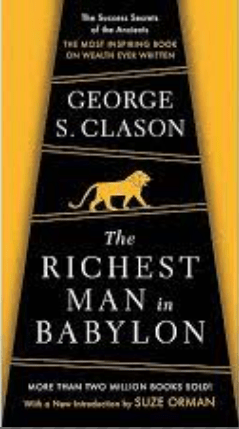
Title: The Richest Man in Babylon
Author: George S. Clason
Pages: 194
Hi all,
I have started the year by reading one of my favourites again. The previous review was done in 017-2019. My objective with rereading the book was so I might refresh my knowledge with the financial lessons it taught me back then. Considering we’re likely to go through some time yet with tighter belts, I thought I would start the year with some old advice.
Not only was this my reason for picking this book, I also had one of those moments where I stood in front of the bookshelf and couldn’t decide which book to start off with.
The book is broken down into the following chapters:
- Introduction
- Foreword
- 1. The Man who desired Gold (pg.1)
- The first chapter starts off with a discussion between two friends, a chariot builder and a lyre player. The chariot builder is unsatisfied that he has worked for many years and delivered fine work, but he is still not wealthy and doesn’t understand what he is doing wrong not to have this wealth. They continue their discussion when the lyre player suggests they should go and visit their friend Arkad, the richest man in Babylon, so he may give them advice how wealth is to be acquired.
- 2. The Richest Man in Babylon (pg.11)
- In the next chapter we follow the discussion held between Arkad and some of his friends. They enquire with him, what it was that brought about that he may be fortunate and they not. He then clarifies for them, that should one desire to become wealthy there are two things that brought this about: one is time and the second is study.
- Time – As a young man you have much more time in abundance than when you have reached seniority. Thus, building wealth takes time and their time needs to be spent wisely.
- Study – The other criteria is to study how wealth is built and then taking action (i.e. apply what you have learnt).
- He also tells his personal story how he started his journey to build wealth. Arkad had started as a scribe and written tablets for people. One day a money lender came by and asked for a certain law to be written on tablets by a certain day. After failing to meet the deadline, he made a deal with the lender: he would finish the tablets by the following morning and in exchange the money lender would teach him how to become wealthy. He fulfilled his side of the bargain and then learnt his lesson: one-tenths of everything you earn you pay to yourself (saving). The remainder must be able to cover your other expenses. That one-tenth you must put to work so that it will also start earning you coins (saving > invest), and its returns should do likewise (returns > reinvest).
- Arkad’s first mistake was that he took his savings from a year and entrusted them to a brick layer to buy expensive stones so they may be sold at a profit. The traders sold them glass since the brick layer couldn’t make out they were given a bad deal.
- Arkad’s second mistake was that he took the returns that were earned from his first profitable investment and spent those on expensive goods.
- The money lender always came back to teach him the folly of his mistaken investments and Arkad accordingly improved by utilizing his savings and returns for better investments so they may continue to reap returns.
- In the next chapter we follow the discussion held between Arkad and some of his friends. They enquire with him, what it was that brought about that he may be fortunate and they not. He then clarifies for them, that should one desire to become wealthy there are two things that brought this about: one is time and the second is study.
- 3. Seven Cures for a Lean Purse (pg.29)
- In the next chapter we meet the king having a discussion with his chancellor. They discuss that the people are not well-off and that something needs to change so the people will have better lives. Thus, they meet with Arkad so he may give a lesson to 100 prominent students so they may be the starting point to improving the situation of Babylon’s people. Here, he teaches them the following lessons:
- Lesson 1: Start thy purse to fattening –> For every ten coins thou placest within thy purse, take out for use but nine
- There are multiple different professions that will earn you different amounts, but the way to start is to put away 10% of those earnings so they may be the building block on which wealth will commenced to be built
- Those 10% we deprive ourselves of short-term gratification are the building blocks for long-term income-bringing investments
- Lesson 2: Control thy expenditures –> Budget thy expenses that thou mayest have coins to pay for thy necessities, enjoyments and worthwhile desires without spending more than nine-tenths of thy earnings
- There is an unusual truth that we all will face. As our incomes increase, so it will seem our ‘necessary expenditures’ also seem to grow (i.e. lifestyle inflation).
- These additional ‘necessities’, however, should not be confused with desires.
- Therefore, make a budget that clearly sets out your true necessary expenses and those expenses that represent desires you wish to be fulfilled, so you don’t confuse the two.
- Then, to make sure you spend only within your limits (i.e. 90%) determine which desires are those that are of most value and dismiss the remainder since they do not give a high level of satisfaction.
- Lesson 3: Make thy gold multiply –> Put each coin to laboring that it may reproduce its kind and produce thee income, a stream of wealth that shall flow constantly into thy purse
- The next lesson deals with putting those savings to work, since coins in the purse by themselves earn nothing. Not only should the principal/capital be invested, but also the returns so that your returns will multiple beyond the initial returns value, thanks to the effect of compound interest.
- Initial returns: Capital + Interest
- Subsequent returns (when not reinvested): Capital + Interest
- Subsequent returns (when reinvested): Capital + Interest + Reinvested returns + Interest on returns
- Lesson 4: Guard thy treasures from loss –> Guard thy treasure from loss by investing only where the principal of thy is safe, where it may be reclaimed if desirable and where thou will not fail to collect the rental. Secure the advice of wise men experienced in the profitable handling of gold.
- The first sound principle we should bear in mind for any investment is to understand what is offered as security for the invested amount
- Your study of the investment should cover:
- Does the borrower have the ability to repay
- Do they have a good or bad reputation on the repayment of loans
- Acquaint yourself what your funds are invested in
- Understand whether the borrower will utilize the funds for a line of business where they have experience
- Lesson 5: Make of thy dwelling a profitable investment –> Own thy own home
- One reason for owning your own home is so that the payments made to cover the monthly dwelling costs don’t end up repaying the dwelling for someone else, but that you may profit from the sale of the home
- Another reason is that you may use the property to grow your own food and thus enjoy some savings in food costs
- A third reason offered is that mentally one is motivated to treat the home differently and making improvements to it so it may grow in value
- Lesson 6: Insure a future income –> Provide in advance for the needs of thy growing age and the protection of thy family
- The first step is to look towards the future and acknowledge that it is better to make preparations for your and your family’s well-being so long as one is able to make earnings.
- In future we may not be sound of mind to make good investment decisions and therefore it is wise to build wealth to last for those future days when we are no longer able to.
- The options he mentions are the following:
- Bury treasure in the ground for future days (not desirable)
- Buying homes and land so these may continue to provide income in future (desirable)
- Make money available as loans so these will earn returns, and returns are reinvested so they may also earn returns so that when returns are withdrawn they have grown so much that they will cover your future expenses (most desirable).
- Achieved by making small contributions on a regular basis, reinvesting returns so the wealth can growth with compound interest
- Lesson 7: Increase thy ability to earn –> Cultivate thy own powers, study and become wiser and become more skillful
- To earn more than what one is currently earning one first needs to have a desire that is both strong and definite. The next step is find a way and plan what they may do to realize that desire (i.e. find a different profession, upskilling within your profession, work harder than your peers to be promoted, etc.).
- The desire must be simple and strong.
- Too many desires results in less time provided to each, which dilutes the chance and motivation to continue when no results appear.
- Lesson 1: Start thy purse to fattening –> For every ten coins thou placest within thy purse, take out for use but nine
- After offering up these lessons over the seven days he leaves them to their own means.
- In the next chapter we meet the king having a discussion with his chancellor. They discuss that the people are not well-off and that something needs to change so the people will have better lives. Thus, they meet with Arkad so he may give a lesson to 100 prominent students so they may be the starting point to improving the situation of Babylon’s people. Here, he teaches them the following lessons:
- 4. Meet the Goddess of Good Luck (pg.57)
- In this chapter some citizens (including Arkad) are found in the Temple of Learning to discuss a topic of interest for the night.
- The topic brought forward is whether there is such a thing as luck and whether the goddess of fortune only favours certain individuals.
- They discuss this through the provision of examples (i.e. gambling) and conclude that none present know of one who has built their wealth through the means of gambling.
- The next two scenarios are those where it appears that two merchants had missed profitable trades and attributed it to missed luck
- Scenario one – A young man is approached by a fathers friend and tells him of a profitable venture he would like to set up, to which he requires funding. They would acquire land and build some infrastructure thereon so it too may be used for profitable ventures. The father urges his son to take the investment since the young man is from a well-off merchant, who is also well-taught as a merchant. The son hesitates and instead uses his funds to acquire a more expensive robe for him and his wife and some jewelry. The venture turns out profitable and the son is annoyed for having ignored the opportunity.
- Scenario two – A merchant has returned with his flock of animals to Babylon, but has to camp outside since the gates were shut. Another merchant comes along and offers his flock of sheep to the merchant at a reduced price. He needs to return to his wife who is terribly ill and therefore cannot sell the flock on the following day. The merchant cannot count the flock in the dark and offers to make a deal in the morrow. The other merchant sells the flock to another willing buyer and on the following day the people of Babylon pay high prices for the sheep since they fear a potential siege and wish to stock up. The merchant is distraught for having been hesitant to act.
- The lesson the people take from the discussion is that the goddess of fortune doesn’t choose individuals who she will favour. Instead, they see that she throws us all opportunities at our feet. Most of us don’t take the opportunity (the PROCRASTINATORS), whilst others are willing to act upon the opportunity (the OPPORTUNISTS) and the latter reap the benefits.
- 5. The Five Laws of Gold (pg.79)
- In the next chapter, the story is told of Arkad who is worried that his son doesn’t understand how to build wealth and would therefore lose it upon inheritance. Thus, he takes his son one day and tells him that he must go and build his wealth over the coming ten years and then return. He will leave him two things, one bag of gold and two clay tablets with advice.
- As expected, the son takes both and leaves Babylon and within a short time loses the gold his father had given him. Seeing his loss as being due to his negligence he takes out the two clay tables and reads the following laws of gold:
- Law 1 – Gold commeth gladly and in increasing quantity to any man who will put by not less than one-tenth of his earnings to create an estate for his future and that of his family
- Law 2 – Gold laboreth diligently and contently for the wise owner who finds for it profitable employment, multiplying even as the flocks of the field
- Law 3 – Gold clingeth to the protection of the cautious owner who invests it under the advice of men wise in its handling
- Law 4 – Gold slippeth away from the man who invests it in businesses or purposes with which he is not familiar or which are not approved by those skilled in its keep
- Similar to one of Warren Buffets rules of investing: Investing within one’s own circle of competence
- Law 5 – Gold flees the man who would force it to impossible earnings or who followeth the alluring advice of tricksters and schemers or who trusts it to his own inexperience and romantic desires in investments
- Gambling and Investments schemes (speculations, trends, unsound products)
- The son turns his life around by following these rules, working for a reputable man and saving 10% of his coin and eventually investing in ventures with his employer (who makes investments in proper ventures) and starts to build back his own wealth. After ten years he comes back to his father, offers him one bag of gold in turn for the one given to him and two for the clay tablets, indicating that the advice he attained was worth more in his eventual success.
- 6. The Gold Lender of Babylon (pg.99)
- In this chapter the tale is about a spear maker who has sold a collection of goods to the king and has been handsomely rewarded for his work. Now, he doesn’t know how best to deal with the 50 coins he has received. Friends and family have come to him and asked if he’d be willing to part with a few coins so they may make some investments of their own.
- He decides to go to a gold lender so he may help him in making a decision. The lender invites him for a meal and then shows him a box of deposits given by borrowers in return for funds borrowed. He tells him the story behind each of them and how he came to make the decision to lend them some funds.
- In the end, he decides not to make the funds available to his brother-in-law since his ambition to become a merchant is not sufficiently backed by experience or other attributes but only wish to become a merchant. Thus, the lesson drawn from the story is that one should better apply a little caution in considering which investments to make than to suffer a great regret.
- 7. The Walls of Babylon (pg.119)
- In this story we follow a soldier on the walls of Babylon, which is currently under siege by the Nineveh. Their king was on the way to conquest and therefore little protection was left behind, which Nineveh took as an opportunity to try and enrich itself from their treasures. Different citizens come up to him in a panicked state, asking how the war fares and he replies that their forces are holding strong and that they should return home. This he does for a few citizens that approach him. After a few weeks the siege is over and Babylon has come out strong.
- The message is that when we consider what investments to make we should give particular attention what is offered in security for the investments.
- Another lesson we can take is that, after having made an investment, we shouldn’t let panic and other fears around us make hastened decisions, but trust that when we selected the investment it had strong foundations and will withstand this frenzy. By putting much effort and attention into the selection of good investments we can rest better when bad times have come upon us.
- 8. The Camel Trader of Babylon (pg.125)
- In this tale a credit lender takes a young man, a debtor, to share a meal with him and tells him his story. He himself as a young man took many debts and spent it on expensive goods for him and his wife. When the creditors came calling he fled Babylon and tried to build himself up in another town, by engaging with a gang of thieves. He was captured and sold as a slave to a desert chief to become his camel herder.
- Here he has a discussion with the wife of the chief who asks him, after getting to know his story, to think about whether he has the soul of a slave or the soul of a free man.
- I took the meaning as the one (soul of the slave) has accepted his lot in life and will not do anything, other than complain and hold anger, in the betterment thereof, whilst the other (soul of the free man) has a strong desire to make himself a better life, will not let hurdles shift his dreams, and will actively work to its realisation.
- Another night she comes to talk to him again to hear whether he has decided what man he is, and he has concluded that he is one of the latter. Thus, whilst she is away for a visit to her mother’s, he flees (with her blessing) and heads for Babylon.
- The message I took from this was that a vital step is to change one’s mindset and have a goal and doing everything to achieve that goal.
- In Babylon, he addresses each creditor that he will repay his old debt, but appeals to them that they afford him time to engage in work to grow his earnings so this may be realized.
- 1/10ths he saves
- 2/10ths he repays he debts
- 7/10ths he uses for the living
- Over time, he manages to repay his debts, as well as grow his own wealth by making proper and profitable investments from his savings.
- 9. The Clay Tables of Babylon (pg.141)
- In this chapter, the author included the letters from a historian to whom clay tablets from a dig site were sent for translation. On these, the story is told of the merchant from the previous chapter, summed up in briefer extracts.
- The historian himself was facing financial difficulty and decided he would try and follow the approach the Babylonian merchant followed himself. This approach also worked for him (in our modern era) and thus was received with tremendous joy.
- 10. The Luckiest Man of Babylon (pg.157)
- In this chapter, another tale is told of a merchant who, as a youth, was engaged in folly and became a slave as a result. On his way to the Nineveh he hears that most slaves end up as brick layers on the wall. Having decided not wanting to follow the same path he asks a guard how he may avoid this path. The guard advises him that when they have arrived at the market and a trader or a merchant looks for a slave that he should be sold to him instead so he may learn a trade. This advice is followed by him and a fellow slave who each end up with a merchant and baker respectively.
- With the baker he learns a trade but doesn’t earn coins himself. Thus, he proactively searches for a means so he may earn coin and agrees with the baker that he may bake additional loaves and sell these in the streets. The baker agrees, and permits him to retain 1/4 of the coins earned from these additional sales.
- He works hard and manages to collect a bundle of coins. One day, he comes across the other slave he met during their journey to Nineveh, who himself has done well as well and entered into partnership with the merchant since he recognized his eagerness to perform successful trades. Their paths separate.
- After some months, the baker himself has suffered financial difficulties from gambling and the slave is taken by the credit lender and sent to the wall. After a few months/years, he is sold to a merchant in Babylon. Upon his arrival he sees that this merchant is the slave with whom he initially met in Nineveh. He has bought him, released him and made him a partner in his business since it was his motivation to seek active work that also led him to do the same and led him to become a successful merchant.
- The lesson I took from this story was that we should not shy away from work but embrace it and do it to the best of our abilities so we can make something profitable from it. If the profession is not our dream, then this should be but the stepping stone that lets us move to the next profession.
- A historical sketch of Babylon (pg.185)
After reading the book again, I feel that for one, the old lessons I learnt back then have gained stronger meaning, and for another, I feel that after gaining some additional work experience, I see the meaning some other lessons truly hold in them.
Some notable ones are:
- Chapter 2 – We should start young to use our capital and skills to grow our wealth and not wait until later since we earn only so much capital to invest, but the opportunities that come from reinvesting returns are limited by when we started.
- Chapter 3, lesson 3 – Money saved also needs to be reinvested and cannot sit by idle. Even though they had gold and silver as coinage, this only allowed them to have a stable currency, but not wealth. Wealth only comes from investing and reinvesting.
- Chapter 3, lesson 7 – The best way to improve one’s well-being is to improve one’s skillset. With higher skills you may become more valuable to your current employer, a new employer or even become successful in your own trade.
- Chapter 4 – Luck is not something to hope for. Opportunities are made available to us (though not directly obvious) and we should take the leap occasionally with some of these opportunities. Thus, less procrastination and more action.
- Chapter 5 – We are lured easily into investing in all kinds of things as young and inexperienced individuals.
- Chapter 8 – We need to change our way of thinking and make better plans and decisions for ourselves and not resort to quick and convenient answers.
- Chapter 10 – Don’t shy away from work, be proactive and take your destiny into your own hands.
Summary:
Book is still terrific for what it initially taught me, and even more so for the additional things i learnt from it after gaining some life experience. The best takeaways I can see are: 1) living the 7 lessons to cure a lean purse, 2) taking opportunities that are lain before us, 3) taking our fate into our own hands and proactively work towards the betterment of our own life, 4) wealth is built over time and with sensible investments. Thus, I will rate the book as a solid 4.75/5.
I hope you enjoy the book as much as I have done. And don’t shy away from reading it a second/third time…
Have a good one :)!!!
 MyBookReviews