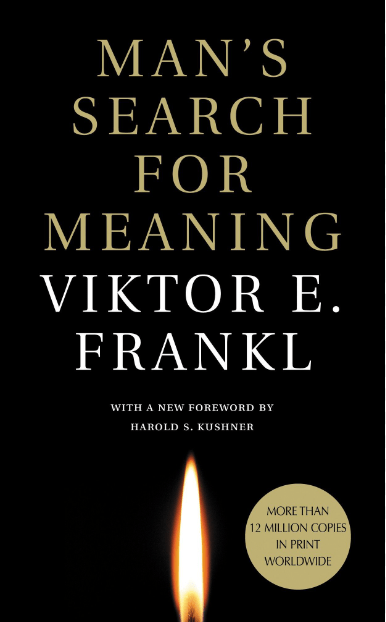
Title: Man’s Search for Meaning
Author: Viktor E. Frankl
Pages: 154
Hi all,
I don’t hope that you have become bored/annoyed by me for doing my first book reviews on books that I had read and reviewed before. With this instalment I come to you with a book that I bought a few months ago and that had only been standing there, waiting patiently for its turn.
Maybe you have heard of the book before, but for those amongst you that haven’t I hope to another edition of my newest books and which have met the expectations that were attributed to it.
It is a book of an Austrian-born Jewish Professor/clinician of logo therapy. He survived the Holocaust that occurred during World War II in Europe but had lost a large part of his family to this atrocious time of human history.
In Part I of the book we accompany him as he gives us glimpses in his daily life (small snippets and not a journal as done by Anne Frank) until his liberation.
In Part II he goes into greater detail to explaining the science and therapy of logo therapy and other means of helping people. In this review I will only focus on Part I.
He explains that when you arrived at a camp, you would all alight from the train and then be split into two rows. Though many of them didn’t know it yet, this was the first selection of who will live in the camp and who will go to the chambers. Since he managed to be selected for the former row he was then guided by the SS soldiers and the Capos (Jewish prisoners that were selected to do some of the dirty work and thus enjoyed privileges above other prisoners) to a building where they handed over all of their possessions and the proceeded to the ‘real’ showers and received new camp clothes.
- One may wonder why would some of these prisoners choose to become a favourite and do heinous and brutal acts against his fellow kin?
- I doubt any of them performed these duties for sheer enjoyment or seeking of status. They will very likely have felt remorse (even after liberation) every time they did harm. Survival can make us do things we would not have thought ourselves possible before.
He also notes from the start that during this time a prisoner would undergo three mental shifts:
- The first is the period following the admission to the new camp;
- The second is the period when he is well entrenched in a camp routine; and
- The third is the period following his release and liberations.
During the first phase he notes that one is in shock that this situation is real and that they are really living in this moment and not dreaming. In this period people are still slightly motivated (or in a delusional state) that this will be over soon and this will be all over. The shock is strongly felt by the reader because the author paints a picture how the people are treated in inhumane conditions that go beyond proper conduct.
During the second phase the prisoner becomes accustomed to the new reality. Pain is merely something part of the daily routine. Sleeping in freezing conditions, surviving in malnourished circumstances and no longer holding on to an identity other than the number one was assigned. At this point, when someone was hurt or injured, no one any longer flinched but accepted it as it is.
During the third phase, when the prisoners are finally liberated they are in a state of delusion because they have hoped and longed for this day for so long that they simply cannot believe that it has finally come. Their new routines have become so imbedded in them that life’s purpose was simply to hope for liberation and what one would do once it came, not thinking it ever would.
- What is really critical in this phase is to help people with therapy to learn how civilized humanity is supposed to be.
- Why this is important is because after their release they have a sense of wanting justice.
- Yet, he writes that justice would not be achieved by inflicting the same harm upon their previous oppressors since being human in a modern age meant that no one had the right to inflict harm upon another. This he realized would be tricky to help his camp goers to understand.
It is quite mesmerizing to read how, even after suffering through such hardships, he realized that the way forward was not avenging in the same fashion, but find a better way.
Another person that came to this understanding was Nelson Mandela of South Africa. In his young years he was fighting against the Apartheid regime for the way they ran the country. His actions weren’t solely through protests, but also by resorting to violence. He was later sentenced to serve in prison. Eventually, he was released from prison in early 1990s, after which the white population under their then president had resorted to abandon the Apartheid regime to become a more equal nation. With his release, his followers will likely have believed that he would become their next president and punish the white population for what their government had done to the African population. However, he saw that violence would not be the way, but rather learning to work together and not repeat their history again.
Quite astonishing how some people have suffered brutally under some form of regime and yet come to such a conclusion.
Summary:
The book is definitely worth a read for anyone that wishes to read some of our 20th century history, but also to those that wish to see how truly powerful some people of this world were, but they would never be all known by name. We learn most when going through difficult times, but it is fascinating how strong some people stood even after undergoing some of the most grotesque punishments. The book deserves a rating of 4.4/5 for its powerful message.
 MyBookReviews