Title: Die Millionars Formel – Der Weg zur finanziellen Unabhaengigkeit
Author: Carsten Maschmeyer
Pages: 341
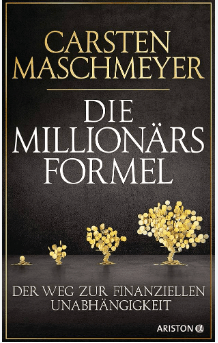
Hi all,
I have always had my eye on this book but only bought it due to a discount at the bookstore. I had also finished reading it a few months back, but kept rewriting my review, since it was too large.
It is from another German author about finances and what he deems to be relevant and prudent steps to take to steadily build your own wealth. As you read through them you will find many of them to be straight forward and simple, which is what the author tried to communicate. Making money is easy. Making more money requires us to make new decisions.
The book is broken down into the following chapters:
- Prelude (pg. 11)
- The author gives a brief introduction how it is still possible to make a small fortune, despite a world where there are low interest rates. Also, why it makes sense to invest in other assets than bonds and life insurance policies, especially when those cost more than they will provide in return.
- Chapter 1 – Successfully managing money (pg. 15)
- It is important to make it clear for yourself 1) where you are right now and 2) where you want to be.
- To get to a better life we need to start making better financial decisions. First is being aware that you need to take your finances under your control and make your money work for you.
- Chapter 2 – The get-rich strategy (pg. 35)
- Develop a financial plan. Save up 10% of your earnings and put it away to work.
- The earlier you start having those savings get to work, the greater the impact of interest on interest earned can be.
- All of your early returns should be reinvested to increase the money working for you.
- Enhance your financial knowledge so that you can learn to find those optimal investments. You are not aiming to become a financial expert, but are aiming to be able to spot a good company from a speculative/trend company.
- To get started, select an amount that will be automatically withdrawn from your monthly pay that is transferred to your savings- / investment account. When your salary increases, also transfer from this increased amount to your other account.
- Chapter 3 – The money machine (pg. 63)
- When you stop working you are also stopping to earn money that will add to your wealth. Thus, to be able to continue living, even when you are temporarily not working you should have built a money machine that will earn money for you.
- The money machine is all the investments you have made (initial investments, as well as subsequent reinvestment of earnings).
- Finance plan:
- Save 10% first
- Use the remainder to cover all other fixed and variable necessary expenses.
- Save money until you have reached an emergency savings amount (3 – 6 months salary).
- After that, invest the remainder in other investments (shares, etfs, etc.) or save money for a home.
- Bear in mind, you should not save so frugally that you do not use some of it to have some fun during the month. You should enjoy the journey to build your wealth.
- Chapter 4 – The income improver (pg. 79)
- You should do everything in your ability to increase your earnings. Either work harder to get promoted or enhance your current skillset so that you might become employed elsewhere where you will be paid more for those skills.
- The more you can earn, the more you have available to invest.
- Chapter 5 – Fight against wealth vampires (pg. 121)
- Keep your expenses under observation so that you may identify those which are consuming much of your earnings, but which are not necessary.
- Stop making spontaneous purchases.
- Differentiate between good debt (real estate) and bad debt (consumer goods).
- Chapter 6 – Ending the zero-interest-rate world (pg. 143)
- Traditional investment products our (great-) grandparents used to utilize were fixed-interest rate life insurance policies, high interest rate savings, etc. These interest rates are no longer available to us in the modern time (at least not for many succeeding years) which is why another means of investing is needed from us.
- Leaving money on low-earning savings accounts, as well as high inflation, only increases the speed at which our money is losing purchasing power.
- In a low-interest world, the winner is the state and the loser is the saver, since the state can borrow at the saver’s expense.
- Change your viewpoint. Don’t see it as things are increasing in price, but rather view it as your money purchases you less!
- Chapter 7 – The yield rocket (pg. 161)
- There are many types of “assets” that you can invest in other than keeping cash. You should look at investing 1) diversified and 2) in productive assets.
- Having an investment in shares /etfs requires one to be an optimist. We need to invest with a mindset that times will be tough for economies and companies, but that times will rebound.
- You need to be comfortable in the choice of investment you make. If you don’t feel that you will be able to sleep with a choice you make, then make one that you would rest more assured with.
- Don’t try and time the market, but rather have your money spend time in the market. You will experience the cost-average-effect from buying on highs and lows.
- Don’t fall for lifestyle inflation!
- Chapter 8 – The dream of real estate (pg. 201)
- If owning a property is something you could consider yourself being comfortable with, then try to realize that dream for yourself. If you don’t believe you could deal with it (sudden damages, etc.) or if you have not yet settled where you see yourself in future, then consider remaining as a tenant for a while longer.
- Being a home owner will require you to increase your emergency savings for any home damages that might happen.
- Chapter 9 – Replacement income in retirement (pg. 227)
- You should not rely on the state pension promised to you once you retire. It is outside of your control to know whether what you will then receive will be sufficient to uphold your current /aspired lifestyle.
- Thus, take active steps to invest yourself as well, so that the money received from the state pension is rather seen as a bonus pay on top of your own accumulated savings.
- Chapter 10 – Receiving and managing capital (pg. 247)
- Become informed of the various types of investments that are available to you. Then, look at which ones are suitable for your purposes and within your risk tolerance range.
- No investment (incl. money in the bank) is ever risk free. Thus, we should rather invest what we have in a manner that manages to earn a decent return at a not to high risk of loss.
- Remember, we only stand to lose 100% of our investment, but the gains we could make can surpass the 100% mark and more.
- Chapter 11 – To greater wealth at your own means (pg. 285)
- Building wealth from a month-to-month paycheck is not easy. Building wealth by starting and growing your own business is much more likely. If you work for a paycheck, your reward (regardless of the hours) will be that paycheck. If you work and grow your own company, your reward is the grown value of the company. The more hours you put in, the greater the reward you can see.
- However, running a business is not within everyone’s spirit and thus, if this is not our means, then we should work to improve our salary earnings.
- Chapter 12 – Releasing the wealth brake pedal (pg. 305)
- Chapter 13 – Protecting income (pg. 315)
- Take out an income-protection insurance, in case you could lose your profession.
- Take out an occupational disability insurance, in case you suffer an injury that makes you incapable of working.
- Take out other insurance that are deemed relevant in your country or for you personally (due to type of profession or family illness history).
- Chapter 14 – Wealth for your loved ones (pg. 321)
- Invest and set up a fund that will finance your family in case of your early departure. This fund should be capable to finance their daily expenses, finance their education and other necessary expenses.
- Chapter 15 – Enjoying financial independence and freedom (pg. 331)
I have refreshed my knowledge of what I had learnt before of finance truths and always am happy to see how a different author reaffirms what another author has already taught about finances. I have implemented some of the strategies from other books (some also included here) and have seen some positive change. The most impactful one: taking control and not being afraid of the topic of finances.
It has become a quite fun topic and hobby to talk about with two of my friends. We regularly talk about companies on the stock market, what is currently going on (i.e. shares dropped due to this announcement, interest rates rose and who might benefit from this opportunity, etc.).
I hope you also learn more from this book!
Summary:
The book is written clearly and simple to understand. It underlines the important steps one can take to change one’s life and improve their financial situation. The book receives a rating of 4.15/5.
Patience is bitter, but its fruit is sweet – Aristotle.
Link (German): https://amzn.to/4pTP86v
Link (English):
 MyBookReviews