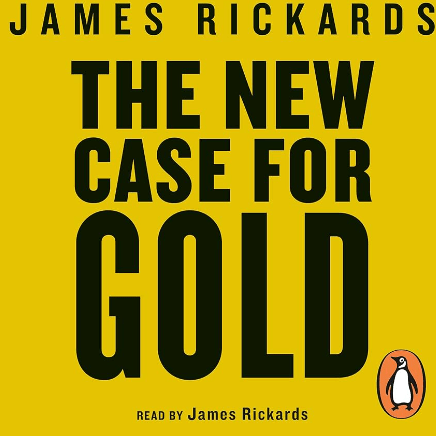
Title: The New Case for Gold
Author: James Rickards
Pages: 170
Dear reader,
The concept of diversification was papered by Harry Markowitz, but its roots run much further back into history. It is something that was spoken of and applied but it was not really put down to paper (economic paper) for the broader populace.
Why do we diversify?
Some prominent investors do not diversify their share portfolio that widely (e.g. the late Charlie Munger only held about 5 stocks in his portfolio) because they focus more time on finding really good companies that don’t require hedging against. However, the majority of the population does not have that same skill and many don’t want to do all the same time-consuming research to find them. Therefore, building a large portfolio is a hedge against one’s own ignorance.
In one of Robert Kiyosaki’s books he tells the story of a prominent family he got to meet in Italy, who have managed to uphold their wealth, throughout the tumultuous changes over the centuries, and have themselves applied a hedge against money. They have invested their money into three pillars: gold, land and art. Today, they very likely also have a pillar for shares / bonds / crypto / other speculative assets, but it shows that even the most prominent families knew that diversifying was in one’s best interest.
From the various books I have read, the conclusion that the majority of writers have agreed on is that having some (min 5% – max 10%) precious metals in one’s portfolio is advisable.
What’s it with precious metals?
Previously (pre-WW1), most world economies were running on a gold-backed standard. This means that gold and/or silver coins were used parallel as paper currency to enter into transactions. Furthermore, for each paper currency there was a specified amount of gold held at the bank. Thus, the bank could not simply print more money for the governments / monarchies. Paper money was considered a stable alternative that also retained some wealth (i.e. store of wealth).
However, in many instances in the past (Roman history, Byzantine history, WW1, etc.) the ruling party wanted to spend more money (entertainment, war, etc.) and therefore devalued the value of the existing currency. During WW1 the banks terminated the exchange of paper currency for gold, and then printed more money to borrow to the ruling party to finance the war. After the war, Britain and France tried to bring their currencies back to a gold-backed standard at the pre-war rate, which had disastrous consequences. Why? Simply because there was more paper currency in circulation than before, with the same volume of gold and other goods.
–> Therefore, more paper currency was chasing the same volume of goods, which made the currency less valuable.
Since people cannot hedge themselves with their paper currency against this inflation game, they can resort to storing their money (purchasing power) in alternative assets, one of which is gold.
Why invest in this alternative asset?
One reason is simply diversification. Another is that gold is a highly liquid item that can be converted into cash quickly. An additional reason is that in a globalized world of supply and demand, you will always find someone willing to exchange some of their goods for your precious metal. When you show up with a paper currency they don’t trust then you will have less luck.
The book?
In this book, you will find arguments from the author why he believes the commodity is an appropriate hedge instrument against our fiat currencies, which have consistently been inflated by our governments for the last decades. Where you cannot control how much paper currency is in circulation (that will store your purchasing power) you are able to invest in another asset that gives you this ability.
The book is broken down into the following chapters:
- Introduction (pg. 1)
- Chapter 1 – Gold and the Fed (pg. 19)
- Chapter 2 – Gold is Money (pg. 28)
- Chapter 3 – Gold is Insurance (pg. 57)
- Chapter 4 – Gold is Constant (pg. 88)
- Chapter 5 – Gold is resilient (pg. 116)
- Chapter 6 – How to acquire Gold (pg. 148)
- Conclusion (pg. 167)
Summary:
After the gold price (amongst others) has recently grown in value I wanted to refresh my understanding of its importance in our portfolios since last reading it in 028-2020. The reader must bear in mind that the author is quite convinced of the downfall of the fiat paper currencies, which is very pessimistic. It makes good cases to understand how we can make provision in an uncertain world (to store wealth). The book will receive a rating of 3.65 / 5.
Link (German): https://amzn.to/4pazrXp
Link (English): https://amzn.to/48WJfj3
 MyBookReviews