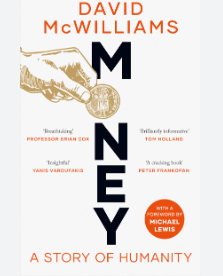
Title: Money – A story of Humanity
Author: David McWilliams
Pages: 370
Dear reader,
Though we may be very familiar we what we define to be money today, we may also have a vague understanding of what could have served as money many years /decades / centuries prior. But often we don’t know how these forms of money / credit / other financial instruments came to be.
To address this question I found the interesting book (008-2022 The Ascent of Money) which explains how money, bonds, stocks, insurance came about. That was quite insightful and I would recommend to be read. However, when I strolled through the bookshop I noticed this book, paged through a few pages and thought it could also offer some greater insight.
It follows a different approach from the other book, in that it puts history and money next to each other to show how humanity advanced in parallel to money. However, I need to make a correction. It is not necessarily the advancement of ‘Money’ but the advancements in forms of ‘Credit’ instead. Credit is placed parallel to human advancement.
The book follows the reader how different forms of money (i.e. credit) were developed, how these aided to advance technological advances that allowed the world to ever evolve. The book is well written and no difficult technical jargon, and is written in chronological order so the reader can properly follow the red thread of history.
The book is broken down into the following chapters:
- Introduction (pg. 1)
- Part 1 – Ancient Money
- Chapter 1 – Money in the Beginning (pg. 15)
- Chapter 2 – By the Rivers of Babylon (pg. 23)
- Contracts on stone tablets (Mesopotamia)
- The concept of “rate of interest” received meaning when people understood they could borrow from the future and repay over time. This was essential to motivate people to want to take some risk to better their circumstances.
- Chapter 3 – From Contracts to Coins (pg. 33)
- Electron precious metals were minted into standardized gold coins of Lydia
- Coins moved their economy from a top-down economy to a bottom-up economy. This means that the king and the aristocracy alone didn’t make a prosperous country, but rather the number of merchants since they have an opportunity to attain wealth. This wealth spurs the economy, which improves the situation for all, including the ruling class.
- Chapter 4 – Money and the Greek Mind (pg. 44)
- When the Greeks also adopted the coin as money, they were enabled to make their trades more efficient throughout their vast Mediterranean trading network.
- In addition, the people of Athens started a revolution, revolution away from ‘mythos’ towards ‘logos’. Thanks to their vast trades, they get into contact with other peoples and their ideas/inventions/religions and start thinking of the world in a more rational and calculated way paving the way to a lot of the Greek literature, mathematics, medicine and literature for which they are well known by.
- Additionally, the low taxes on the peoples (since they were not a monarchy) gave more disposable income to spend, whilst the other kingdoms in the neighboring monarchies had steep taxes that resulted mostly in the aristocracy alone to spend on lush items.
- Chapter 5 – The Empire of Credit (pg. 57)
- The Roman empire stretched much further than the Greeks, connecting Europe to Asia, people different cultures, languages, religions, etc. After conquering another territory they would mostly let the kingdom be ruled and run by the local peoples, with the exception of few administrative tasks (incl. tax collection). Therefore, they were tolerant of different cultures, which is the best form of ruling a kingdom that is vastly different from one’s own.
- Some towns in the Roman empire were more wealthy than others, since they were much more tolerant towards each other and where everyone understood that the common unifying language there was money. Trade and money trumped all their individual cultures and religions and therefore attracted more people to it.
- The Roman empire was largely financed using credit. By standardizing their coins with a fixed value in grams silver, the people would initially take the coin to have value since it was supported by the state. In later decades, emperors would continue to debase the currency, and people would gradually lose more and more faith in the coins’ value.
- Part 2 – Medieval Money
- Chapter 6 – Twilight of the Feudal Economy (pg. 81)
- Under such an economy, the land is owned by the wealthy church or aristocracy and the lower citizens are permitted to farm the land in return for a % of the crops (not currency), which doesn’t enable to trade other than barter for basics.
- When the (metal) plough was introduced from Hungary, the farmers of Europe were able to generate more surplus foods and use less hands on the fields. This gave other people the opportunity to dedicate their time to other endeavors (trades, arts, etc.).
- Chapter 7 – Saracen Magic (pg. 96)
- European traders still relied on the Roman numerals, whilst those from Asia were already using the Hindu-Arabic numerals (in addition to other mathematic formula) to conduct their daily trade.
- Leonardo of Pisa (Fibonacci) wrote the Liber Abaci to introduce these to the European continent and the merchants started to adopt it rapidly since it was more efficient to use for trade.
- The art of bookkeeping using these numerals would be introduced by Luca Pacioli, which would give traders a means of accurately calculating their financial performance and position due to double-entry bookkeeping.
- Chapter 8 – Darkness into Light (pg. 113)
- Florence became an important merchant city and with large amounts of money the wealthy families financed art and construction to make their city beautiful for all to enjoy.
- They minted their own coin, which others then used as a base currency, one which they could trust to uphold its value. The strength (stability) of the currency gave strength to the republic.
- It was forbidden to make money from money (i.e. interest = usury) in the eyes of the church. Therefore, the bankers instead levied a service fee for exchanging currency or loaning it to people.
- Chapter 9 – God’s Printer (pg. 135)
- The Hundred Years War between France and England (1337 – 1453) diverted trade more towards Germany.
- When the Ottoman’s won over the last pieces of the Byzantine Empire (1453) it closed the Silk Road from Europe to Asia, which prompted European monarchs to seek other paths to reach Asia. Some went around the African horn whilst others ended up discovering the New World (Americas).
- Gutenberg wanted to start a new venture and thanks to the money flowing into Germany via trade someone was willing to fund it. He went to build the printer and became the official printer for the church absolvent letters and later the bibles.
- Thanks to more wide-spread printing there came a literacy boom as more people learnt to read (books also became cheaper). Literate people allowed for ideas to be spread wide and people used their minds to think more on other topics (politics, economics, literature, science, etc.)
- Chapter 6 – Twilight of the Feudal Economy (pg. 81)
- Part 3 – Revolutionary Money
- Chapter 10 – Invisible Money (pg. 159)
- The idea that money could be represented by a piece of paper was a next slow step to be gradually adopted by some economies in Europe.
- The Netherlands was one of the economies that profited from the closure of the Silk Road since they sent ships to acquire valuable products from the east Asian countries and sell it back home for profit. To fund these expeditions, they collected money from various individuals and sent them off. They became shareholders to this ship-company. However, since these expeditions take time and some people require liquidity sooner they created a bourse where people could sell their shares to other people.
- These inventions (stock market and public company) were soon adopted in other countries.
- More important, the mentality of the people had changed to being more open to take risks and become a more business oriented economy, which in turn made them more open and tolerant towards different cultures and nations.
- The openness to risk-taking would also bring them to suffer their first financial bubble, known as the Tulip Bubble.
- Chapter 11 – The Father of Monetary Economics (pg. 177)
- John Law, a Scot, fled his country since he had killed someone in a duel and decided to travel and work in Europe. He gambled more than he worked and managed to accumulate some fortune. When he became introduced to the central bank and the stock exchange, he had his own idea how it could be run better, by allowing more money to be printed than for which there was gold backing.
- Most nations didn’t adopt his suggestion, with the exception of France, who were in a terrible financial state and were willing to try anything to improve the country’s prospects.
- His central bank became the sole issuer of the currency. Further, he created a company that acquired all the companies operating in the French territories of America and gave that company the sole license to operate for the French. He gave the people that held bonds in the monarchy shares in return for their bonds, thus reducing the debt burden of France. Additionally he continued selling shares to more and more people, since the news was put out that there were golden prospects.
- More money was flowing in the country and spurred the economy. However, soon people started to think that the prospects may have been oversold and the sell orders overflooded the buyers, resulting in the shares and currency values to crash, well known as the Mississippi Bubble.
- As a result, the people would not trust paper currency for a long time to come.
- The British tried a similar experiment, with the same result of the company going bust, known as the South Sea Bubble.
- Chapter 12 – The Bishop of Money (pg. 192)
- After the French Monarchy was overthrown, the task was for the revolutionaries to establish a new kind of state. Bear in mind, all the neighbors were still run as monarchies, so their interest was to install a monarch in France again.
- Thanks to the improved literacy rates, enabled by the printing press, Europe was going through an Enlightenment phase.
- The revolutionaries had to find a way to stabilize the country, and that included stabilizing its taxes and currency. The people had gone to revolt due to high taxes. Thus, the new government could not raise taxes to pay for the debts and neither could it raise its interest rates.
- An idea was introduced by Talleyrand-Perigord, where he suggested to confiscate all the property that was held by the church and sell the rights to future ownership to collect some money. People were happy with this arrangement and thus it was able to reduce the debts. However the problem still persisted that it would need to introduce some form of taxation in order to run a country.
- The revolutionary leaders were not willing to compromise and therefore simply printed more and more rights to future land ownership. This would not end well as people became suspicious and ultimately landed France in a hyper-inflation.
- Chapter 13 – Money and the American Republic (pg. 209)
- After the Americans successfully won their liberty from the British monarchy they had to start organizing the country on their own. Alexander Hamilton had been a close correspondent with Talleyrand and therefore understood too well how important it would be for the American colonies to establish a strong currency.
- The show the new Dollar was a credible currency, they linked their currency to the Spanish currency, which was a credible currency at the time.
- Furthermore, he wanted to help shape the new America into a proper capitalist country that focused strongly on trade whereas some other leaders, including Jefferson, didn’t want to shape a true capitalist society since they believed that the currency should not have such force to corrupt its people. Therefore, his view of economy was less progressive and explorative and more risk averse.
- Chapter 10 – Invisible Money (pg. 159)
- Part 4 – Modern Money
- Chapter 14 – Empiricism and the Evolutionary Economy (pg. 229)
- Chapter 15 – Money on Trial (pg. 245)
- Chapter 16 – Yellow Brick Road (pg. 263)
- Chapter 17 – Modernist Money (pg. 279)
- Chapter 18 – Into the Abyss (pg. 294)
- Part 5 – Money Unbound
- Chapter 19 – Who Controls Money? (pg. 317)
- Chapter 20 – The Psychology of Money (pg. 337)
- Chapter 21 – The Evolution of Money (pg. 351)
Take aways:
- Money available to all people –> making money (gold) available to people allows people to take risks and invent new
- Low taxes –> disposable income to be spent as people like
- Democratic government system –> opportunity to try new things at one’s own discretion
- Tolerance towards other cultures –> trade and money are the key currencies
- Technologies give back time –> when we are able to do things more efficiently (i.e. less man power and generate more surplus) some people can dedicate their time to other crafts
- Hindu-Arabic Numerals –> kick-off technology for future advancements
- Stable currency gives strength to the republic / state.
Summary:
Overall, very interesting book to see how money shaped people and how people shaped money. In addition, it can be seen how, when the currency of a country is stable and available for trade, and the mindset of the people is open to new and change, the country sees more ideas (technology, literature, science, etc.) emerge and shape the country into something new.
It gives a clear message, that money should be kept stable but also be available to people so they can take the opportunity to take risk and explore and possible invent something valuable to society.
The book will therefore receive a rating of 4.5/5.
Have a good one!
Link (English): https://amzn.to/4pgsZOL
Link (German): https://amzn.to/4si66wS
 MyBookReviews