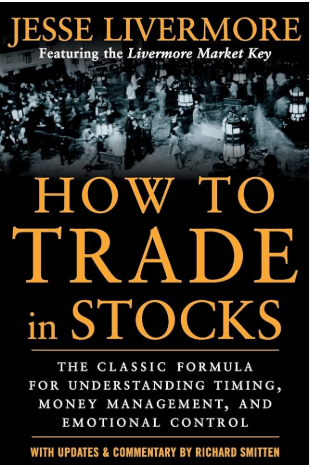
Title: How to Trade in Stocks (The Classic Formula for Understanding Timing, Money Management and Emotional Control)
Author: Jesse Livermore
Pages: 180
Dear reader,
The following book was written by a stock trader that followed a speculation strategy, rather than long-term investment strategy. It is not because I wanted to explore speculation as my next strategy, but rather to see what a speculator has learnt throughout his career and what advice he can give.
I must admit it holds some valuable lessons that even a person with a long-term investment strategy can apply. Why? Even though our holding period is for more than a few years, it is important to take note that the business cycle of a company changes over time (growth, slow growth, cyclical, drop, turn-around, etc.) and therefore we also need to consider whether the investment is still appropriate for our portfolio. After all, the investments serve the purpose of growing our wealth and not end up as a loss.
The book is broken down into the following chapters:
- Chapter 1 – Challenge of speculation (pg.1)
- Chapter 2 – When does a Stock act right (pg.13)
- Chapter 3 – Follow the Leaders (pg.19)
- Chapter 4 – Money in the Hand (pg.25)
- Chapter 5 – The Pivotal Point (pg.31)
- Chapter 6 – The Million Dollar Blunder (pg.41)
- Chapter 7 – Three Million Dollar Profit (pg.49)
- Chapter 8 – TDT Timing Secrets (pg.57)
- TM (The Market)
- Check the current line of least resistance to establish the overall current market direction.
- TIG (The Industry Group)
- Check the specific industry group index movement.
- TT (Tandem Trading)
- Check the stock price movement of the stock of interest and of a second stock to compare them.
- TTD (Top Trading Down
- Check all above data together to get an overall picture.
- Additionally, perform a proper Due Diligence of the stock you wish to acquire, before you make any BUY decision.
- The purpose is that you invest time to research a stock so you find and understand multiple factors that influence a company and ultimately become comfortable to invest your money. However, there will always be unknown factors. Yet, by studying some, you can obtain some level of comfort for your investment decision.
- TM (The Market)
- Chapter 9 – Money Management (pg.91)
- Chapter 10 – Emotional Control (pg.113)
- Chapter 11 – Computer Interpretation of Livermore Stock Trading System (pg.151)
- Chapter 12 – Livermore Secret Rules to Stock Market Success (pg.163)
Some of the important lessons I will take away from the book are the following:
- View investing as a business and not as gambling, so that you will take it more serious when making decisions where to put your money in.
- There are times when one should invest and there are times when one should not invest.
- Money cannot be made every day on the stock market. Only on few days of the year great opportunities present themselves, which is when you should take part.
- During the other days/ weeks/ months you need to let the market shape itself for the next big move.
- The formula to success lies in:
- Timing –
- You need to learn to have patience and not desire to invest everything you have saved to invest. Good investment opportunities come seldom and are only available for a brief moment. This is when you should have the necessary cash to strike.
- All you need to know is that there are good reasons behind every movement of a stock. You don’t need to find out the WHY before you invest. This will be revealed in due time. If you invest too much time to determine the WHY, you may lose out on the opportunity of having bought cheap a stock that was falsely undervalued by other traders.
- “…It is not the thinking that makes the money – it is the sitting and waiting that makes the money…”. –> Sitting and waiting patiently in cash until the perfect situation to invest presents itself to invest.
- Money Management –
- Never average your losses. When a stock has lost significant value, wait to see how it performs in future before you put more money into it.
- Do not delegate the task over your savings to another individual without having an understanding of what is done with it. You have the most vested interest in retaining the value of your position, whilst another person (whose money it is not) has a lower vested interest.
- Don’t risk all of your capital on one single venture. Rather, spread the capital over a few.
- Do not believe that since you may be successful in one area (stock picking) that you will also be successful in any other venture (real estate, art collection, precious metals, options, etc.).
- Never make any trade unless you know you can do so with financial safety (i.e. emergency fund is set up, some additional savings on the side and money used to invest is money you can afford to lose).
- Rules:
- One – Never lose money! Money is your lifeline.
- Two – Set a target as to how many shares of a stock you wish or how much % of your portfolio should be per stock.
- Three – Keep a cash reserve. There is a never ending stream of opportunities and if you miss one, simply wait a while for the next one to present itself. DON’T reach for a trade! There are times when your money should be inactive.
- Four – Stick with the winners. However, do not confuse this approach of investing in the leaders with the “buy and hold forever” strategy.
- Five – Park 50% of any sold share profits in the bank before you immediately reinvest, so you can see the money.
- Emotional Control –
- You should ignore personal opinion and apply strict attention to the action of the market.
- The human side of every person is the greatest enemy of the average investor
- Do not permit yourself to be influenced by the emotions of the other investors in the market. Keep to your principles and leave emotions out of your trades.
- Timing –
- Keep records
- Start keeping records of all the trades (buy and sell) you have conducted throughout the year and document the reasons (i.e. the stock price fell due to some news, but the financial data indicates that the company is still healthy, etc.) why those trades were made. Review these records at year end to see whether you acted responsibly or whether you made a misjudgment.
- Review your portfolio
- We buy stocks with the purpose of building wealth. However, if the company has been struggling for an extended period of time we should review the fundamentals of it to determine whether it will still be able to store and grow wealth or whether it has reached its peak and should rather be swapped for a new player.
- As the decades go, some companies manage to keep up with the trend, whilst others (some of them former top companies) do not and instead lose value.
- Portfolio size
- Hold a small portfolio size over which you are able to keep a good overview. If the portfolio becomes too large, you will lose overview and not be able to trade as successfully.
- –> It is much easier to follow a few companies than too many.
- Leaders vs. Trends
- Invest in the leaders in a segment you are interested in and not the smallest players since the leaders are the stocks that determine the general direction of this segment overall.
- Note – just as styles in jewelry and other trend items change over time, so too do leaders in the segments switch places with other companies. Therefore, do not believe that an investment today will definitely hold out for long periods. You need to check whether the company keeps investing to remain relevant with the modern day demands of consumers.
- Cycles
- Be careful to use the terminology bearish and bullish, since these evoke the understanding that there is an expected prolonged period of either one of these phases.
- Instead, use Upward- or Downward Trend to explain short-term movements.
- Mistakes
- Learn not to make excuses when you are wrong. The market will show the investor when he is wrong. Accept your mistakes and study what your research told you incorrectly to learn from mistakes.
- Notes
- Keep a notebook where you write down interesting events (election results, diseases, revolts and strikes, political tariffs, etc.) that happened on different occasions. This is to understand whether this also had a role to influence the stock price movements.
Summary:
Overall, interesting book, with good tips that both a speculator (short-term) and investor (long-term) can adopt in their strategies. The book repeats some of the above tips in multiple chapters since the book is written as though they were the notes from various conversations. The book will receive a rating of 4.25/5.
Best wishes!!!
Link (German): https://amzn.to/4jkjZ9Y
Link (English): https://amzn.to/3MWNkLt
 MyBookReviews