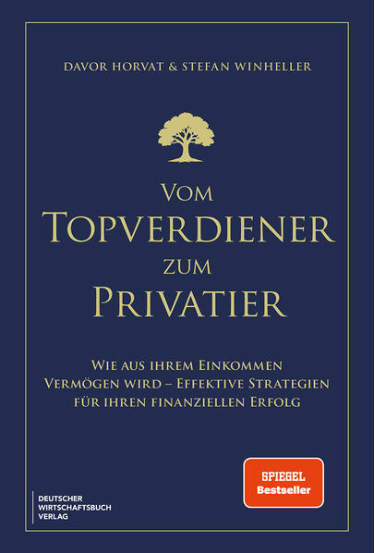
Title: Vom Top Verdiener zum Privatier
Author: Davor Horvat & Stefan Winheller
Pages: 362
Hi all,
although the author mainly addresses top income earners, it is also a top read for earners from other income groups as well. The author tries to help the top income earners to maintain their high standard of living even in retirement, however, lower income earners can also apply some strategies because their aim in retirement is not the same standard as the other group. Its goal is perhaps to live better off than merely being dependent on the state pension alone.
In Germany, the income groups can be classified as follows (2025):
| Monthly gross in EUR | Annual gross in EUR | % in the population (accumulated) | |
| Top earner | > 23.277 | > 279.324 | 1% |
| Peak earner | 8.360 – 23.277 | 100.320 – 279.324 | 10% |
| Good earner | 5.860 – 8.359 | 70.320 – 100.308 | 20% |
| Better earner | 4.072 – 5.859 | 48.864 – 70.319 | 35% |
| Normal earner | 3.315 – 4.071 | 39.780 – 48.863 | 45% |
| Middle earner | 2.379 – 3.314 | 28.548 – 39.779 | 60% |
| Low earner | 1.793 – 2.378 | 21.516 – 28.547 | 70% |
| Little earner | 1.195 – 1.792 | 14.340 – 21.515 | 80% |
Therefore, for a top earner to maintain their current standard of living, even during retirement, they need to take some serious steps to build the money machine that will provide them with the same sum of earnings p/annum as when they were working.
To help with this, the book guides the reader through a series of topics that will help the earner make proper decisions that will hopefully help them to make the appropriate provisions.
The book is broken down into the following chapters:
- Chapter 1 – Why you should read this book (pg. 7)
- Chapter 2 – Your starting point on your way to becoming a rentier (pg. 13)
- Four initial steps that you should take on your way to build your money machine:
- Step 1 – Define what financial independence means for you (i.e. set your goal as clearly as you possibly can)
- Write down a list of all your current expenses (fixed and variable) per month. The objective is to find out how much passive income you need to cover your basic necessities without requiring to work.
- Then, make a list of all the expenses you expect to be incurred for activities other than basic necessities (hobbies, holidays, culture, lifestyle, small luxury). These expenses are on top of your basic necessities.
- The, if you want an additional financial barrier for expenses that give you additional luxury and freedom (luxury spending, choosing where to live, spontaneous big spending) determine how much you would potentially need for such expenses.
- Next, you need to estimate for how many years such expenses will fall upon you. You can use different sources to estimate a conservative amount.
- Finally, you can discount those expenses for the selected time back to a present value using a rate between 3% and 7%, which represents the current value you would need to invest on the day of your retirement, were you to make this investment only once.
- Now, if you don’t have this fixed amount on hand, you will need to draw up a savings plan to invest the total balance by the time you reach retirement. The earlier you start saving the lower the monthly contributions need to be to reach the said amount. Therefore, time is your friend and it is best to start as soon as possible.
- Note – it is not within your control to determine how much money you will receive from the state pension. However, it is within your control to determine how much you could top up your pension by, since the money you invest yourself will only be available to you at retirement.
- Step 2 – Build your financial base
- In the first step, the focus was mainly on what expenses would need to be covered. In this step, we will look at the income side.
- Write down a list of all the different incomes you are currently earning (i.e. salary income, dividend income, interest income, rental income, etc.).
- Next, write down a list of all the current expenses (fixed) that get deducted from your income before it lands on your bank account (i.e. taxes, pension insurance, health insurance, unemployment insurance, other insurances, etc.) then deduct the amount of living expenses you calculated for a month / year from the net balance. This net balance shows you the amount you currently have available to invest / save.
- The point of the exercise is to understand what is happening with your money every month.
- Step 3 – Identify savings potentials
- Often top earners will lose some sight over their expenses because in the end there appears to be sufficient income to cover them all. However, living like this without a plan will not allow them to live a retirement life at the same living standard as before.
- Therefore, financial plans are critical to help individuals to gain control over their finances. The objective with this step is not to make your life less comfortable to live in. More so it tries to help you to prioritize what’s most important to you.
- The take away for you should be: invest regularly, selective, simply and cost-effectively.
- Step 4 – Develop the appropriate investment strategy
- Your strategy should be broken down as follows: one portion that regularly generates income and one portion that focuses on growth.
- Regular income can be derived from bonds or dividend paying stocks, as well as rental income.
- Growth can be derived from stocks focused on growth rather than high dividends.
- Note, the more time you still have to invest, the more likely it is that your stronger focus is on growth than on returns. Contrary, the less time you have to invest the more likely your focus will lie with regular returns. Therefore, as time progresses, your focus will shift, prompting a rebalancing of your portfolio.
- Your strategy should be broken down as follows: one portion that regularly generates income and one portion that focuses on growth.
- Step 1 – Define what financial independence means for you (i.e. set your goal as clearly as you possibly can)
- In order to make the most of your financial plan, there are five guidelines that you should follow in your life to make the achievement of your goals a greater likelihood:
- Guideline 1 – Adopting the correct mindset for financial success
- Achieving financial success requires more than financial education. Your attitude, discipline and stamina also play an essential role to keep following the investment strategy.
- Guideline 2 – Reducing debts
- Differentiate between bad – and good debt.
- Bad debts are mostly incurred for consumables which will bring no future return.
- Good debts will generate future returns.
- Bring down your debts so that the monthly income at your disposal is at your disposal for investing and saving, not to repay others.
- Differentiate between bad – and good debt.
- Guideline 3 – Living within your financial means
- Focus on conscious consumption, rather than living impulsively.
- The goal should not be to reduce your living standard that results in not having funds to spend on yourself. Instead, you should prioritize from what you get the most utility and value, not mass consumption.
- Guideline 4 – Building wealth with patience and discipline
- Keeping in mind that growing wealth takes time. Therefore we need to shift our focus from short term to long term.
- Guideline 5 – Following a clever investment strategy
- Do not buy into multiple investment products. Each costs money, which reduce the returns that your money could have earned from a cheaper investment product.
- Invest into simple products that are not constructed complexly.
- The simplest investment products are bonds, shares and real estate.
- Do not get caught up by short term trends.
- Guideline 1 – Adopting the correct mindset for financial success
- Four initial steps that you should take on your way to build your money machine:
- Chapter 3 – Your financial advisor is not your friend, nor should he become it (pg. 59)
- Before engaging a financial advisor, there are some things to keep in mind:
- Financial advice is never really free. If they present you with a freeby then that is merely some information to get you interested to come and pay for the advice from other packages.
- The true costs are never completely disclosed. The cost structure is written complex and only in % terms, but those % costs add up.
- Every costs eats up your returns and future potential returns.
- Remember, understand how the financial advisor is compensated. If they are compensated on commission, they do not have your best interest, since they work to earn their commission. In contrast, a financial advisor you pay a fixed amount does have your financial interest, since you are paying them for advice, not to be referred to a product from another company.
- Before engaging a financial advisor, there are some things to keep in mind:
- Chapter 4 – Investment types and -products – What you really should know (pg. 87)
- Some do’s and don’ts:
- When you don’t invest in an asset class directly (e.g. shares, bonds, real estate) but rather in a fund that holds these assets, avoid investing in a fund, where it’s asset holdings are complex (i.e. the fund invests in multiple funds, which hold partially assets and partially holdings in other funds).
- The fund does provide you with diversification, but complexity does not translate to better diversity.
- The following asset classes are available to invest in:
- Primary investment classes:
- Shares
- Bonds
- Real estate
- Money market
- Raw materials
- Secondary investment classes:
- Private Equity
- Collectibles
- Land / Forestry
- Crypto
- What differentiates the asset classes is their liquidity (primary is more liquid), accessibility (PE is not available to the general market), risk (with shares you have the live trading price, vs collectibles where you need to find the buyer for your price) and inherent value (Shares are ownership of a company, whilst crypto is not attached to an item, but merely derives value that people are willing to pay for it).
- Primary investment classes:
- Quality has a price?
- When you wish to receive an outstanding product or service you are generally expected to pay more cash for it. The best tickets to a game, the best quality hand bag, etc.
- However, when it comes to investing, paying more does not translate to better results. Here the goal is to have lower costs, so that more of your invested money can work to generate you returns.
- Picture the following two scenarios:
- Scenario both:
- Investment on day 1: 100.000
- Return p/a: 6%
- Period invested: 20 years
- Scenario 1:
- Total cost p/a: 2,5%
- Investment value after 20 years: 193.290
- Scenario 2:
- Total cost p/a: 0,5%
- Investment value after 20 years: 290.120
- Scenario both:
- Some do’s and don’ts:
- Chapter 5 – Do not speculate! Invest instead! (pg. 157)
- Experience has shown that trying to achieve long term success with short term and regular trades will not bring the same returns as when following a long term strategy with fewer trades.
- For one, the frequent trades all incur costs for you, which eats the returns. Furthermore, every trade requires to be taxed for its gains, which also eats into your returns.
- Analysts daily try to find information that will give them some foresight to how one stock might become better valued in the coming days, so they can invest now and profit later. However, countless studies have shown that trying to time the market has not worked and that countless great opportunities were missed frequently by top traders.
- Therefore, instead of following analysts research and tips, invest in a widely diversified ETF. The longer you are invested in these ETFs the closer your annual return will become a figure between 7% – 10% p/a, since you monthly investments are made during high and low phases, averaging your returns.
- MSCI World return p/annum from 1970 – 2024 9,83%
- MSCI Europe return p/annum from 1970 – 2024 8,10%
- MSCI Germany return p/annum from 1970 – 2024 7,71%
- S&P 500 return p/annum from 1970 – 2024 10,95%
- Between 1970 and 2024 there have been multiple crises and economic booms. During these 55 years, there have been only 15 years where the MSCI World has not stood higher than the beginning of the year. However, over 40 years, the index has been higher than when it began.
- Most ETFs shown above have a stronger focus on Industry countries. Their countries growth rates have not been very good for many years, in contrast to the growth rates of Emerging countries. Therefore, to try and profit somewhat also from the Emerging countries, you can add an ETF (from the same issuer preferably) for the latter markets. This brings an additional level of diversification plus opportunity to attract more growth.
- By investing in an ETF you will hold a share in multiple companies. Some will be successful and some will be less successful whilst others might die off. With an ETF you are lowering your risk of investing in a single stock that unfortunately might not become successful and therefore bring a lower return than the investment made in it.
- The following are some of the mistakes that you will come across that you should try to avoid to make the best of your investment journey:
- Mistake 1 – Overestimating yourself after landing a few successful trades in the short term.
- Mistake 2 – Involving emotions when making investment decisions. Psychologically we are hurt more when we lose money on an investment than when we are happy when we make money on an investment. There have been many crises in the past, all of which have affected the stock market in their own way. When stocks fall we need to be brave to hold on to stocks and not sell with the crowd. Why? Because if you know that you identified and invested in a solid stock, then it is very likely that it will again gain in value.
- Some events cause crises that affect all stocks, even though nothing has happened in the company to justify its value falling.
- Other events cause crises which affect certain sectors only, for which reason your stock also fell, but also not necessarily because your stock is directly impacted.
- Finally other events cause crises that affect your stock directly. In this case you need to look whether the drop in price is justified or whether there is an overreaction.
- Sometimes a drop in price is justified because the stock was overpriced due to euphoric expectations. Thus, the price is experiencing a correction.
- Other times, the price drop is far more than is justified. Here, people have overreacted to some news event.
- Mistake 3 – Believing in timing the market.
- Mistake 4 – Seduction of stock picking.
- Mistake 5 – Overly invested in the home market (i.e. home bias)
- Mistake 6 – Impatience – the expectation to make huge gains in the short term
- Chapter 6 – The road to an investment portfolio – Your seven steps (pg. 191)
- Now that you have learnt of the market and psychology of the market, you will learn of the seven steps to follow to help you build your own portfolio:
- Step 1 – Determine your risk tolerance
- A higher risk tolerance allows you to invest more funds into the asset class stocks, which will enable you to earn and grow your wealth more significantly than compared to investing largely in bonds.
- This choice is not just a personality matter, but also an age matter. Your need for cash is higher during your retirement phase than during your early work life. During the latter, you able capable of sustaining losses in market crises since you have time for your funds to recover.
- Step 2 – Focus on the appropriate asset classes
- Based on your risk tolerance selected in step 1, you will now determine which asset classes are appropriate to cover those risks appropriately.
- Also relevant to consider here is the allocation between countries you wish to cover in your portfolio. Here the author not only recommends investing in Industrial countries but also a small portion in Emerging countries.
- Step 3 – Choose the appropriate market indices
- The purpose of this is to find an index to track how this market is currently developing. Then you will use this to compare how your own finance instrument is performing in comparison to this.
- Some criteria that an appropriate index should fulfil are the following:
- Criteria 1 – The index should be broad and contain a large group of companies
- If you want to buy an ETF that follows the US economy, the better index to compare your performance against is the S&P 500 or MSCI USA since there are more companies included therein than the Dow Jones with a mere 30 companies.
- Criteria 2 – The index should be a performance index and not a stock index
- Performance indices track the value of the stocks therein, including the dividends issued (assumed to be reinvested), whilst stock indices solely track stock prices.
- The former is a better comparable index since your total return should be taken into consideration when comparing your ETF performance against that of the Index.
- Criteria 3 – Use the classic indices that accurately reflect the market companies.
- Those indices of only few branches do not give an accurate depiction of the current economy.
- Step 4 – Choose the appropriate finance instrument
- You are not able to invest directly into the index, therefore the best alternative is to invest in index funds which very closely track the index itself, which is an ETF.
- Since there are many hundreds of ETFs out there, one should be careful in the selection of an ETF that meets the criteria that best address your needs. Some of these criteria to be considered include:
- Criteria 1 – Type of distribution ETF
- One version of ETF will distribute the dividends that were earned from stocks held in the fund whilst others ETFs will use those dividends and automatically reinvest them in more stocks.
- Criteria 2 – Size of the index fund
- An ETF fund should hold at least 50 million EUR of managed funds. One reason for this is the liquidity of the fund. If there are many customers holding this fund, then there is larger volume of purchases and sales of the fund shares compared to smaller ETFs.
- Criteria 3 – Currency the index is depicted in
- Since the fund will invest in countries with different currencies, the fund value is not only impacted by stock price movements, but also currency movements. Investors should therefore bear this in mind.
- Criteria 4 – Cost of the index fund
- ETFs managed passively are already cheaper for the investor. However, some funds may be slightly more expensive than others. Investors should ensure the cost of the fund is not too high so that most of their invested funds can have enough opportunity to grow over time.
- Investors will look at the TER (Total Expense Ratio) to compare the different fund costs.
- Criteria 5 – Synthetic vs replicating fund
- One method of replicating the selected Index is physical replication. Here the fund physically buys stocks in the companies itself. This fund is less risky, since actual stocks are owned.
- Another method is artificial replication, where the fund doesn’t buy the stocks but enters into swap agreements with another party that owns the stock. This option is slightly more risky since your fund is dependent on the other party not becoming illiquid / insolvent.
- Criteria 6 – Variance from Index
- The Tracking Difference shows how well your ETF has performed in relation to the index which it was built to replicate.
- Criteria 7 – Stock domicile
- The ETFs are constructed mostly by banks which are domiciled in different countries. For European stock owners it is more beneficial to buy into an ETF that was set up in a European country than in another country. Mostly this is to avoid being required to pay taxes in another country in addition to your country.
- For legal reasons, some of the ETFs domiciled in US and Canada are not even traded directly in Europe, however it should be checked regardless.
- European based stocks are mostly named with “UCITS” or similarly within the ISIN number.
- The ETFs are constructed mostly by banks which are domiciled in different countries. For European stock owners it is more beneficial to buy into an ETF that was set up in a European country than in another country. Mostly this is to avoid being required to pay taxes in another country in addition to your country.
- Criteria 8 – Liquidity of the fund
- The larger the fund is the more likely it will become to trade the stock at a price that is desired by you.
- Step 5 – Buy the market
- Some are happy with buying into one ETF and carry on with their daily lives. Others want to dive a bit deeper and focus on some specific sectors / countries / trends / other element that attracts their interest.
- The purpose is the same, to generate a good return.
- An alternative to merely investing in a world ETF is investing in a few more to enhance your diversification, since the world ETF might too strongly depict one market / country / sector.
- MSCI World could be too strongly focused on the US or even on tech stocks.
- To counter this, the investor can buy into the ACWI, which spreads the investment over more countries and focuses less on one. Another approach could be to invest in the MSCI World as well as (for e.g.) an ETF for Emerging Markets or ETF for Small Caps, which are less represented in the MSCI World and could afford better diversity. However, keep in mind, every ETF is a separate investment product and each carries its own cost.
- Simply research ETF compositions on httpsLjustetf.com or other websites.
- Step 6 – Regularly (but not frequently) review the composition and make adjustments where required
- Your portfolio should not be rebalanced too frequently. However, when you set your risk tolerance you determined how much of you portfolio should be weighted with growth and how much with recurring income.
- Over time, one side will perform better than the other, which will then cause the balance to have shifted. The investor should then regain the balance set in the strategy by buying more assets from the other asset class to return to the desired balance.
- Three guiding principles should be kept in mind when rebalancing:
- Remain invested for as long as possible
- Do no manage your portfolio too actively
- Remain disciplined
- Step 7 – Living from your wealth (strategies to use wealth until death)
- Chapter 7 – Real estate investing is not a cash cow (pg. 263)
- Real estate investing is something that some people also enjoy following, but is more capital intensive, for which reason I have excluded a brief summary.
- Chapter 8 – How you avoid to pay too much tax (pg. 303)
- This topic was interesting how tax planning is performed, but is not relevant for most readers.
- Chapter 9 – Your starting point from top earner to rentier (pg. 361)
The book definitely provided some insights to matters that I didn’t think of too much about in the past, but will reconsider for my investment future. Especially how to diversify further with ETFs, since some additional ETFs also offer strong growth potential.
From a YouTube Channel (Finanzfluss – German) the host mentions that he follows a 70% World and 30% Emerging Markets strategy, whilst holding few single stocks. From the Norwegian Investment fund I also learnt to consider including an ETF for Emerging Markets and possibly even for Small Caps.
These books gave food for thought, which I would also recommend others to consider, but not drown in of course.
Summary:
The book is quite insightful and helps an investor to build up their investment strategy. It elaborates on classic mistakes new investors (and professional investors) are confronted with frequently as well as different strategies that one can consider to meet their needs, since no product is a one-size-fits-all. It reads easily and explains each topic in good detail. The chapters are in the order of thought that the investors needs before they start with physical investing.
The book will receive a rating of 4.75/5.
I hope you will enjoy it as much as I have!
Link (German): …
Link (English): …
 MyBookReviews