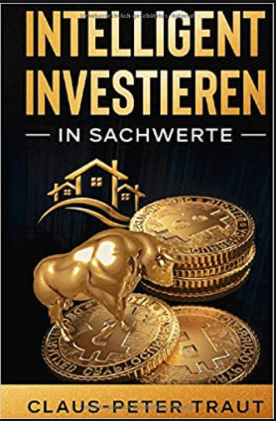
Title: Intelligent Investieren (in Sachwerte)
Author: Claus Peter Traut
Hi everyone,
I hope you’ve been well, and safe.
Today I’m bringing you some investment advice from the German shores. It was written during the pandemic of COVID-19 that we’ve been going through lately, and therefore gives solid advice for our current situation.
The introduction of the book brings into focus the two investment classes, “Geldwerte” and “Sachwerte”, which differentiates between real assets and monetary assets.
He classes the following assets as “Geldwerte”:
- cash
- cheque account
- savings account
- fixed deposits
- life insurance
- Loans
- Savings plans
And the then he categorizes the following as “Sachwerte”
- Property
- Gold & Silver
- Shares
- Collectibles & exotic investments
- ETFs
- REITs
- Cryptocurrency
The argument is that in uncertain and difficult times, the better investment for your savings should not be in currency, but rather in those investments that are not affected as materially as cash.
At all times the government and central banks need us to continue our spending as usual and accordingly amend monetary- (interest rates, or quantity of circulating cash) or fiscal policy (legislation and taxes) when the economy is heading into any one extreme direction so that the economy comes back to a stable position.
In uncertain times people tend to spend less on many consumable goods (clothing and furniture, electronics, etc.) and more on food and other basic necessities. Also, they tend to save a little more, because they are not sure what the next few months might have in store for them.
- This saving behaviour, repeated by millions of people results in less cash being spent, shops selling less, and maybe even people losing their jobs.
- Thus, governments sometimes opt to reduce tax %’es, and central banks either reduce borrowing rates, or even pump more cash into circulation
In Europe we are in negative interest rate territory (at least they have done it, and will do it if they feel that is what it takes to get people to spend) and sometimes also printing money
- Due to low interest rates, putting your money in the bank to earn interest, will not bring you the returns you would wish
- Due to more money being created by the central banks, the amount of goods that can be bought have remained unchanged, but the amount of currency chasing those goods have increased, thus, prices for those goods will rise to a new equilibrium —> inflation, the killer of purchasing power of paper currency (fiat currency)
These arguments, the author brings to the attention of the reader, and thus introduces the reader, on a high level, to the investment alternatives that are available. Now, even though the introduction to the different investment classes are good, and the risks he outlines for each of them are completely valid, my suggestion would be to read up even more on the investment you might be looking to go in to.
- He does bring in the most relevant and basic things that every investor should keep in mind (like the period you want to invest for, whether the investments are liquid or illiquid, how much of your portfolio you should dedicate to each class) it remains your responsibility what you want to invest in and become an expert in everything you need to know on those assets
Summary:
Enjoyed the book since it gave a guide of investing when we are in slightly more difficult times than the majority of normality we are used to. Thus, time-specific investment tips. The high level introduction of what the investment class is, the risks and other things you would need to consider prior to entering the investment. The book is similar to another investment book for beginners, so serves also as a good intro. The book falls within my rating of 4.2/5
I want to leave you with a quote that I think every investor should keep in mind, since it holds high value in a times and ages.
“The further you look back in the past, the further you can look into the future” – Churchill
 MyBookReviews