Title: Guns, Germs and Steel
Author: Jared Diamond
Pages: 444
Genre: History and Anthropology

Hi all,
today I present you with a book unlike any other that I have read before. I was always curious to understand why some peoples in some regions developed at different rates from others, and therefore made them much stronger when they encountered other peoples in other locations, which ultimately ended up with elimination, colonization or even slavery.
Some of our close and distant ancestors had the belief that they were the chosen peoples, and were thus the superior peoples. Others believed they descended from a race of peoples that just were the superior race meant to rule over the others.
These beliefs have made their dents clearly visible in history, and the repercussions can in most cases still be felt today.
Being of curious mind and not simply accepting the general belief that others wrote of in very old books, I discovered the following book “The Seven Daughters Of Eve” (014-2019) which sparked my interest much more to find out why did civilizations develop at a different pace (i.e. from merely being curious, I now really wanted to fond out for certainty). Here, the author had made analyses of DNA from different areas, clearly providing evidence that, yes, we all came from a different ancestor, however, that none really was superior over the other.
This book has received a Pulizer Prize from America, and is from my side a must read for every avid reader. It explores the question from an anthropological, geographical, biological and other sciences’ point of views, where he shows that it wasn’t as a result of the people, but due to their circumstances that they advanced quicker than other societies, with the ultimate result of becoming stronger.
The book is broken into four sections, with each section broken down into further chapters that analyze the theme in greater detail. See below:
- Prologue: Yali’s question
- A friend of the author from New Guinea asks the author the question why his (the natives) people and that of the authors were so differently developed. Since history and the life on earth is not very simple, the answer is also not straight-forward. However, by looking at some variables (in the upcoming chapters) the author tries to give an estimated argument why this could be.
- From Eden to Cajamarca
- Chapter 1: Up to the starting line
- First, the author uses 13.000 years ago (11.000 B.C.) as a good starting point and will analyze from there since the Ice Age had ended and real development would start from here
- Below is an illustration that shows roughly when people first inhabited each continent and island. This was made using carbon-dating.
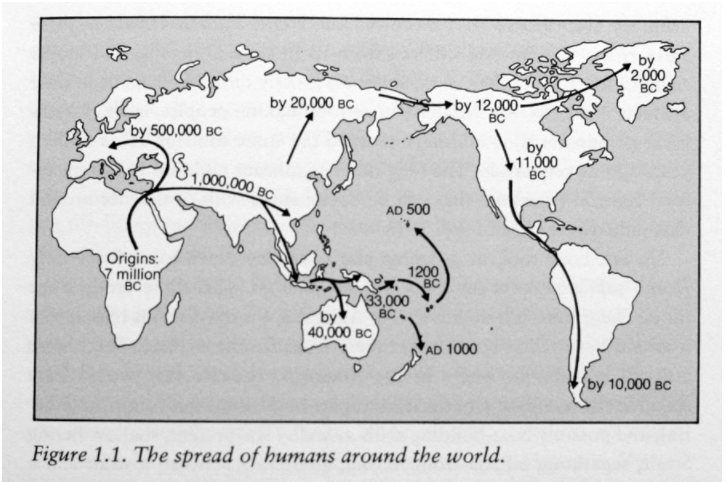
- At around this time the peoples were nomads, and thus were traveling frequently from one location to the next. They lived as hunter-gatherers and used stones to furnish the tools they needed for their lifestyles.
- Between 100.000 and 50.000 years ago something like the ‘The Great Leap Forward’ must have occurred which entailed:
- the perfection of the voice box because when communication is improved it allows us to cooperate better with others, thus increasing our potential of living in groups
- Chapter 2: A natural experiment of history
- In this chapter the author draws on the history of the peoples from New Zealand. On one island the inhabitants were further developed than a neighbouring island. Why this island is a good example is because the islands were only discovered why European seafarers who then made notes in their journals of their encounters.
- Now the question is posed, why did the one island fare better than their neighbours when their ancestry and history is fairly similar.
- The first hint that the author experiments with is that the environment is an important variable, specifically:
- climate – one island’s climate was better suited for agriculture, whereas the other ones less so, which resulted in the latter remaining hunter-gatherers
- geological types
- marine resources
- area – the former island had a larger area to support a greater population size than the other
- terrain fragmentation – on the former island, the smaller tribes were distributed on the island, but could be reached easily and thus they belonged together, whereas on the latter the tribes were also fragmented and didn’t interact much with each other
- isolation – the latter islands inhabitants didn’t interact much with each other, whereas the former did interact with its neighbours
- The author therefore made the analysis that when the climate is suitable for farming, the peoples gradually made the shift in lifestyle from nomadism to egalitarian, which resulted in people living in closer proximities to each other. This in turn allowed some to work on specialized crafts since the crops from farming now resulted in surplus foods. Another work that came about was the creation of officials and representatives that would render services for the farming community with other farming communities, thus run the society so that everyone else could focus on their crafts or farming activities.
- Chapter 3: Collision at Cajamarca
- This chapter gives a brief introduction into the colonial quest by the Spanish to the New World, which started with the discovery of Panama in 1492 by Chrisopher Columbus.
- The subsequent invasions were by Cortes of modern-day Mexico (then the Aztecs) and Pizarro of modern-day Peru (then the Incas).
- The Spanish were of significantly low number of explorers in comparison to the number of natives that they faced, yet they managed to overtake the native population. This is baffling, especially if you compare Pizarro’s 168 men winning against the thousands/millions of natives who were present when their then king Atahuallpa was their king. Bear in mind the Spanish were better equipped, but the number in people is quite baffling.
- However, it is this topic that the author explores in greater detail in the subsequent chapters.
- Chapter 1: Up to the starting line
- The Rise And Spread Of Food Production
- Chapter 4: Farmer Power
- In this chapter the argues that when the first peoples started wandering into the lands of the other continents they would have encountered different climates, plants and animals.
- Majority of human history had been spent on Africa as hunter-gatherers. Going to other continents, they would continue with this lifestyle.
- When they came to other lands and encountered other animals, the animals were at a disadvantage because the animals didn’t know what they would face in the upcoming years. This would result in large populations of those lands being hunted down either to small numbers, or to extinction. Since surplus foods could not be acquired, and the peoples traveled frequently, the bands/tribes would have remained in small numbers and not repopulate as frequently.
- Chapter 5: History’s haves and have nots
- In this chapter we find out that some plants better suitable for agriculture first appeared in few places on earth (see map below). When people came to discover that they can acquire nourishment from these foods as well, they added it to their diet.
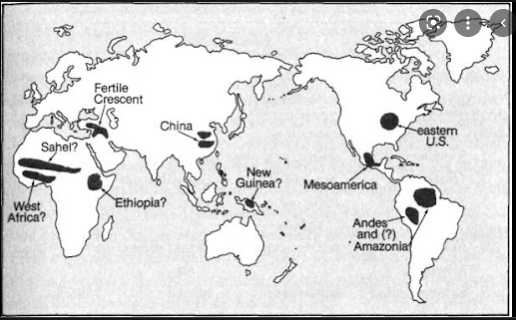
- It was the people who lived in those areas that were the first to change their lifestyle from full-time nomads to part-time egalitarians since the crops would only come once and not year-round
- Chapter 6: To farm or not to farm
- At the end of the day, the peoples wanted to live the life that would require the lowest risk (i.e. from starvation, infection and death) but the greatest return (i.e. the most amount of food and least energy utilisation).
- Since for some people the lifestyle of hunter-gatherer was still lucrative (due to abundance of wild animals) some stayed put with this form of living. Whereas others where the animal population was not so significant anymore in relation to number of people, they either adopted the sedentary lifestyle by cultivating the wild plants that grew in that region or they adopted the wild plants their neighbours were growing (and who were not too far away).
- Thus, for some people the hunter-gatherer lifestyle was still more lucrative and attractive than farming.
- What this process of farming resulting in is the following:
- Living in one place all year around
- Living with many other people in close proximity
- People focused their full attention to grow large quantities of crops
- Due to their egalitarian lifestyle and surplus foods, the tribes could increase their population size much sooner than when they were hunter-gatherers
- This growth in population required more food, which resulted in more lands being cultivated to reap a greater abundance
- More people born but less required on the field allowed others to do other work
- and on and on this cycle goes….
- gradually the population size of the egalitarian lifestylers would overtake that of their fellow hunter-gatherers, who remained relatively the same size throughout since their food availability was not as predictable
- Chapter 7: How to make an almond
- What also differed from region to region was the types of plants it held.
- In the plants shown on the map above it referred to crops that could produce large quantities and required less energy to domesticate and grow than the same hectare of other plants
- Thus, another reason why some people chose to remain hunter-gatherers was because their plants required more energy to grow produce than what wheat did. Further, next to requiring more energy, the volume of yield was lower. Thus, only when the climate in their area was suitable for wheat and crops would they adopt it
- Finally, the way the early farmers decided which plants to domesticate some species over others was for the following criteria:
- Size – the larger the edible the better
- Bitterness – the sweeter the better
- Fleshy or seedless
- Oily seeds
- Fibers
- By gradually selecting those wild plants that met their criteria they grew more and more of those, and the wild variants would not be grown again.
- Chapter 8: Apples or Indians
- This chapter goes into greater detail to understand why some areas flourished with their flora (which resulted in them advancing sooner) than their neighbours.
- The variables the author looks at are the following:
- climate – the climate to grow crops (which produce greater food surplus than other plants in tropical areas covering the same area size) is different between regions
- climatic variation – crops don’t flourish in all weather conditions. therefore, a tribe from a tropical area or winter area will struggle to plant and harvest from a crop that doesn’t grow well in another climate
- topographies – crops don’t grow better in some latitudes than in others
- wealth in ancestor crops and mammals – having a greater availability of plants that yield large produce allows one greater opportunity to grow the greatest surplus
- competition – if you are prone to be invaded by neighbours that steal crops then the lifestyle is less suitable than when your neighbours have the same lifestyle
- Chapter 9: Zebras, unhappy marriages and the Anna Karenina Principle
- Tolstoy once said “Happy families are all alike, every unhappy family is unhappy in its own way” which is the Karenina Principle that applies for animal domestication.
- It boils down to six criteria that need to be present in order to have successfully domesticated an animal. When one of them is not met, then the animal cannot be domesticated:
- Diet – Green pastures are plentiful available, therefore one can easily domesticate more cows instead of a carnivore, because meat is not as readily available. Further, the meat takes longer to become available. Therefore cows instead of carnivores were domesticated.
- Growth rate – A cow can have offspring in much shorter durations of time than an elephant. Therefore, in the sense of being ‘useful’ to humans, it is made more sense to domesticate cows than elephants.
- Problems of captive breeding – Some animals don’t reproduce as well as when they are free. Therefore, this would result in them not having offspring, and die out.
- Nasty disposition – Some animals are less dangerous than others and are therefore better predictable, which are better candidates to be domesticated and live with humans.
- Tendency to panic – Some animals will flee when confronted by a predator, whereas others will seek the safety of the pack. Animals that flee at the sight of a predator are not good candidates for domestication
- Social structure – Some animals are pack animals and need to be within a pack where there is someone to guide them, whereas in other cases some animals are in small groups or even alone. Animals best suited for domestication are herd animals because if they can recognize you as a pack leader then they see their position within the herd.
- When the animal doesn’t meet all these criteria, then it is not helpful to humans and can therefore not be domesticated. Only few animals met these criteria and were therefore domesticated.
- These animals were not available equally throughout the world, and therefore some societies could use them earlier than others to advance their society ahead of others
- Chapter 10: Spacious skies and tilted axes
- Another reason why some societies made quicker advancements is due to their proximity with other tribes.
- In the past, when the climate is the same in one area and the other, then the crops from the other tribe can be adopted in the second tribe. This is the case for the West-East axis lying countries. Societies lying between North-South axis had different climates and could therefore not adopt the same crops as their neighbours because they were less suitable.
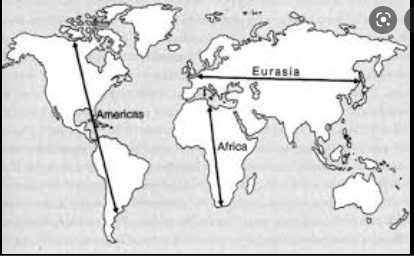
- Another important variable is the geographic barrier. This refers to the barriers that nature has in place between two tribes (i.e. open landscape vs. mountain terrain or desert area). Therefore, when the barriers are easily passable the people may have been more open to travel to others and interact (and also exchange goods and ideas). This exchange was crucial since those tribes that were less accessible (due to harsh geographic regions – mountains, deserts, large water crossings, etc.) were more isolated and thus received less opportunities to exchange ideas and foods.
- Chapter 4: Farmer Power
- From Food To Guns, Germs And Steel
- Chapter 11: Lethal gift of livestock
- This chapter goes into the topic of what role animals play in farming societies. In an earlier chapter it was discussed that when the peoples arrived the animals didn’t know what they were facing when the peoples arrived and many of them were gradually reduced in numbers by the hunter-gatherers. In another chapter we discussed that the different plant species spread throughout the world was uneven. Then we read that it is farming communities that result in innovations being brought to light.
- Why is this all important?
- Simply, people living in close quarters resulted in the breeding and spreading of new viruses that only came from crowded groups of people. Additionally, due to those communities living with their domestic animals allowed the spread of viruses from animals to humans.
- Why is this important?
- The people in farming communities that eventually grew to become cities and kingdoms resulted in the “birth” of new viruses that would not have come around with smaller communities. Thus, the larger populations gained some immunity but when those same peoples traveled to other countries that were still hunter-gatherers, those people become exposed to this greater virus. Therefore, the argument is that the virus that came with the people of advanced societies was a significant silent killer of the bands and tribes.
- Chapter 12: Blueprints and borrowed letters
- The discussion in this chapter is about every society either advancing their lifestyle not solely based on their own ingenuity, but seeing and adopting something they came across in another community. This adoption was only possible where societies had regular interaction with other societies.
- Thus, where a group of people didn’t interact with other tribes by choice, or due to geographic barriers, they didn’t advance their lifestyles, and those that did interact either adopted something that another society had used for some time by learning how to make it and then remake it themselves (blueprints) or by seeing something someone else applied, but not learning how to build it and then trying to figure it out on your side how you remember it working (borrowed)
- Chapter 13: Necessity’s mother
- This chapter tries to determine how different societies came up with new inventions. A general accepted view is that when the necessity for something arises then we will invent something to address the necessity.
- However, the conclusion would then be that humans aren’t creative to invent something without a need arising first. The author revokes this argument, bringing forth that due to humans in those societies constantly being in competition with each other the people out of their own motivation also devoted themselves to bring forth new inventions even though the necessity isn’t there for it yet.
- He supports this by documenting some example products that were invented for completely different purposes, but which were then later adopted for something else. Therefore, an invention was later used to fulfil the need of something else, rather than the need the inventor wished to satisfy. Further, some inventions weren’t really considered relevant only until a few years later.
- Chapter 14: From egalitarianism to kleptocracy
- In this chapter the author goes into the discussion about the roles of the ruling people. Because within farming communities more people can focus on specialization as well as political activities, those becoming politicians had the potential now to use their position for the good of the people, but also for their own benefit.
- He brings in the example of one African country and compares it with one European country and asks why the European country is deemed better? The African country has available resources and a good landscape to grow certain foods, whereas the European country would be less successful to grow those plants. The argument goes that the political body of the African country is not yet trusted as well as the European one and the latter is therefore better to attract external customers.
- Why is the latter one better in attracting external people? It is broken down that the European country has had institutions for many centuries (and has therefore over this time period developed a system that works to run the state) whereas in the African country it gained independence only in the last 100/200 years and therefore the new rulers of the country are learning to shape a system to run the country the best way.
- Chapter 11: Lethal gift of livestock
- Around The World In Six Chapters
- Chapter 15: Yali’s people
- Chapter 16: How China became Chinese
- Chapter 17: Speedboat to Polynesia
- Chapter 18: Hemispheres colliding
- Chapter 19: How Africa became black
- Chapter 20: Who are the Japanese?
- Epilogue: The Future of human history as a science
It is my firm belief that anyone wishing to get a better understanding of the divergent development of different societies over the different centuries, this would be a great book to start off with. Another book I also read to explore this question was “Civilization: The West above the Rest” by Niall Ferguson, which gives six elements that made the West stronger than other countries. The aspects are relevant and make sense, but I felt that they only really applied from Greek/Roman times onwards. It didn’t explore how the different regions in the world had developed before that (to my memory since I read it last a long time ago). Therefore, in addition to that book, I would suggest this book as the pre-read, to develop some high-level background information of developments in the world before 2.000 BC since they also were important determinants how history developed thereafter.
Summary:
A master of a piece of script that does come close (as possibly can be) to explain how our societies developed at different rates from other societies. It discusses it not merely from aspects of technological progress and agricultural progress, but goes deeper to understand why different areas had those advantages before others.
The book receives an honourable rating of 5/5.
Happy reading, and wishing you a belated merry Christmas, but a happy New Year!!

