Title: 7 Habits of Highly Effective People
Author: Stephen Covey
Hi everyone,
I finally managed to get around to read this book as well, and boy, can I tell you, it doesn’t disappoint. If there was anything that I would recommend to start their reading journey off with, it would be with this one.
It digs deep to our most inner core, and focus on getting our Character Ethic in order, and then, and only then, work on our Personality Ethic, because all our personalities should have a strong base to stand on already (which is the Character Ethic).
Our life cycle starts off with us being young children, who are very dependent on our parents to get things done. Then, as we grow, we become more and more independent, that we become more and more capable of getting things done by ourselves and don’t need to be dependent on anyone. Finally, once we achieved that stage, we move over to the next phase, which is interdependence. We learn the value of how much more effective we can become as we live more interdependently. Although we are able to live independently, we acknowledge the efficiencies that come with interdependent relationships.
This is the same cycle that the book follows with the 7 habits.
- Habits 1, 2 and 3 focus on bringing you from dependent to independent, by building up your strong foundational Character Ethic. —>Private Victory
- Habits 4, 5 and 6 then teach you to learn the value of interdependence and how we can move from independent to this stage. —>Public Victory
- Habit 7 then closes off by elaborating how important it becomes for us to always go back and reflect on what we experienced and how that had an impact on our other habits, so that we might refine our goals and Character-/Personality Ethic, so we may become even more Effective People.
Your journey with this book should be about first building a strong set of principles that are not open for continuous change; and at the same time being relentless in the quest for improvement and continuous self-renewal
Building character, rather than building success
We already have formed a character and personality through our whole life. We thus see the lens through our character/values and personality and judge everything with that foundation.
- We must look at the lens through which we see the world,
- as well as at the world we see,
- and that the lens itself shapes how we interpret the world
lens = character
The Character Ethic taught that there are basic principles of effective living, and that people can only experience true success and enduring happiness as they learn and integrate these principles into their basic character. After World War II success became more a function of personality, of public image, of attitudes and behaviours, skills and techniques, that lubricate the processes of human interaction.
Lastly, before we can truly understand the Seven Habits, we need to understand our own paradigms and how to make a paradigm shift.
- paradigm = is the way we see the world, i.t.o. our perception, understanding and interpretation.
- based on that paradigm we judge everything we encounter in our daily lives
- the way things are (ie. the reality)
- the way things should be (based on our values)
- our attitude and behaviour is the personality we exhibit , which stems from the character we initially we built, and how we judge everything around us
In summary – The more aware we are of our basic paradigms, maps, or assumptions, and the extent to which we have been influenced by our experience, the more we can take responsibility for those paradigms, examine them, test them against reality, listen to others and be open to their perceptions, thereby getting a larger picture and a far more objective view.
What are some examples of these principles, you may ask? Below, we have made a list of a few of them, which does not include an exhaustive list:
- fairness, integrity, honesty, human dignity, service, quality, potential, growth and patience
- principles are supposed to be self-evident
Effectiveness is the balance of the P/PC elements. (production/ production capability)
Habit 1: Being Proactive
We as human beings have the ability of self-awareness. The ability to imagine and see yourself, by separating yourself and envisioning seeing yourself sitting there. Because we have this ability we can learn and understand why we act the way we do, and in that way learn what drives us.
Taking this skill, we can reflect on our current social paradigm, and see that what we do is largely determined by how we were conditioned (ie. taught/ brought up).
According to ‘response theory’ we are conditioned to respond in a particular way when a we encounter a particular stimulus. However, because we have the self-awareness capability, we can encounter a situation and not act immediately as conditioned, but we can choose to act differently. Our instincts aren’t as fixed as a buck when it sees a lion running towards it. (Although if we were in that situation and were to invoke this freedom to choose, I doubt we would have better success 🙂 , but I hope you get the meaning)
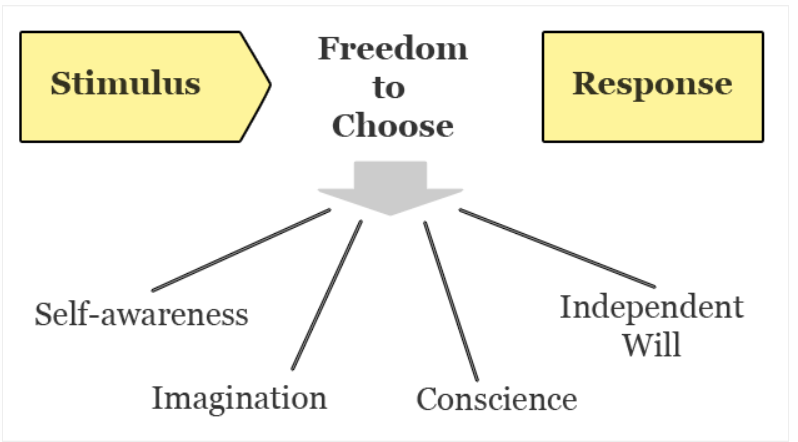
Because of the above endowments, we can write a new program on how we should act when we encounter a particular stimulus, and act separately from our instincts and training alone.
So what does the habit of proactivity then mean?
It means that as human beings, we are responsible for our own lives. Our behaviour (response) is a function of our decisions.
The difference between reactive people and proactive people is that reactive people are driven by emotions when they face a particular situation, whereas proactive people are driven by values (carefully thought about).
- This doesn’t mean that proactive people aren’t influenced by external stimuli
- On the contrary, they also face such stimuli, however, their response is a value-based choice or response.
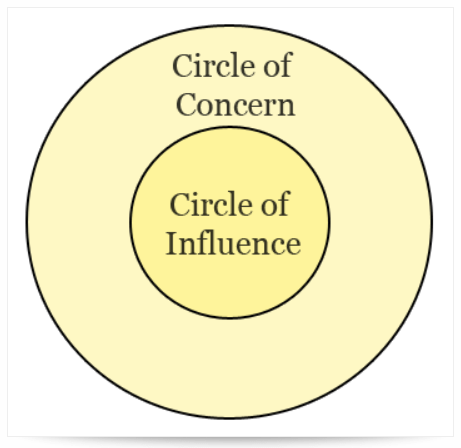
Another way to become more self-aware is to look at where we focus our time and energy.
- things that lie outside our circle of concern are things we have no concern over
- things within our circle of concern are all the things that we are to some extent concerned about in our lives
- things within the circle of influence are things within our control, that we can change
- things beyond our circle of influence are things we concern about but have no ability to influence/change/correct
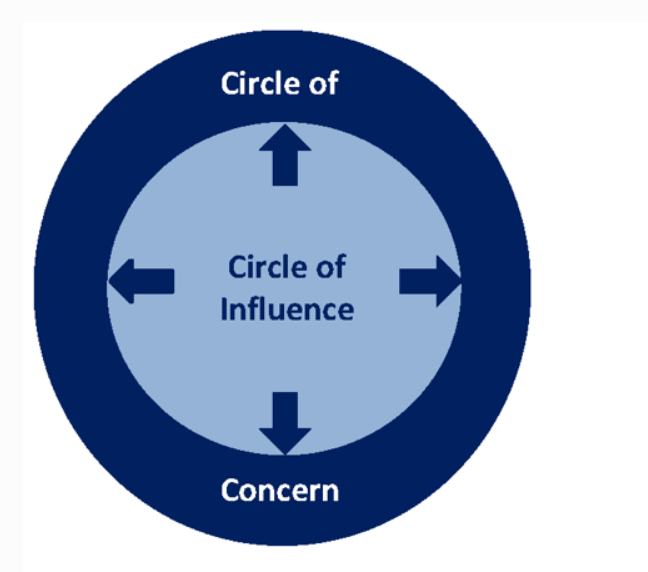
- if you spend your time in your circle of influence you are proactively seeking to resolve the matters (and end up being more effective), whereas, if you spend most of your time outside your circle of influence, you waste energy thinking and worrying too much of things that you cannot control
The proactive approach is to change from the inside-out: to be different, and by being different, to effect positive change in what’s out there.
- being self-aware we can decide how we respond
- how we decide to respond will result in different kinds of consequences and mistakes that arise from that decision
- being proactive, we are responsible how we run our lives
Habit 2: Start with the End in Mind
The application of this is to picture your last day on this earth and make that your frame of reference by which everything else is examined.
….
Know where you are going, so you can determine where you are now. This is what is supposed to bring you a different perspective. With this habit you come to realize that everything is created twice, 1) the mental creation and 2) the physical creation.
- If you don’t become proactive and take responsibility to make decisions for and by yourself, then you won’t take the step towards becoming independent, but remained conditioned and dependent upon others
The two forms of creation can be assigned the following roles:
- leadership – responsible to visualize where we want to go and what we want to achieve (first creation/mental creation) —-> going back to the first picture, we see that imagination and conscience are two of the endowments between stimuli and response
- management – responsible to take active steps to get us to that envisioned goal (second creation/physical creation) —–> after we utilized the endowments of ‘imagination’ and ‘conscience’ we choose our response
The two endowments ‘self-awareness’ and ‘imagination’ empower us to write our own scripts. Though this process we are either “rescripting” our existing paradigms, i.e. engaging in a paradigm shift
In summary – you approach your role, with your values and direction clear in mind. You take responsibility for your first creation, and also for rescripting yourself so that your paradigms from which your behaviours and attitude flow are congruent with your deepest values. It also means to begin each day with those values firmly in mind.
The way you start off is by setting yourself a personal mission statement, which lies at the center of our circle of influence. And whatever lies at this center will be the source of our:
- 1) security (sense of worth, your identity, your self-esteem, your basic personal strenght),
- 2) guidance (your source of direction in life),
- 3) wisdom (your perspective of life, your sense of balance, your understanding of how the various parts and principles apply) and
- 4) power (the faculty or capacity to act)
— By centering our lives on the correct principles, we create a solid foundation for the development of the four life-support factors. It is the center that puts all other centers in perspective.
Therefore, your mission statement becomes your constitution, the solid expression of your values and vision. It becomes the criterion by which everything else in your life is measured.
- this mission statement gives you a clear picture of where you want to be, and where you currently are
- it gives meaning and purpose for everything you do, which makes what you do easier and gives you a sense of calm since you know where you are heading towards
Habit 3: First things first
Habit 1 tells you that you have the power to change who you are. Habit 2 brings into perspective that you should set yourself a personal mission statement, which requires the first form of creation, namely mental creation.
Habit 3 starts you off with the second form of creation, namely physical creation.
Here we step into the shoes of management (after leadership in habit 2 set the mission) and get to work. You take all the tasks and prioritize them according to the following boxes. You put them in a table, so you have an overview of everything that you need to get done, whether it is important or nor, and also whether it is urgent. This way you can break down the important from the unimportant, and then break them down further to most urgent.
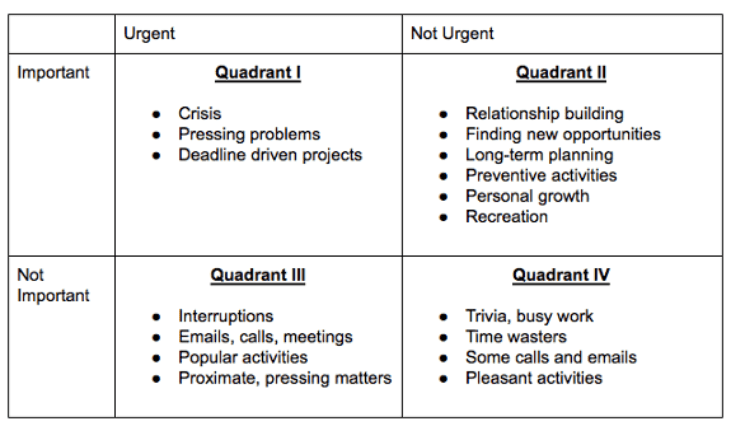
This way we schedule our days, weeks and months for different tasks and get things done.
- the way you spend your time is a result of the way you see your time and the way you really see your priorities
The objective of Quadrant II management is to manage our lives effectively- from a center of sound principles, from a knowledge of our personal mission, with a focus on the important as well as the urgent, and within the framework of maintaining a balance between increasing our production and increasing our production capability.
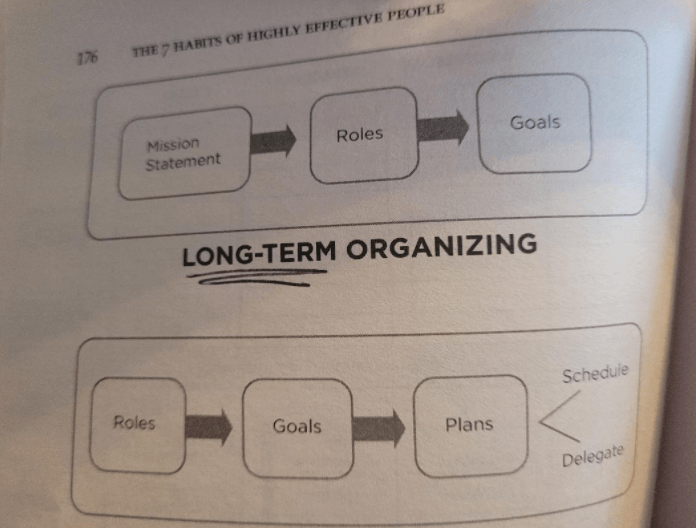
The way to do this is to become a Quadrant II Self-Manager
- identifying the different roles you have in your life (ie. parent, manager, son, etc.)
- setting the goals for that role
- scheduling your tasks
Habit 4: Create a Win-Win
Once we achieved the Private Victory, we will have achieved true independence, that we can live effectively on our own. Now, to become truly effective, we learn how to work best with other people so that we may become highly effective.
…
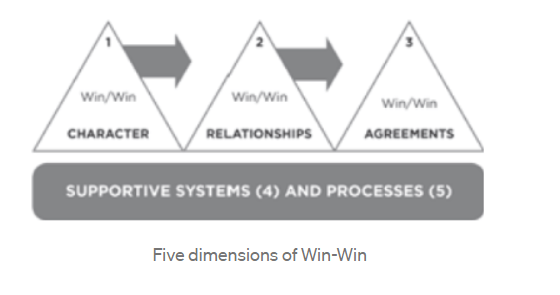
The six paradigms of human interaction are the following:
- Win/Win (see life as cooperative and not as competition)
- Win/Lose (people who are prone to use power/ position/ credential/ possessions or personality to get their way)
- Lose/Win (people who don’t have standards for themselves and work solely for the other’s gain)
- Lose/Lose (someone who doesn’t have direction and thinks no one else should too, but rather be miserable as well)
- Win (what matters here is that they get what want, no sense of competition)
- Win/Win or No Deal (if we cannot find a situation that would benefit us both we agree not to go through with it)
Habit 5: Seek first to Understand, and then to be Understood
We have a tendency to rush in, fix things up and give advice, but often fail to take the time and correctly diagnose, to deeply understand the problem first.
If you want to be really effective in the habit of interpersonal communication, you cannot do it with technique alone. You have to build the skills of emphatic listening on a base of character that inspires openness and trust.
We must not listen to someone in one of the four ways:
- ignoring (not really listening at all)
- pretending (pretending to listen by giving them time to speak, but not listening to their words or the way they communicate it)
- selective listening (listening to only few things, but not everything – not listening to everything that is said, and the way that it is communicated)
- attentive listening (listening to the words, but not the way they are communicated)
…but rather should learn the skill of emphatic listening (listening to the words, as well as the way the discussion is being held)
By learning to listen empathetically we learn to ignore our own perceptions (lens) to be the only valid one out there, but try and understand the situation from their perspective and truly try and understand, before we try and help them.
Habit 6: Power of Synergy
All the habits we have covered will prepare us to identify an create true synergy.
By learning to leave your comfort zone and confront an entirely new and unknown, you open yourself to new possibilities.
- If you only stay within your comfort zone you won’t identify some of the efficiencies that could have come from unexplored territories, and never untap true potential
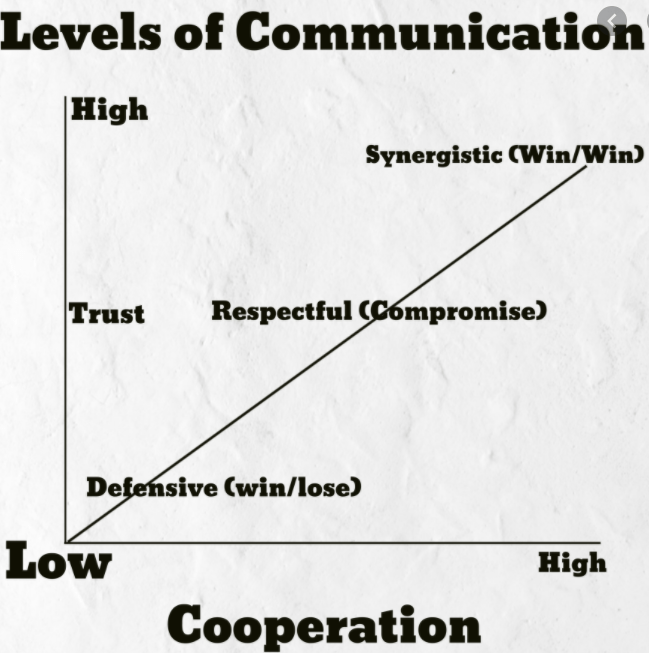
- getting out of your comfort zone means speaking up and having trust that it won’t result in a bad relationship, but rather taken and treated fairly
- through effective communication and high levels of trust we can truly identify the greatest synergies, and improve on our effectiveness
Habit 7: Sharpen the Saw
The final habit deals with preserving and enhancing the greatest asset that you have, you.
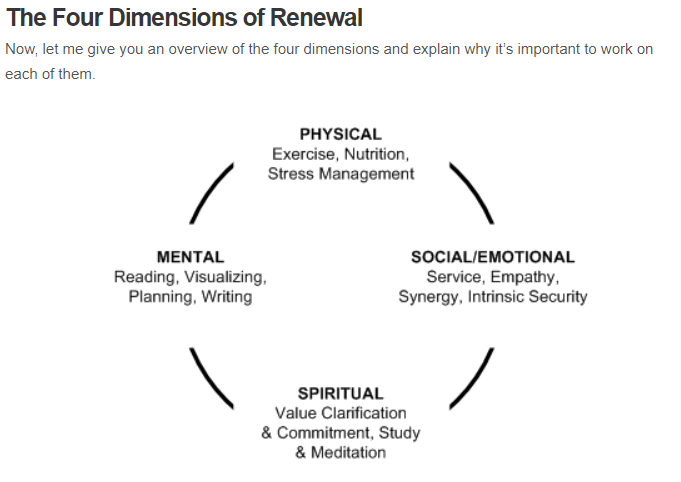
By giving our attention to these four elements we create a platform and process for continually improving ourselves, and thus becoming more highly effective.
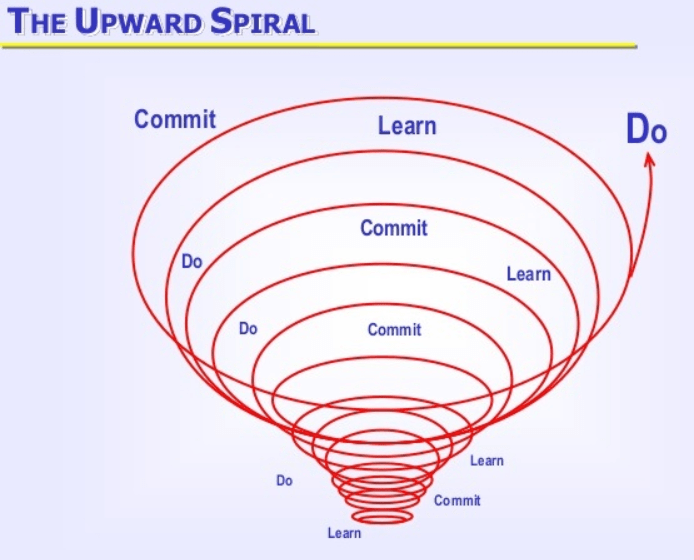
- renewal is the process that empowers us to move upwards, growth direction
Summary:
The book is very easy to read and understand, and the structure thereof follows the road you need to follow in order to really establish the habits as they were intended. It gives the reader lots to think about. The book for me deserves to be read at the very least by every person eat least once, because its application does not only lie in one area of our lives, but is very diverse, and therefore one can use it for almost anything. The book deserves a strong rating of 5/5
Just before we finish off, the contents of the book may inspire you in the beginning, which they should. But the true value of the book comes when we actually implement these principles and practices into our daily lives. Then, to reread would be suggestible since it gives one a refresher and you might learn something more that you didn’t catch before.
Happy reading you all, and stay safe! 🙂
 MyBookReviews