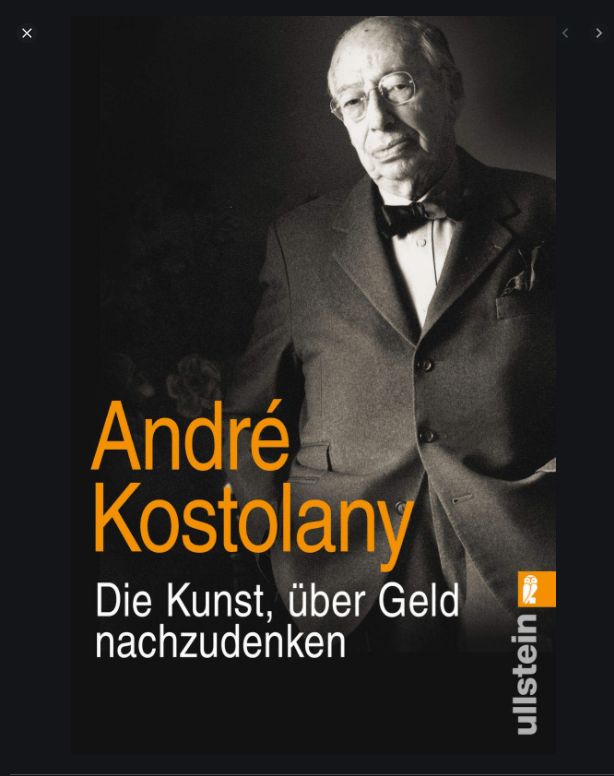
Title: Die Kunst ueber Geld nachzudenken (The art of thinking about money)
Author: Andre Kostolany
Hi all,
another great book on finance of one well-known investor, which has some great advice for you as well.
Though i didn’t have much luck finding this book to be published in both German and English, I will give you the best it has to offer in advice. Born in 1906 in Hungary, he has lived through two world wars and lived in different countries, using his experience along the way in speculating on stocks, from Paris to New York.
The first chapter starts off with describing the desire for money as being the driving force of the economic progress.
- We exchange our time and energy to receive a few coins/paper so that we can use this to acquire other things that other people have put their time and energy in to. This collective effort of people spending their time and energy where they can earn coin to satisfy their needs and wants is what drives the economy to grow and become more and more advanced.
Money means different things to different people, but one thing it do that everyone would enjoy, is it makes you independent from others.
Rule 1 – One shouldn’t run after money, but rather walk towards it.
- …On the stock exchange, you shouldn’t follow where everyone else is heading (ie. sell when everyone sells, or buy when everyone buys, but rather act on the opposite end).
As much as we wish to earn money, we shouldn’t cling to it, but rather re-invest it so it can work to make you more money. If money isn’t put into the economy then we will head into a deflation, since goods will become cheaper and cheaper to attract buyers. In the modern economy, should this happen (ie. hoarding of money in bank accounts) the two things that governments do to get spending going again is 1) set negative interest rates, or 2) create more money, which causes inflation, and your money’s purchasing power drops.
Rule 2 – Don’t cling to your money, but rather invest it wisely so you can evade the tax of inflation, and earn more money
There are three ways of becoming a millionaire in a short span of time, namely 1) marry rich, 2) a good business idea, or 3) speculator. A speculator only knows as well as you do what will happen in the world tomorrow, he doesn’t. However, a speculator knows what happened yesterday, and what happened today, and therefore uses these two pieces to speculate what will happen in the future.
- He looks at the development of the economy, politics and the society and develops and expectation of what might follow in the future and is set out to profit from this guesstimate
Rule 3 – Speculation is an art and not a science.
Since being a speculator is filled with uncertainty, you should only use what you can afford to lose, and not bet your life savings on it, with catastrophic results.
Rule 4 – Only use what you can afford to lose.
What differentiates a speculator from an investor is that the investor makes an investment with the intention to hold it for the long term and even build up his portfolio, that will make provision for his retirement. In contrast, a speculator, works with current trends in the market and searches to invest in those trends that will make him a return in the shorter term. However, this form of speculation that he is suggesting is not daily speculation, but can also result in his investments being held for a few months. The other kind of speculator that is involved is the one that makes trades on a highly frequent basis (almost daily). The kind of speculation he invites you to join is that of the mid-term speculator, not the daily speculator.
Contrary to the investor, the speculator is interested with the daily news that happens in the economy. He will look at the following factors: money and credit politics, interest rate, economic growth/contraction, international trade and politics, financial statements and other statements. Using these components, he will build up a strategy of where he believes the economy could be heading towards, and the accordingly makes the investments that would benefit such predictions.
There is no school that can teach one to become a successful speculator, but is rather a skill that needs to be developed by trial and error.
Rule 5 – Making mistakes provides you with the best opportunity to learn
Being a speculator doesn’t restrict you to one form of investment, ie. shares. It means making an analysis of where you think the economy might be heading, and then betting on shares/ raw materials (through future contracts)/ bonds/ property/ other which you believe will benefit from those developments.
- However, caution is advised, that the investor should first become an expert in the field before taking on the investment, since the aim of an investment is to generate a return, not to lose money
Through many years booms and crashes occurred in different forms. Those that are interesting to read up on are the following:
- Netherlands – 17th century – Dutch tulip mania
- France – 18th century – Mississippi bubble
- America – 19th century – Panic of 1893
- America – 20th century – Great Depression
- America – 20th century – Black Monday
- America – 20th century – Tech bubble
- World – 21st century – real estate bubble
What is interesting to note is that the stock market diagram is more than just a reflection of the development of the prices of different companies over time. It has become a mirror of the events happening within an economy. Over the long term, it is evident that the market is growing (incl. impact of inflation) but that over the short term there are set backs, due to people’s expectations growing unrealistic at some stages, and the market then self-corrects.
Experts will always try and explain what cause the growth or decline in the stock market. Though on some points they may be correct, the true answer is that there are innumerable factors that influence the daily stock price, that the only true indicator of stock price movement can be attributed to Demand and Supply.
- There are only a fixed number of shares in issue. Thus, when demand for them grows, those that weren’t sold yet become more valuable, driving the price up, and vice versa.
- Therefore, it is the speculator’s job to identify the current trend in the economy, make an estimated guess what people would tend to do if this predicted event would occur, and then invest in those assets that you believe people will want to buy
Rule 6 – The true factors influencing the price of the share price are Demand and Supply
Rule 7 – Next to analyzing market trends, become an expert of spotting people’s tendencies
Since the past is not a good indicator of what will happen in the future, a speculator needs to stay up to date with current events, so as to identify any pointers that might change the economic situation in the future. Important here is to spot where the money is flowing. Because we discussed in the beginning that money is the driving force of the economy a speculator needs to be aware where the money is flowing towards. If money is flowing out, then no growth can happen in the economy.
Rule 8 – Know where the money is flowing. No money, no growth.
Supporters of the Gold-backed standard pronounce that the quality of a currency is dependent upon the amount of reserves (ie. gold) the central bank has locked in its vaults. However, the author challenges that claim, by arguing that the quality of a currency is actually dependent upon 1) the economic power of a country, and 2) management of funding by the state.
- As a brain exercise, think about two companies. Both are delivering the same services, and are of equal size. Company A has some gold in reserves, and runs its normal business, whereas Company B doesn’t have gold but only currency. Let’s also include a third player, company C, who also has gold, but isn’t run very well.
- Company B’s team delivers great quality services, and its management does a good job at maintaining a healthy liquidity of the company.
- Company A’s team delivers good services, and management does also do a good job of keeping the company’s liquidity in check.
- Company C’s team delivers good services, but management doesn’t manage its liquidity very well, which causes problems some times with paying their suppliers.
- Taking all three of the above into consideration, if I were to engage in business with one of the above companies, I would choose only between A & B, and not C. Just because they have gold, doesn’t guarantee their country is good. Company A doesn’t have gold, but offers quality services and maintains stable liquidity measures, is a good opponent to Company B.
Rule 9 – Gold reserves do not determine a currency’s quality. The power of an economy and the management of their finances determines its quality.
The strongest influencers of the stock market movements are 1) Money, and 2) Psychology.
- Without money there won’t be any up- or downswings in the stock market. For this reason, the Speculator needs to keep an eye out for the factors that influence the money available.
- Inflation (caused by money printing)
- Interest rate (monetary policy)
- When interest rates rise money generally flows from the stock exchange into investments where the investor can earn interest
- When interest rates fall money generally flows to the stock exchange since alternative investments don’t offer attractive returns anymore. Further, companies can borrow at lower rates and thus try and expand its operations.
2. Psychology is what drives the prices up and down, due to people’s reactions to news within and outside of the economy.
The two kinds of speculators are:
- shaky speculators
- die hard speculators
What differentiates the speculator between the two categories depends on their possession of the four G’s: “Geld, Gedanken, Geduld und Glueck” (Money, Independent thought, Patience, and Luck). If one doesn’t possess one of the four, but the other three, that puts one automatically in the field of a shaky speculator.
….a Geld – Money Only use your own money, and not someone else’s money, or money on debt.
….b Gedanken – Independent thought The speculator who makes intellectual decisions on investments is the wiser investor than one that is driven by the decisions of the masses.
….c Geduld – Patience The most important attribute that is needed on the stock exchange, but in most cases is lacked by most.
….d Glueck – Luck
Rule 10 – What differentiates a shaky speculator from a die-hard speculator is their possession of the four G’s.
Due to the fact that the market is inhibited by both forms of traders discussed above, we come across Booms and Crashes. The die-hard speculator will need to analyze where we currently are in the market, then predict (based on the information available at the time) what could happen in the upcoming days/weeks/months, and then make an investment decision accordingly. He will use the following graph to determine what needs to be done:
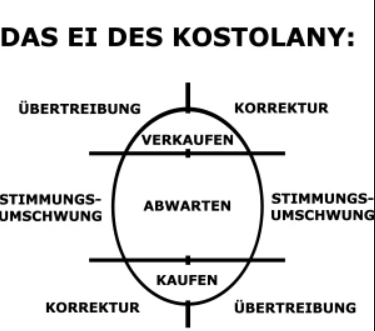
He will determine if he needs to hold his position (middle), sell his position (top-left) or even purchase for his position (left-bottom), and in this way is acting anti-cyclical.
Rule 11 – Position yourself anti-cyclical.
The position a speculator can take is bearish or bullish. Depending on your outlook for the economy (or company), you can take one of the two positions. However, when you take the bearish position they only way to make a profit is to sell off when the shares have reached a low point —> thus, here you cannot remain passively invested. In contrast, investing bullish one can take a passive position since many companies rather tend to work towards growing bigger.
The next topic on the agenda is where/which sources you should use for information that you will use to make an investment decision. Mostly inexperienced individuals will choose to rely completely on the expert. However, many famous investors from funds advise you to become better informed and take an active role where your funds should be invested. The sources the author used are everything and everyone around him.
- Taxi driver
- Friend
- Radio
- Newspaper
- Online news
Using these sources, he attained an understanding of what was happening in the economy, and also had read up a lot what had happened in the past, and through these sources decided where on the egg he believed they were currently positioned at, to make an informed decision. Another reason why an expert doesn’t necessarily know which company will become even bigger is because they concentrate their time and energy going through news, articles and other reports whereas another source (people coming to a new shop, and selling good products) could possibly not come to them until much later
Rule 12 – Information is available everywhere
With so many more sources of information today, and the world economy having become even more complex than before, it is hard for any one person to take all this information in and know everything that is happening. There is simply too much for one person to go through, next to their other responsibilities. Therefore, a speculator mustn’t know everything, but should rather be able to understand everything.
Rule 13 – A speculator doesn’t know everything, but understands everything
The book then finally closes off with his list of 10 prohibitions for any speculator:
- Following tips, and using secret success information
- Believing that the seller knows why he’s selling, or, that the buyer knows why he’s buying, for having information that no one else has
- Trying to recoup losses at any cost
- Relying on past prices as good indicators of the future
- Buying shares, and letting them be with the hope of selling them some day for a gain, without taking steps to decide where to invest in
- Following stock prices on a regular period
- Permanently looking at your portfolio whether you made a loss or gain
- Selling off shares, just because you want to use the money for something else
- To be affected by political sympathies
- Becoming over-optimistic when you have made a profit
Summary:
The book gives you quite a lot to think about, and also teaches the potential investor to always exercise caution when making an investment decision and not make any one of them blindly. As we have seen from other books, this book focuses strongly on helping you try and identify what kind of investor you are, and what you need to do and change in order to become an effective investor, so that you don’t lose your money on folly investment tips given by bad experts. The book gives sound advice that is true even today. I give the book a rating of 4.8/5
I hope that you learnt a lot from this, as I have, and take this into account when you have doubts on investing so you can reassure yourself why you make an investment decision to provide for your future.
Happy reading!!

