Title: The Lessons of History
Author: Will Durant & Ariel Durant
Hi all,
I hope you all are enjoying the time off, even during the current circumstances.
I have once learnt that one important thing we should make part of our lives is to learn our history so that we don’t repeat some of the mistakes. One person once said that if we don’t learn from history we are bound to make the mistakes that were made in the past.
The authors have read a great extent of history books and have now reached a point where they want to realize what they will do with everything that they have learnt. Keeping it to yourself won’t benefit anyone, and therefore they have decided that writing a book on the most important things they have learnt is their way of sharing something of everything they have learnt.
They have broken down their knowledge into 13 Lessons.
Lesson I – Hesitations
There is an old phrase that says “history is written by the people winning the war”. The truth embedded in this statement is more significant than we might think.
If you read through any history books you will read the one version of history generally accepted by most historians. However, history is mostly a compilation of one/few more historians of the current accounts as observed by the author at the time, and subject to their bias. This means that it could have been written by the author in the view point of his patriotic or religious views.
- Therefore, they select a manageable amount of facts from the whole crowd, and stipulate that as the historic event.
Lesson II – History and the Earth
Where we are today is evidence of how over the generations our ancestors have mastered more control over the earth. However, even as we have progressed, one thing remains clear, we are all destined to become fossils of the soil.
The influence of geographic factors diminishes as technology grows. The terrain may offer opportunities for agriculture, mining and trade, but only the initiative of people can transform the possibilities into fact.
- Man, not the earth, makes civilization
Lesson III – Biology and History
We are subjected to the laws of biology:
1st biological lesson – life is a competition
We compete on individual levels, but also on group levels. With improvements in social developments we improve our co-operation in order to strengthen our group in its competition with other groups.
Until our states become members of a large and effectively protective group they will continue to act like individuals and families in the hunting stage.
2nd biological lesson – life is selection
The competition for food, mates and power determine which organism will succeed or fail. Inequality is not only natural and inborn, it grows with the complexity of civilization.
- Leave men free, and their natural inequalities multiply
- To check the growth of inequality, liberty must be sacrificed
3rd biological lesson – life must breed
Nature has a passion for quantity as prerequisite to the selection of quality. She relishes the struggle that picks the surviving few. If the human brood is too numerous for the food supply, Nature has three agents for restoring the balance: 1) famine, 2) pestilence and 3) war.
Malthus (Thomas Malthus in Essay on Population) brought forward the argument that the balance between mouths and food needs to be maintained, and the means Nature does this is by the three means shown above. However, when more land was found in Amerika, this refuted this argument. Further, with the advances in medicine the sick were able to be kept alive for longer than ‘Nature’ intended.
- However, the supply of food that can be generated from a fixed quantity of land will reach its limits, and therefore, the mouth to food balance may no longer be maintained, which would bring us back to Malthus’ argument of how the balance may be maintained once more, unless we find more land for the increasing size of supply.
Lesson IV – Race and History
Comte Joseph-Arthur de Gobineau once brought forward a theory (in 1853 – 55) that the different human races were distinct from one another based on physical structure, mental capacity and qualities of character, and that one race (the Aryan) was by nature superior to all. He argues that the rise, success, decline and fall of a civilization depended upon the inherent quality of the race. The argument went further that when one race intermingled with the other race, then the lineage would be weakened.
However, the book refutes this theory, by bringing in the argument that the Mexican, Chinese and Hindu (as three examples) hadn’t interacted with the other races, yet made significant advancements on their own.
The book therefore supports the argument that:
- It is not the race that makes the civilization, it is the civilization that makes the people: circumstances geographical, economic, and political create a culture, and the culture creates a human type.
- Another book that supports this is from Niall Fergusson in “Civilization: The West and the Rest”
….this has become one of the most sensitive topics due to the historical pasts of different countries (slavery, etc.) , and therefore I believe it is our responsibility to not let one work from one author influence all our thinking, since they may represent their personal views and biases, and not the true picture.
Lesson V – Character and History
We may define human nature as the fundamental tendencies and feelings of mankind. The authors go on to bring in and introduce us to the “Table of Character Elements”.
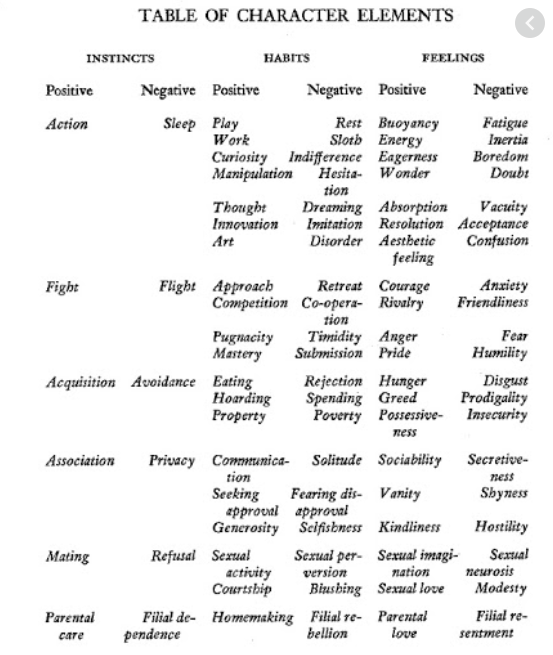
Each instinct generates habits and is accompanied by feelings.
Therefore, we create our culture by following certain actions when we are confronted by certain events. And every people have acted slightly differently, and have therefore formed their unique culture.
- A great book to understand more on this also is “Rule Makers, Rule Breakers” by Michele Gelfand, who breaks down cultural differences between some European countries and also beyond Europe
Just as important as it is for us to be mindful of our traditions, it also becomes necessary for us not to become too attached to them when there is a possibility to change something for progress and efficiency.
Lesson VI – Morals and History
Morals are the rules by which a society exhorts its members and associations to behaviour consistent with its order, security and growth.
- Moral codes differ because they adjust themselves to historical and environmental conditions.
Therefore, when our ancestors moved from the Primal Age to the Agricultural Age, and then to the Industrial Age, the moral codes that were present at each time were slightly different due to the circumstances at the time.
As an example:
- Primal Age – if someone becomes sick they may be left behind by the pack, due to their changes of living not being great. Further, challenging someone for the leadership role would require a fight to the death. The leader would then be allowed to mate in order for the strongest breed with more wives to survive
- Agricultural Age – we can kill wild animals that threaten our herds without any repercussions. We started to live in larger groups and communities and therefore put some rules in place that should protect our land and liberties so all could live together. Someone may challenge someone to a dual stand-off for the honour of the family name.
- Industrial Age – we can extract resources and use coal in our factories without necessary regard to the impact on our environment. Children may be used in factories, and hygiene isn’t known to be a great concern
- Information Age – we have become greater aware of our climate footprint and put in fiscal policies to reduce our footprint. We may not challenge someone to a dual-challenge.
Lesson VII – Religion and History
Throughout history religion has conferred meaning and dignity, and through its sacraments has made for stability.
Religion was used to support one’s legitimacy to rule the throne. It was sometimes used to initiate a war, or retaliate when one ruler of a different country invaded their country’s religious symbol (ie. when the Ottomans invaded Constantinople, which was held by the Christian religion).
Also through difficult times (the Plague, the Thirty Year War, World Wars, etc.) it was a place to find hope.
Lesson VIII – Economics and History
History, according to Marx, is economics in action – the contest, among individuals, groups, classes and states, for food, fuel, materials and economic power. However, economic factors alone were not always the incentive that drove people’s bahaviour. Sometimes, the incentive came through political powers and military powers.
- However, the experience of the past shows that every economic system sooner or later relies upon some profit motive to stir individuals or groups to productivity.
- The profit motive can come from economic incentives, or from political or military profit motives (ie. more land, more resources, etc.)
Lesson IX – Socialism and History
In free enterprise the spur of competition and zeal and zest of ownership arouse the productiveness and inventiveness of men. The natural selection of skills and with a basic democracy in rule determines the articles that will be produced for consumption by the public , rather than the goods selected by government that the public may consume.
- What makes the system of government control (communism) impractical is the fact that it is run by people who are subject to being corruptible and work being performed by people not efficiently
- In this way, the free system, where the market is let to its own devices (laissez faire) is more efficient as it will root out its inefficient components.
A system therefore lies between one of the three below:
Communism——————Socialism———————Capitalism
- What has become evident in the Western governments in recent times is that governments are taking on more social responsibilities (ie. free education, free health care, pension plan, etc.) which require more taxation to be able to finance these programs, and therefore those governments are moving further away from the capitalistic views
Lesson X – Government and History
Most governments of the past have been oligarchies – ruled by a minority and chosen 1) by birth, 2) by a religious organization and 3) by wealth.
- The favourable views are from the aristocracy, with the argument that ruling requires special education and preparation, which only they can afford.
This natural inequality of men soon recreates an inequality of possessions and privileges, and raises to power a new minority with essentially the same instincts as in the old
- what spurs the majority on to revolt against the ruling classes is when the ruling class engages in conspicuous consumption, rather than making productive re-investment in the economy and their workers.
If our economy of freedom fails to distribute wealth as ably as it has created it, the road to dictatorship will be open to anyone who can persuasively promise to security to all. —–
Lesson XI – History and War
War is considered the ultimate form of competition and natural selection in the human species. The causes of war are the same as the causes of competition among individuals: acquisitiveness, pugnacity and pride; the desire for food, land, materials, fuels and mastery.
Lesson XII – Growth and Decay
We have defined civilization as social order promoting cultural creation. An intricate and precarious web of human relationships, laboriously built and readily destroyed.
History repeats itself – civilizations begin, flourish, decline and disappear – or linger on.
- When the group or a civilization declines, it is through no mystic limitation of a corporate life, but through the failure of the political or intellectual leaders to meet the challenges of change.
- Caught in the interval between between one moral code (ie. Age or Generation) and the next, an unmoored generation surrenders itself to luxury, corruption, and a restless disorder of family and morals, clinging desperately to old restraints and ways
Nations die, old regimes grow arid or suffer other change. The resilient man picks up his tools and arts and moves on, taking his memories with him, and with him civilizations migrate and move elsewhere.
- A great explanatory of this material is on Youtube, Mike Maloney Hidden Secrets of Money series, Ep. 2 The Seven Stages of Empire, where they talk of the rise and fall of nations and the pendulum of quality money
Lesson XIII – Is Progress Real?
Human nature hasn’t changed significantly over the course of time, but the means of achieving ends have changed (ie. the means are the technologies and economic systems that we apply to more efficiently get things done)
Summary:
The book sums up some basic truths, and how different beliefs over the course of time has led to different (and sometimes devastating) consequences. It wants us to see the real truth, that sometimes our views were distorted, and led us down a different route in history as a result of those beliefs. It breaks us down to who and what we really are, what our inner core is really about. The book gets a rating of 4.2
All the best to you!!!
 MyBookReviews