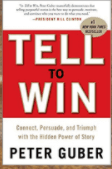
Title: Tell to Win
Author: Peter Guber
Hi all,
Another week has almost passed once again, and this week I am happy to provide my review of this week’s read.
It centers around the idea that in order to make a speech more memorable to a listener (to all kind of audiences) is to include a story element to it. One argument is that when we are presented with facts and figures to explain something it doesn’t attract most of our attention, and because we become bored by it, the key message of the speaker is by the audience. However, when the speech is delivered with a story element to it, then we relate better to it, attach an emotion to it, and then are more likely to retain what we were told.
Therefore, you distinguish between a data dump (i.e. non-story) with a good story.
Next to that, the author stresses the importance of knowing the audience you are about to address in order to update you style of presentation.
- Thus, getting to know the backstory of your listener/audience will help you better address the story
The essential three components that are included in a good story are as follows:
- Challenge;
- Struggle; and
- Resolution
The beginning of the audience should captivate the audience by introducing its key players, as well as their background so the audience can get a feel what and who they are dealing with – including understanding the challenges that a character faces at that time.
Then, as the story progresses, more emphasis is placed on the struggle that the character is going through. The idea is to capture the audience with more than their attention. They should be able to emotionally connect and maybe even relate to the thing they are going through. The more connected the audience becomes to the character, the more memorable it will become to them.
Then, the story progresses to reach a climax and finally the resolution.
- It becomes evident that the best story thus comes together when it comes from the heart and not from the mind
- Stories ignite regions of the brain that processes meaning. And as meaning-seeking creatures it’s not just about taking in information.
However, as an effective story-telling, it is not only about telling, but also about being an active listener yourself. You need to be able to hear and read your audience in order to understand that they are getting the message that you wish to deliver or if it feels more like just another presentation to them, in which case you have some work to do to capture their attention once more.
The author uses multiple examples within each chapter to explain what he means with each lesson, and thus allows you to see the practical application of how he learnt the lesson, and why it made a difference in his business proposals.
Summary:
Overall, it explains very well that information overload and data dump are not the most efficient means to communicate important information to our audience. We are meaning-seeking creatures and relate much better to stories than simple facts without any meaning to them. This lesson can be applied in personal and professional aspects of our lives, and therefore is a great read for all individuals.
The rating which I give the book is 4.3/5
Have a good weekend!!! 🙂
 MyBookReviews