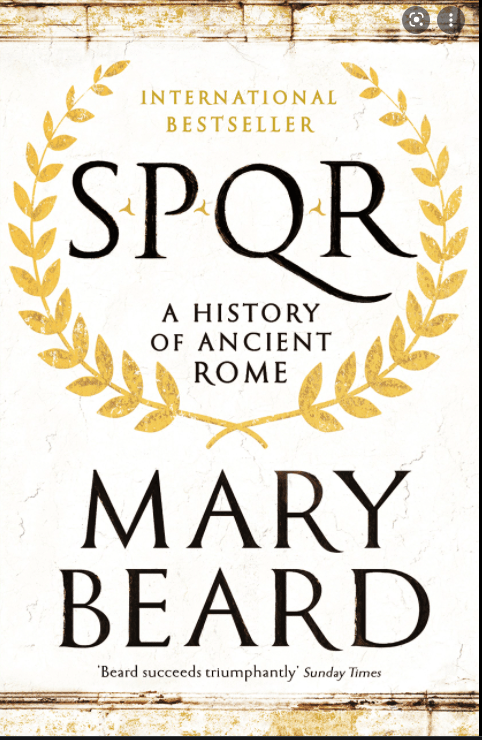
Title: S.P.Q.R. (A History of Ancient Rome)
Author: Mary Beard
Pages: 536
Hi all,
I wish that you all have started the year off well.
I managed to meet my goal in the number of books I planned to read, and hope to do the same for this year. Just before the year came to a close I took the liberty of buying some books that were calling out from my wish list. Book 029-2021 was one of them, and book 001-2022 is another.
My real introduction to history of Rome was from the book 006-2021 (The Storm before the Storm). There, it gives the reader some background of the foundation of Rome, the earliest wars it had as a Republic, before finally coming to the chapter where it discusses the political life from 146 BCE up until 44 BCE (i.e. Julius Ceasar’s death). The main theme is what events unfolded during that last century before becoming the Roman Empire after having grown and expanded as a mere Republic.
This book covers the years 753 BCE and closes off with the 14th emperor (Commodus) around 197 BCE, whereafter it would enter its next dynasty.
The book is broken down into the following chapters:
- Prologue: History of Rome
- Chapter 1: Cicero’s finest hour
- Chapter 2: In the beginning
- Chapter 3: The Kings of Rome
- Chapter 4: Rome’s great leap forward
- Chapter 5: A wider World
- Chapter 6: New Politics
- Chapter 7: From Empire to Emperors
- Chapter 8: The Home Front
- Chapter 9: The Transformations of Augustus
- Chapter 10: Fourteen Emperors
- Chapter 11: The Haves and Have-nots
- Chapter 12: Rome Outside Rome
- Epilogue: The first Roman Millennium
What differentiates this book from the former is that it here discusses in greater detail what the myths were that were recorded as facts in their history and what the archeological evidence suggests to us. She goes into greater detail why we cannot simply rely on what the old Roman historian writers have recorded since oftentimes what was recorded is not the real truth but them trying to make sense of what they knew was true and what they knew as myth/truth.
It goes into much greater detail, step by step, how the country changed from decade to decade/century to century and what are the possible reasons behind those changes and why they were so significant to the history of Rome.
The true head-turner is once we reach 146 BCE, which is seen as being a significant turning point in the Roman history. It is from here that the country was involved in conflicts abroad and at home which together brought about the demise of the Roman Republic and the birth of the one-man-rule Roman Empire.
Summary:
Overall, an insightful book, because it tries to identify what aspects of Roman history correlates with archeological evidence. It explores geography, politics, culture clashes, war and much more in such detail that the reader will distinguish between what was thought of as being history but is in fact myth, and why it was made out to seem as being history. We accompany some of the different politicians and emperors and try to understand their motives and their goals. The book deserves a grappling 4.8/5.
Have fun, and keep well!
 MyBookReviews