Title: The Prince
Author: Niccolô Machiavelli
Pages: 71

Hi all,
looking back at the types of books I have read, this may be the first one to deal with politics, old politics to be more precise.
If you simply pick up the book and start to read it you might not understand how to read it. Therefore, to get the best from the book it is good to read the 1) Note and 2) Dedication first and then reading the rest of the book. Why? When you read those, you will understand the purpose behind the book.
Machiavelli wrote this booklet to present it to his ruler as a gift. Others would please the ruler with material gifts. He took another approach. It was at the time of the Renaissance, classical Greek scholars had fled from Constantinople due to the Turkish invasion and settled to some extent here in the Italian States. They brought with them their history and knowledge and shared this with their Italian hosts (read more of this in 016-2022 The Greeks).
Machiavelli has studied ancient and recent history (both Greek and Italian) and devised a book to guide a ruler how he should rule his kingdom to allow the probability of retaining it be high. He thought that a gift of such knowledge would be ever more valuable than any material goods and flattery that are otherwise always presented on such occasions.
- Therefore, with this in mind, you will enjoy the book best when you read it from the perspective of the era in which the writer lived in. However, many of the suggestions provided then still find application today, though a little twisted for a modern audience.
In most chapters, the author introduces a lesson and then explains this with the help of an example from a king in his time or one from the ancient Greeks. It is mostly from examples that the trickier lessons become clear. However, the introduction of each lesson is also quite clearly explained.
The Princedoms mainly addressed are the ones shown below, and cover the first few chapters. The chapters thereafter go into detail on the governance of these individual Princedoms:
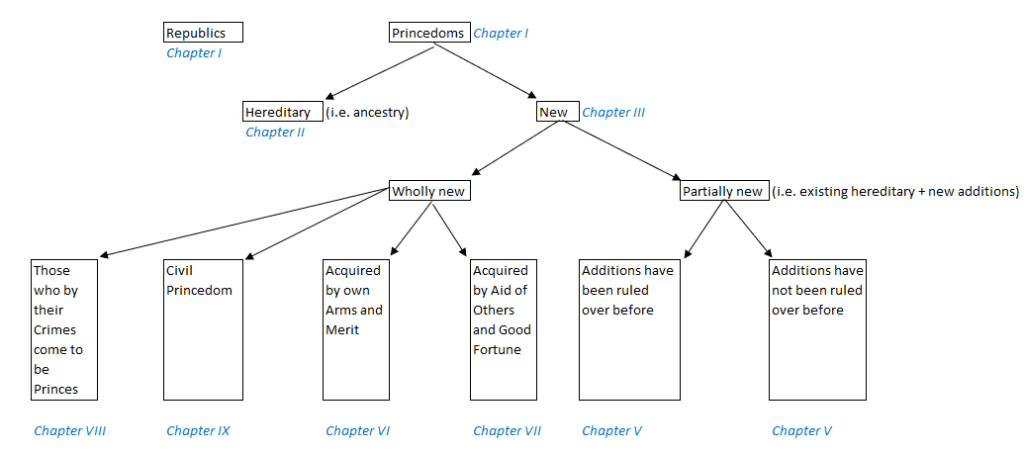
The book is broken down into the following chapters:
- Chapter I – Of the various kinds of Princedom, and of the Ways in Which They are Acquired (pg.1)
- Chapter II – Of Hereditary Princedoms (pg.1)
- Under these States, the people are accustomed to the family and their Princes and are therefore maintained with far less difficulty than new States since all that is required is that the Prince shall not depart from the usages of his ancestors, trusting for the rest to deal with events as they arise.
- Chapter III – Of Mixed Princedoms (pg.2)
- When entering a new province and new people, they will take up arm’s against their current ruler if they believe that their conditions will improve under a new ruler. However, if they find this not to become true, they may be just as ready to take up arms against you.
- Therefore, upon entering a new province, it is essential that you have the good will of the people.
- Further, when entering a new province, the inhabitants:
- have the same language and customs/values as you (Case A)
- have a different language and customs/values than you (Case B)
- If you encounter the former case (Case A), it will be easier to retain the new province if you follow the following two guidelines:
- Kill the reigning bloodline, so none will seek to reclaim it in the future
- Change none of the current ways in the province (i.e. taxes, laws, culture, etc.)
- If, on the other hand, you encounter a province where the latter case applies (Case B), maintaining it becomes more difficult. However, a Prince may do one of the following to retain their loyalty:
- The Prince should go dwell there in person since this will make his tenure more secure. When you are on the spot, problems can be dealt with immediately and the people will recognize that.
- Another approach is to set up a small Colony close to the Province who then undertake the administrative tasks, but do not infringe upon other people’s daily lives.
- The Prince may instead of Colonies sent soldiers to the Province to oversee the province. This is more expensive since the revenues generated from the province will likely go to cover the cost of the soldiers.
- In addition to the suggestions mentioned above for Case B, the Prince should also make himself the head and protector of his weaker neighbours and endeavour to weaken the stronger ones. This means he must also ensure that his neighbours don’t become stronger than him.
- In thus acting, wise rulers have to consider not only the present difficulties but also future ones, against which they must use diligence to provide for the future potential enemies.
- Chapter IV – Why the Kingdom of Darius, conquered by Alexander, did not, on Alexander’s death, rebel against His Successors (pg.8)
- Chapter V – How Cities or Provinces Which before their Acquisition have lived under Their Own Laws are to be Governed (pg.11)
- Under this chapter we cover both those states that have lived under a prior ruler and one that has not, but has lived free.
- Regarding those provinces acquired that have lived freely before and not under a Prince (Case A):
- There are three ways in which this State may be held:
- Destroy it
- Reside there in person
- Let it suffer to live on under its own laws, but subject it to a tribute, and governed by a combination of locals and few from your circle
- Under the third approach, the government will see that it cannot stand without the support and protection of the Prince and must do all it can to maintain him.
- Also, a city is more easily maintained when it is controlled by its own citizens.
- These steps are necessary, for a people that have lived freely before can hold the desire to do so again and will not hesitate to strike at you when misfortune overtakes you
- There are three ways in which this State may be held:
- Regarding those provinces acquired that have lived under a Prince before (Case B):
- Such people may be easily maintained since they have not known to live as free men and would much rather follow one that may be loved by them for letting them live under the same ways as they have with their previous Prince
- Chapter VI – Of new Princedoms Which a Prince Acquires with his own Arms and by Merit (pg.12)
- The Princedoms discussed in the following two chapters are those that are wholly new, i.e. no mixing of an existing kingdom with a new addition.
- Such Princedoms can be acquired by Merit or Favour.
- Regardless how a Princedom is acquired, the wise man should follow the roads that have been trodden by the Great and imitate those that have excelled, so that if he cannot reach their perfection, he may at least acquire something of its savour.
- The one acquired by Merit is discussed in this chapter.
- They who come to the Princedom by the virtuous paths, acquire with difficulty, but will keep with ease.
- The difficulties arise mainly from the new laws and institutions which they are forced to introduce in founding and securing their government.
- Once these difficulties have been overcome, at their own hands, they will be in a stronger position when faced with new difficulties.
- Chapter VII – Of new Princedoms Acquired by the Aid of Others and by Good Fortune (pg.15)
- They who become Princes by mere good Fortune do so with little trouble, but will have much trouble to maintain themselves when difficulties arise.
- Such States acquired by Fortune come in two ways:
- In return for money (Case A)
- Through the favour of him who confers it (i.e. a King makes you his satrap for this province since he cannot reside there himself) (Case B)
- These Princes are wholly dependent on the favour and fortunes of those who have made them great.
- They lack both knowledge and power that would enable them to maintain their position.
- States suddenly acquired can never have such a root or hold as another one that has laid strong foundations for longer periods once a storm hits them suddenly.
- However, they may be able to maintain such a Princedom when a) they have a capacity for learning quickly how defend what they have acquired from Fortune, and b) can lay those foundations, after they rise, which others have laid before
- Chapter VIII – Of Those who by their Crimes come to be Princes (pg.20)
- There are also other ways to acquire the Princedom than wholly from merit or fortune.
- These are:
- The ascent to power is made by paths of wickedness and crime
- When the private person becomes ruler of his country by the favour of his fellow-citizens
- The path, where wickedness is applied, is discussed in this chapter and the second in the following one.
- When a man utilizes wickedness and crime to acquire his princedom, the question arises how he is to maintain it. There are two paths he may follow, one of which will lead him to maintain it (keeping to cruelty and punishment):
- Cruelties are well-employed
- They are done once for all under the necessity for self-preservation and are not afterwards persisted in
- Cruelties are ill-employed
- Cruelties from small beginnings increase rather than diminish as his rule goes on
- Cruelties are well-employed
- Hence, we learn that on seizing a state, the usurper should make haste to inflict what injuries must, at a stroke, that he may not have to renew them daily, but be enabled by their discontinuance to reassure men’s minds, and afterwards win them over with benefits
- Chapter IX – Of the Civil Princedom (pg.24)
- In this chapter is discussed where a Princedom is acquired not by wickedness, but by being chosen by his fellow-citizens
- The road to this Princedom lies either:
- through the favour of the people (Case A)
- through the favour of the nobles (Case B)
- He who comes to the Princedom by favour of the nobles, has greater difficulty to maintain himself than he who comes to it by the aid of the people since he finds about him many who think themselves as good as he and who, on that account, he cannot govern.
- A Prince can never secure himself against a disaffected people, their number being too great, while he may against a disaffected nobility, since their number is small. Also, a Prince must always live with the same people, but not with the same nobility.
- As regards the nobles (Case B), there is a distinction to be made:
- Those that govern their conduct to bind themselves wholly to your fortunes
- They do not govern their conduct to bind themselves wholly to yours:
- because they are held back by pusillanimity and a natural defect of courage; or
- because they abstain from doing so
- In summary, it is essential for a Prince to be on friendly footing with his people, since, otherwise, he will have no resource in adversity
- Chapter X – How the Strength of All Princedoms should be Measured (pg.27)
- The way to measure the strength of a Princedom is by assessing whether, should he be confronted by external events, he is strong enough 1) to stand alone, or 2) he needs continual help from others.
- When the Prince is strong enough to stand alone to defend themselves (with men and money at their disposal) then such a Prince is fit to take to the field against any assailant.
- Conversely, where the Prince is not able to stand alone, they should remain behind their walls and defend themselves there, rather than meeting an assailant on the field
- These Princes should focus their efforts to strengthen and fortify their towns and take no heed of the country outside
- A Prince, therefore, who has a strong city, and who does not make himself hated by his people, cannot be attacked, or should he be so, his assailants will come off badly.
- If the people have possessions outside, they may lose patience with their Prince. However, when they know that with their Prince they will overcome this, they will remain loyal to him
- Chapter XI – Of Ecclesiastical Princedoms (pg.28)
- Chapter XII – How many different kinds of Soldiers there are, and of Mercenaries (pg.30)
- The kind of soldiers that the Prince can call on are the following:
- His own subjects
- Mercenaries
- Auxiliaries
- Partly one and the other
- Of Mercenaries the following is said:
- These are at once useless and dangerous, and he who holds his state by means of mercenary troops can never be solidly and securely seated because they have no tie or motive to keep them in the field beyond their paltry pay
- To maintain some control over them the Prince should go with them into battle to hold them to their promises
- Of National Arms the following is said:
- Princes who depend on their own National Arms have the greatest success, since the men have a stronger link to the Princedom they are protecting than mere pay (i.e. home and families)
- The kind of soldiers that the Prince can call on are the following:
- Chapter XIII – Of Auxiliary, Mixed and National Arms (pg.34)
- Of Auxiliaries the following is said:
- They are the troops brought to help and protect you by a potentate whom you summon to your aid
- They may be excellent and useful soldiers, but are always hurtful to him who calls them, for if they are defeated, he is undone, if victorious, he becomes their ‘prisoner’
- Of armies mixed the following is said:
- Armies composed of partly national and partly mercenaries/auxiliaries are far superior than mere mercenaries/auxiliaries alone but are inferior still to forces purely national
- Of Auxiliaries the following is said:
- Chapter XIV – Of the Duty of a Prince in Respect of Military Affairs (pg.37)
- Of the duty of a prince, the following are presented:
- A Prince should have no care or thought but for war, the regulation and training it requires, and should apply himself exclusively to this as his peculiar province. It not merely maintains those who are born Princes, but often enables men to rise to that eminence (Case 1).
- On the other hand, when Princes devote themselves rather to pleasure than to arms, they lose their dominions (Case 2)
- The message is not to say that a Prince should always prepare to head to war and make conquests to enlarge his Princedom. Rather, he should, during Peace, learn as much as possible of all the lands and people under his control and how he can better protect them should some event cause disruption to their current lives.
- In meeting his responsibility of giving attention to war, he should give his attention to improving in two ways:
- Practice
- He should practice his skills with his soldiers so they may see him to be capable and competent to lead them
- He should travel his lands to learn the geography so that it may be used to their advantage against any invading forces
- Knowledge
- The Prince should read histories and should note the actions that were taken by the great men.
- How they conducted themselves during the wars, how to avoid their mistakes (and in turn defeat) and imitate successful tactics and strategies (and in turn gain victories).
- Practice
- Thus, a wise Prince should pursue such methods as these, never resting idle in times of peace
- Of the duty of a prince, the following are presented:
- Chapter XV – Of all the Qualities in respect of which Men and most of All Princes, are praised or blamed (pg.39)
- The author lists a series of qualities (good and bad) to showcase which are opposites from one another, and thus why the Prince should aim to reflect all the good ones to his people.
- However, it is impossible to possess all the good qualities, on condition of human nature, and therefore, the Prince must be discreet enough to know how to avoid the infamy of those vices that would deprive him of his government.
- Chapter XVI – Of Liberality and Miserliness (pg.41)
- Chapter XVII – Of Cruelty and Clemency, and whether it is better to be Loved or Feared (pg.43)
- Every Prince should desire to be accounted merciful and not cruel. Nevertheless, he should be on his guard against the abuse of this quality of mercy.
- Being loved and feared can hardly exist together, and therefore it is far safer to be feared than loved.
- A Prince should inspire fear in such a fashion that if he does not win their love, he may escape yet from being hated
- Every Prince should desire to be accounted merciful and not cruel. Nevertheless, he should be on his guard against the abuse of this quality of mercy.
- Chapter XVIII – How Princes should keep Faith (pg.45)
- Everyone understands how praiseworthy it is in a Prince to keep faith, and to live uprightly. Yet, there are times when men were cunning to accomplish greater things and got the better of those who trusted to honest dealing.
- There are two ways a Prince may contend:
- First, in accordance with the law,
- Second, by force
- A Prince should understand how to use well both since sometimes following the honest dealing against an unjust man will not bring about a fair result, which then means justice needs to be acquired by other means.
- A Prince needs to learn both ways of interaction so he may be well-equipped, and then learn to restrain himself so he may act in a civilized manner
- This links well with the phrase “…it is better to be a warrior in the garden, than a gardener in war…”
- You need to learn and acknowledge that you have the potential to be evil and learn to control yourself, so you don’t unleash that to the world
- Chapter XIX – That a Prince should seek Escape Contempt and Hatred (pg.47)
- Chapter XX – Whether Fortresses, and certain Other Expedients to which Princes often have Recourse, are Profitable or Hurtful (pg.55)
- Chapter XXI – How a Prince should bear himself so as to Acquire Reputation (pg.59)
- Chapter XXII – Of the Secretaries of Princes (pg.62)
- The readiest conjecture we can form of the character of a Prince is from seeing what sort of men he has about him.
- The Prince’s intelligence can be one of three:
- He understands things by himself
- He understands things as shown to him by others
- He understands neither on his own, nor when shown to him by others
- The Prince should surround himself with people whom he can approach for council, but should also be of sound mind and intelligence to understand the consequences of his decisions
- Chapter XXIII – That Flatterers should be Shunned (pg.63)
- Chapter XXIV – Why the Princes of Italy have lost Their States (pg.64)
- Chapter XXV – What Fortune can effect in Human Affairs, and how She may be Withstood (pg.66)
- There are many Princes that are of the opinion that human affairs are governed by Fortune and God, that men cannot alter them by any prudence of theirs, and for this reason have come to think that it is not worthwhile to labour much about anything, but leave everything to be determined by chance
- A Prince who rests wholly on Fortune is ruined when she changes (i.e. when good the kingdom is struck with some adversity)
- Other Princes who do not rest wholly on Fortune will have a better chance of surviving when they are best able to adapt to the times
- Thus, a Prince cannot remain cautious and never change his ways, even when times and circumstances around him have changed since, when adversity strikes, he is wholly unprepared and will fail to uphold itself. Whereas, had the Prince adapted as the circumstances showed signs of change, he will not be as adversely affected when the adversity hits you
- There are many Princes that are of the opinion that human affairs are governed by Fortune and God, that men cannot alter them by any prudence of theirs, and for this reason have come to think that it is not worthwhile to labour much about anything, but leave everything to be determined by chance
- Chapter XXVI – An Exhortation to Liberate Italy from the Barbarians (pg.68)
The chapters that I have found quite striking were chapters VI, XIV, XXII and XXV. They teach you quite valuable lessons that can be adopted both in personal life and professional life.
(Interesting side note, the chapter numbers are in Roman numerals. In 1202 Fibonacci (Leonardo of Pisa) wrote his book ‘Liber Abbaci’ where he introduced the benefits of the Hindu-Arab numerals. More on this in book It All Adds Up 007-2020).
Summary:
I thought the book was a little tricky to read at times, but then, taking a moment to reflect, it became clear again what was meant exactly. The book communicates lessons of politics that were relevant in his time, but also find relevance today, to a different extent at least. It is a quick read and therefore the lesson of each chapter is not lost with too lengthy chapters. The book receives a rating of 4.6/5.
Quite an interesting start to my political genre of books, and will see whether this genre has other equally good books.
Have a good one!
 MyBookReviews