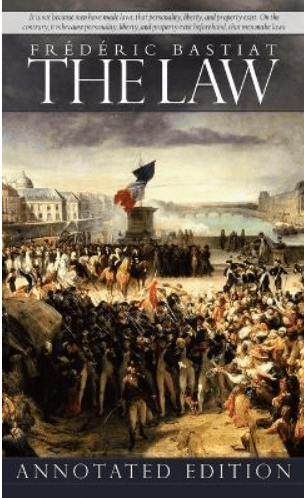
Title: The Law
Author: Frederic Bastiat
Pages: 55
Hi all,
continuing my trend of rereading some of my old books, I opted for a political genre. My first review of the book was under 039-2020, and the refresher is especially relevant when one lives in turbulent times. Not only did I refresh some of the key principles that the book sets out to make, I have also better understood some of the axioms he uses to support his argument. That is the great thing about rereading and is a good reason to go back to some old things from the past.
The book is quite short, since it wasn’t intended to be a book, but merely an essay from the author. It doesn’t give an argument with large quantities of statistical analysis and data, but keeps the argument simple with logical axioms to support his claims.
He argues that mankind has three things that were given to it by the creator: 1) personality, 2) liberty and 3) property. If we lived individually and someone were to threaten to take away any one of our rights, then we could defend ourselves from their removal. Now, when you bring a group of people together, who have decided to live together, then there should be certain conditions each member should abide by to make living together acceptable to all members. These conditions would be the law that protects for each member their three rights. It follows, thus, if anyone were to try to take one of these rights away from us, the law would be enacted to prevent this from happening.
- The law is thus the defence of the individual rights.
However, the law, as it developed, become not only a tool to protect our rights, but also a tool that would allow for legal plunder to become right, and our defense of legal plundered items, a crime.
- The law of taxation permitted for transactions and work to be taxed (legal plunder) and trying to defend one’s earnings would be deemed tax evasion (crime).
- Thus, the law has diverted from its initial purpose.
The law has thus been perverted as a result of two causes:
- One, naked greed
- We have already discussed that mankind utilises its faculties, by laboring, to satisfy their needs and wants.
- However, since we try and avoid pain and suffering, which labor may bring with it, some decide that they will settle their needs and wants on the shoulders of others’ labor.
- They will highlight the importance of their role as a politician, and other politicians overall, so that it may justify the legal plunder of other people.
- When other people feel the injustice of this, they may follow two paths: join politics to remove this bad influence, or join politics and claim their share of this legal plunder.
- Two consequences of this are:
- It will remove the distinction from people’s conscience between justice and injustice (i.e. people will forget what the initial purpose of the law was, and that legal plunder is in violation of those laws).
- It will give people’s struggles a greater degree of importance (i.e. problems people suffer can be brought to the government’s attention, and they need to solve these).
- Two, misconceived philanthropy
- Under this cause, legal plunder is cleverly disguised by the socialist/communist as being everyone’s patriotic duty and social responsibility.
- Hand in hand with this, they call out that it is politicians that are needed to direct the people to a good civilized existence.
- Bastiat critizes this point especially and at length since the politicians, according to him, claim that the people, left to their own devices (i.e. not being led by politicians, but by themselves), would not be capable to bring about an advanced civilization.
- They emphasize the importance of their role and suggest that the people should merely be passive in the economy.
- However, this, he argues, is not true in any way, since it was mankind that brought about the law and not the other way around.
From all this, you can take away that he is a strong supporter of full capitalism. Even though he agrees with a simple form of government should be in place, it’s role should be simple and only present to protect the three rights bestowed upon mankind.
The book was initially published in 1850, and at the time, he didn’t see any one nation closely emulating this form of government. The closest he did associate with it was the United States of America. However, it also had its flaws (thus not embodying the perfect system) since it had slavery and tariffs.
- Slavery prevented people of colour to enjoy their three rights
- Tariffs prevented markets operating completely unregulated (since the tariffs were imposed on imports)
Summary:
Overall, very insightful how the law has been reshaped over time and made life more regulated than when the laws were initially introduced. Liberty is different now than a decade/century passed, however, it is not always clear to us since we only live in a brief window of time and the laws at the time are a normalcy to us.
It, I guess, would not be feasible to abolish all laws and let the markets run amok. However, it does give someone something to think about how our lives are shaped by the forces of legislators and not necessarily by the people anymore. The book will thus bring in a rating of 4.75/5.
Happy reading!
 MyBookReviews