Title: Mythos (The Greek myths retold)
Author: Stephen Fry
Pages: 394
Hi all,
I am pleased that I can continue with my journey of rereading some of my favourite old books. I have last written a review about it under 009-2019, which was my second step to induce me to take on a greater interest in ancient civilizations. The first was the film Troy.
When I started reading the book, I tried to build the family tree in my head as I read along. However, since some of the gods coupled with multiple gods/mortals, this started to become more tricky. Therefore, the best way I found to keep track was to only know the lineage of the main lines, which allows one to understand where the next offspring has their heritage.
The book is broken down into the following chapters:
- Foreword (pg. vii)
- The Beginning – Part One
- Out of Chaos (pg. 3)
- The ancient Greeks didn’t believe that the world simply appeared out of nothing.
- Although it is difficult to learn when and how the stories of their gods exactly took shape, we can be sure that someone that played a role in this were the other tribes and kingdoms around them (for example the kingdoms in Asia Minor and beyond).
- Whatever the truth, science today agrees that everything is destined to return to Chaos.
- The inevitable fate of entropy: the great cycle from Chaos to Order and back again to Chaos.
- The First Order (pg. 5)
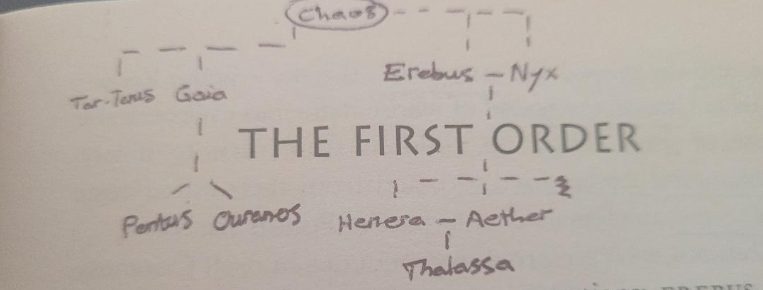
- Out of Chaos came the first four Elementals, which were not called gods since they were something quite different. They were primordial deities. They simply were all over and didn’t take the shape of a person as we later saw the next line of beings.
- The first two were:
- Erebus – darkness
- Nyx – night
- Their union brought forth two additional elementals:
- Hemera – day
- Aether – light
- These two also brought forth an offspring, Thalassa, which would become the counterpart of Pontus, son of Gaia, elemental of the sea.
- The next two that sprang forth from Chaos were:
- Gaia – earth
- Tartarus – depths and caves beneath earth
- Gaia on her own brought forth two further offspings:
- Pontus – the sea
- Ouranos – the sky
- …
- The Second Order (pg. 7)
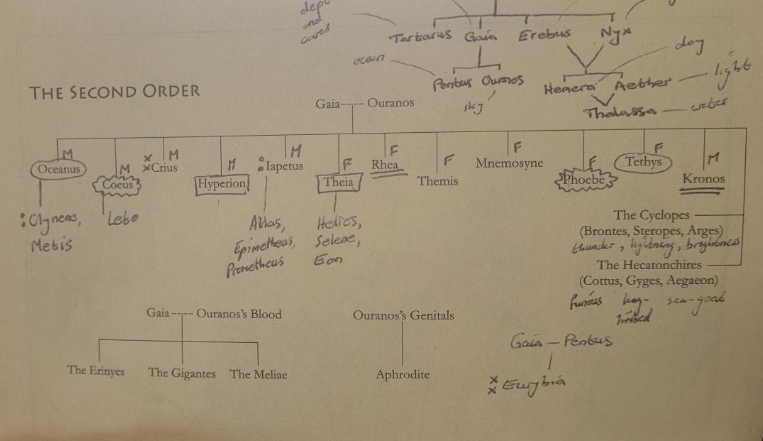
- When Gaia coupled with Ouranos, she bore him six sons and six daughters. She also bore him two sets of triplets: the Cyclops (Brontes {thunder}, Steropes {lightning} and Arges {brightness}) and the Hecatonchires (Cottus {furious}, Gyges {long-limbed} and Aegaeon {sea-goat}).
- Four sons and daughters married with one another.
- Oceanus with Tethys –> bearing Clymene and Metis. They would give birth to further river deities, the first being Nilus.
- Coeus with Phoebe (prophecy) –> bearing Leto.
- Hyperion with Theia –> bearing Helios (the sun), Selene (the moon) and Eon (the dawn).
- Kronos with Thea –> bearing the six of the Third Order.
- Two sons married with a daughter of the other couples.
- Crius with Eurybia (daughter of Gaia with Pontus)
- Iapetus with Clymene –> bearing Atlas, Epimetheus and Prometheus.
- Two daughters didn’t marry, but they still bore offspring after coupling once with another god.
- Themis (embodiment of justice)
- Mnemosyne (meaning memory)
- Four sons and daughters married with one another.
- Erebus and Nyx were also busy bringing their own offspring to the world:
- Nyx on her own bore:
- Moros (doom)
- Apate (deceit)
- Geras (old age)
- The twins Oizys (misery, depression and anxiety) and Momos (mockery, scorn and blame)
- Others that they bore together were which were terrifying:
- Eris (discord)
- Nemesis (retribution)
- Charon (ferryman of the dead)
- Hypnos (sleep)
- thousands of Oneroi
- Phobetor (nightmares)
- Phantasos (phantasy)
- Morpheus (son of Hypnos)
- Thanatos (death)
- Three exceptional contrasting children they bore were:
- the Hesperides (nymphs of the west) which announced the arrival of the dark with the last spark of light on the horizon
- Nyx on her own bore:
- …
- Ouranos was satisfied with his 12 offspring, but not so much with the two sets of triplets. Therefore, he shoved them back into Gaia’s womb.
- In retaliation, she went to mountain Othrys where she fashioned a weapon that one of her children should use to punish their father.
- She went to each of her twelve children to request them to punish their father and in return they could rule alongside her. All refused, except Kronos.
- When Ouranos came to bed at night Kronos sprang forth and swung the scythe, which cut off Ouranos’ genitals.
- Kronos took these and threw them over the ocean.
- They landed just off the shore of Cyprus, which then gave rise to the goddess of Aphrodite (love).
- Where Kronos had castrated his father blood had dripped. This gave rise to the birth of the three triplets:
- The Furies (Alecto {remorseless}, Megaera {jealous rage} and Tisiphone{vengeance}).
- The Gigantes
- The Meliae (nymphs which were guardians of a special ash tree)
- He then cut his mother Gaia and out fell his two sibling triplets. Them, together with his father, he led deep down to Tartarus and imprisoned them.
- He then came out of Mount Othrys and became a pair with Rhea.
- Before being jailed, his father had issued him a warning, that his children would also one day be the reason for his downfall.
- Kronos went on to impregnate his wife Rhea and each time she gave birth, he would take the child and swallow it. This happened with their first five children (Hestia, Hades, Demeter, Poseidon and Hera).
- When their next child was due she hitched a plan to save the child. She let off screams that indicated to Kronos that his child was born. She then handed to him a rock in bundles which he swallowed and left.
- Rhea then fled from Othrys to Crete where she gave birth to her sixth child Zeus in Mount Ida.
- There he was raised by the Meliae, a she-goat named Amalthea and Metis (daughter of Oceanos and Tethys).
- When Zeus was of age his mother introduced him to her husband Kronos, to be their cupbearer. Kronos eagerly drank the draught, but soon found that this had upset his stomach.
- He threw up the rock and his five siblings. Zeus wanted to kill his father with his own scythe since his father was now in an unconscious state from the drought. However, he was not able to do this since his mother Gaia still protected him.
- Therefore, the siblings fled.
- When Gaia coupled with Ouranos, she bore him six sons and six daughters. She also bore him two sets of triplets: the Cyclops (Brontes {thunder}, Steropes {lightning} and Arges {brightness}) and the Hecatonchires (Cottus {furious}, Gyges {long-limbed} and Aegaeon {sea-goat}).
- Out of Chaos (pg. 3)
- The Beginning – Part Two
- Clash of the Titans (pg. 43)
- The war that would follow would be known as the Titanomachy, which would be a 10 year conflict.
- The sheer impact of this war was what would shape the world over which the victors would eventually come to rule.
- The six siblings were joined by few Titans (Prometheus, Epimetheus, the Gigantes, the Cyclops and the Hecatochires). It was the young Olympians with their small Titan allies that emerged as the victors.
- Even though a Titan could not be killed, since they were immortal, they could still be punished.
- Zeus would strip most of the Titans of their powers and forgive them for their mal-alliance, but others he would serve a punishment for eternity.
- Atlas was sentenced to hold up the sky for eternity at the junction of Africa and Europe.
- Kronos was punished to travel the world, measuring, counting and recording time for eternity.
- Whilst the battles had been ongoing the gods had still given time to satisfy their pleasures and the population of beings on the world had increased. Even animals came to being, alongside all kinds of new plants that sprung forth and were fertilized by the blood-drippings of the fighting gods.
- Zeus secretly coupled with Mnemosyne and they bore the Nine Muses (Calliope {muse of epic poetry}, Clio {muse of history}, Erato {muse of lyric and love poetry}, Euterpe {muse of music}, Melpomene {muse of tragedy}, Polyhymnia {muse of hymns – sacred music}, Terpsichore {muse of dance}, Thalia {muse of comic arts} and Urania {muse of astronomy and stars})
- Zeus coupled with Eurynome and they bore the Charites (Aglaea {splendour}, Euphrosyne {glee and merriment} and Thalia {cheerfulness}) and they were better known as the Three Graces.
- The Horai triplets were born by Themis, and consisted of two sets of triplets. The first set were Auxesia (summer), Carpo (winter) and Thallo (spring). The second set consisted of Eunomia (goddess of law and legislation), Dik`e (goddess of justice and moral order) and Eirene (goddess of peace).
- The Moirai triplets (the Fates) were born by Nyx and were Clotho, Lachesis and Atropos. Clotho would spin the wool (life), Lachesis would measure out the length and Atropos would decide where to cut the wool.
- The Keres were other triplets from Nyx.
- The Gorgons were descended of Phorcys and Ceto, which were the children of Gaia and Pontus. The Gogons daughters were Stheno, Euryale and Medusa.
- The Third Order (pg. 58)
- The world had been shattered and therefore he would allot each of his siblings their own domain of responsibilities.
- Zeus – For himself, he assumed overall command as supreme leader and emperor, master of the weather and storms. King of the Gods, Sky Father, Cloud Gatherer.
- Hestia – The home and hearth of all peoples.
- Hades – Lord of the Underworld where all dead souls headed to.
- Under his command came Erebus and Nyx, as well as majority of their offspring.
- Thanatos (death) would lead most souls to the entrance of the underworld.
- The dark river Styx’s brother Charon was appointed the ferryman who carried the souls from the bank to the cave that lead to Hades’ kingdom.
- The Furies also acquired a place in his underworld.
- Offspring from Gaia and Tartarus included Echidna and Typhon. Their offspring was a hellhound, which Hades adopted and was called Cerberus. His sister Hydra was posted to the entrance.
- Poseidon – Lord of the Oceans and Waves with his kingdom located beneath the depths of the Aegean Sea. With his consort wife he bore his son Triton.
- Demeter – She was given the divine responsibility for harvest and growth, fertility and the seasons. Though she did not wish to engage with any other god, she eventually bore two children from her brothers.
- With Zeus she bore the daughter Persephone.
- With Poseidon she bore the son Arion.
- Hera – She committed to rule the world alongside her to be husband Zeus. Of him she expected a commitment to her alone. However, as can be seen in the following chapters, Zeus did not uphold his loyalty, which is the reason Hera cursed or set harm upon the offspring he bore with others.
- …
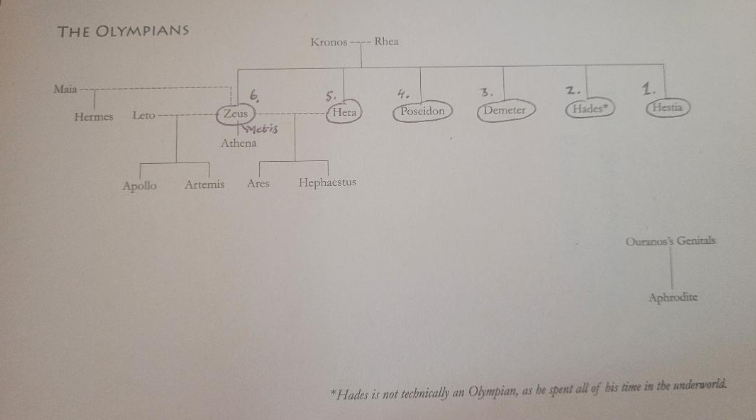
- Zeus aspired to rule his newly-acquired kingdom differently from how his father Kronos had done. Thus, it was believed that a leadership council of 12 should be formed. 6 members (Zeus, Hestia, Hera, Demeter, Poseidon and Aphrodite) were already included.
- Other members that were to join subsequently were:
- Hephaestus (god of fire and blacksmiths, artisans, sculptors and metalworkers) – First child, son of Zeus and Hera was disfigured and therefore thrown from Olympus. However, after growing up he proved his worth and was welcomed to the table. After saving his mother he was given the right to marry Aphrodite, which had herself been in a relationship with Ares.
- Ares (god of war) – The second son of Zeus and Hera, and the personification of a warrior.
- Apollo (lord of mathematics, reason and logic, poetry, medicine, knowledge and enlightenment
- ) and Artemis (goddess of the chase and chaste, the untutored and untamed, of midwives and the moon) – Zeus also bore twins with Leto (daughter of two elders – goddess of motherhood and modesty) at the isles of Delos.
- Athena (goddess of wisdom, handicraft, statecraft, warcraft and justice) – At his wedding to Hera, Zeus chased after his former tutor Metis, with whom he then engaged in relations. Afterwards, she transformed herself into a fly and he was tricked to swallow her. She bore her daughter. Hephaestus used one of his tools to split Zeus’ head from which Athena emerged, fully armored. Zeus, being an immortal, soon recovered from the headache.
- Hermes (messenger of the gods due to his fleetness of foot and mind) – Titan Atlas had fathered seven daughters with Oceanid Pleione. The eldest was called Maia. Zeus got her with child at Mount Cyllene.
- The world had been shattered and therefore he would allot each of his siblings their own domain of responsibilities.
- Clash of the Titans (pg. 43)
- The Toys of Zeus – Part One
- Prometheus (pg. 115)
- Zeus approached his close friend Prometheus and exclaimed to him that their world is quite empty of living things. That they should start a new race and set it out amongst nature to see what happens.
- Prometheus then set out to find the right clay and started shaping different kinds of peoples with different colours (green, violet, blue, black, brown, ivory, yellow and red) and other features.
- When Zeus returned with Athena he had been too hasty and accidentally knocked over three clay figures (green, violet and blue).
- Athena blew life into the figures and they became the first males, for Zeus had forbidden Prometheus from giving them two items: i) females and ii) fire, since he was afraid that these would enable them to become powerful without the gods help and maybe even challenge them one day.
- Zeus clapped his hands and the few became many, which then went their own ways to inhabit different parts of the world.
- The co-habitation of the world between the people and the gods was to become known as the Golden Age for there were no hardships that the people had to suffer, the weather was always good and food was available in abundance.
- However, to Prometheus, he believed that it was not good for people to live in unchallenged lives, since they had such potential to become more. Thus, he went against Zeus’ command and brought down fire from Olympus to the people and taught them many of its uses.
- The Punishments (pg. 131)
- The First Punishment
- Zeus soon realized what Prometheus had done and, together with the other gods, hatched a plan to deal an appropriate punishment upon the people. Hephaestus was instructed to shape a female, whom all the female gods gave some of their abilities and into whom Aphrodite breathed life.
- Hermes escorted Pandora to the location where Prometheus and his brother Epimetheus lived amongst the people. Prometheus was absent and Epimetheus knew his brother would object, so he married Pandora quickly after their introduction.
- Zeus had bestowed a gift onto her, a clay jar, with the instruction not to open the seal. In the beginning she upheld his instruction and left the clay jar untouched. But curiosity nagged at her and thus she decided to have a brief glimpse. This resulted in the evil that had lurked inside to come out and live amongst the people of the world.
- The evil were children from Nyx and Erebus’ offspring Apate (deceit), Geras (old age), Oizys (misery), Momos (blame), Keres (violent death). They were the offshoots of Ate, Ruin, Eris and Discord and were named Ponos (hardship), Limos (starvation), Algos (pain), Dysnomia (anarchy), Pseudea (lies) Neikea (quarrels), Amphilogiai (disputes), Makhai (wars), Hysminai (battles), Androktasiai (manslaughters) and Phonoi (murders).
- Pandora tried to shut the jar and the evil, but the only child she sealed in the jar was Elpis (hope).
- This new world would become known as the Silver Age for the peoples now lived with these evils for the rest of their lives.
- Prometheus bore a son, Deucalion and his brother and wife bore a daughter, Pyrrha, who married each other.
- The Second Punishment
- The people continued to spread and multiply in numbers and Zeus had still not forgiven Prometheus for his transgression.
- Zeus was one day invited for a feast by king Lycaon of Arcadia, son of Pelasgos, one of the original clay figures.
- For reasons unknown, he has his son killed and the meat served to Zeus. Once he realized what had been done, Zeus healed the son, Nyctimus, and transformed Lycaon into a wolf.
- However, the peoples of the time were treating the world quite poorly and showed no respect to the gods, which is why Zeus called for a Great Flood to cleanse the world so that it could start anew.
- The only survivors of this ordeal were Deucalion and Pyrra.
- Together, they traveled to Delphi and consulted the oracle Themis what they could do to have more offspring. She gave them a riddle, which they solved and resultantly gave them 100 boys and 100 girls. The age of the new people had begun.
- Finally Zeus felt the time had come and he lay out his punishment for Prometheus, who took it upon himself and let the punishment be inflicted.
- The First Punishment
- Persephone and the Chariot (pg. 149)
- In this story, Persephone was walking the fields with her companions, when one day, a chariot from below the grounds burst forth and took her with to his realm below the earth.
- The world had always had good weather and brought about good harvest. However, when Persephone was missing, Demeter neglected her responsibilities, which resulted in bad crops and famine amongst the people, who then in turn called to the gods for relief.
- Zeus finally intervened and it was discovered that Hades had taken her with him. Hermes was dispatched to retrieve her. Before he came, Hades offered Persephone some food. When Hermes arrived it was discovered that she had eaten from the Underworld, which meant that she always had to return to Hades.
- Thus it came to be that for six months she lived in the upper world and her mother upheld her responsibilities and the world flourished. And for six months she returned to the Underworld, during which time she neglected her responsibilities and mourned her daughter.
- Cupid and Psyche (pg. 157)
- Prometheus (pg. 115)
- The Toys of Zeus
- Mortals (pg. 189)
- Phaeton (pg. 196)
- Briefly, Phaeton was the son of Apollo and a mortal mother. One day, he went to school and heard one of Zeus’ demi-god sons (Epaphus, son of Zeus and mortal Io) boast of an upcoming trip he is taking to the North African coast of Libya with his father. Phaeton declined the offer, stating that he will be busy helping his father fly the chariot of the sun across the sky.
- Epaphus stated that Apollo never gave the reigns to the chariot over to anyone else, and that Phaeton was thus a liar. Phaeton made his way to the east, where the sun rises, and where Apollo’s kingdom lay. He was granted an audience and tricked Apollo that he may ride the chariot, alone.
- Once he took off the trip went well for the most of it. It was when they came over the North African coast that he started to descend lower and leaned over so he may wave to Epaphus. However, this only caused the horses to lose direction with their charioteer. They came too close to the land that most of it caught on fire (now the Sahara desert).
- Zeus eventually interfered by striking him down with a lightning bolt. He fell to his death. Where he fell, his affectionate friend Cygnet fell to his knees to mourn his passing.
- He was turned into a swan, who also remained mute and only upon their death gave out one last cry.
- Cadmus (pg. 210)
- In the Levantine kingdom Tyre the king (Agenor, son of Poseidon and Libya) and queen (Telephassa, daughter of Nilus and nymph Nephele) had five children: one daugther (Europa) and four sons (Cadmus, Cilix, Phoenix and Thasos).
- One day there was a white bull that walked amongst the fields. Europa was so astounded by it that she walked closer to it. The bull let her climb on and together they headed for the sky. They fly away to the island of Crete. The bull was in fact Zeus who had taken a liking to her. She would bear him three sons (Minos, Rhadamanthus and Sarpedon – the first two would subsequently be appointed by Hades to serve as judges in the afterlife).
- Agenor instructed his sons to seek for their sister and not return home without her.
- As the years passed and none succeeded in the task, each eventually would go on to found their own kingdom away from home.
- Phoenix would return home and rename the kingdom as the Phoenicia.
- Thasos settled on a nearby island, called Thasos
- Cilix also abandoned the task and went to Asia Minor to raise a kingdom named Cilicia.
- Cadmus went to Greece with his newly wed wife Harmonia (daughter of Zeus and Electra – of the Seven Sisters (daughter of Atlas and Oceanid Pleiade)).
- Their kingdom of Tyre had brought about the invention of the alphabet. And with their quest they spread the knowledge and uses of this new invention wherever they went.
- Cadmus and his entourage headed for the oracle of Delphi, which informed him where he should lay his foundations for a new kingdom. After a brief lay-over they eventually ended up at Boeotia, founding the city of Thebes.
- Twice Born (pg. 230)
- Cadmus and Harmonia’s marriage gave two sons (Polydorus and Illyrius) and four daughters (Agave, Autonoe, Ino and Semele).
- When Cadmus and Harmonia decided to undertake their leave and travel the kingdom was left to their daughter Agave and her husband Pentheus, one of the sons of the Five Founding Lords.
- Pentheus ruled over a strong kingdom, but he always had to look over his shoulder since his in-laws were ambitious and had plans of their own. The only one he could trust was Semele, who was a devoted priestess of Zeus.
- Zeus fancied her, appeared to her and they had brief relations. Hera found out that he was not being faithful and therefore laid a trap for Semele. This resulted in her death.
- However, Semele had been with child at the time. Therefore, Zeus cut open her womb and placed it into his thigh. When it was time, Hermes joined Zeus to travel to Nysus and he cut open the thigh so the child may be born. He was named Dionysus (god of wine).
- When he came of age, he would take the place of Hestia on Olympus that the new twelve round was in place.
- The Beautiful and the Damned (pg. 244)
- The Doctor and the Crow (pg. 250)
- Crime and Punishment (pg. 256)
- Sisyphus (pg. 264)
- Hubris (pg. 283)
- Arachne (pg. 292)
- More Metamorphoses (pg. 301)
- Eos and Tithonus (pg. 317)
- The Bloom of Youth (pg. 324)
- Echo and Narcissus (pg. 330)
- Lovers (pg. 345)
- Galateas (pg. 349)
- Arion and the Dolphin (pg. 363)
- Philemon and Baucis, or hospitality awarded (pg. 373)
- In eastern Phrygia there was a small settlement called Eumeneia, which had barren soil and thus made life difficult for the populace.
- On a mountain there lived an old couple, Philemon and Baucis, who had just returned from a hard day’s work when they heard a knock on their door. There were two strangers who requested some food and a bed for the night. Being of good nature, the two welcomed them into their home. Thinking of giving them food and drink they knew that if they served them some of their reserves their winter would not be easy. However, since the code of hospitality (xenia) demanded this of them, they served them well.
- The strangers stayed with them for a few days and the couple noticed something peculiar. It seemed that the food and drink they served from their cannister and pantry always had more than enough and didn’t run out.
- On the final day, the two travelers told them that they have been good people, unlike all the other homes they had visited in the region. In each they had been shown away.
- They informed the two that they should leave their home in a few day’s time since there would be an event coming which would turn the whole of Eumeneia into dust.
- They believed these two to be two gods, Hermes and Zeus, and therefore decided to oblige their request. When the day came, they left their home and had been bid not to turn around and look at the events. Unfortunately they did, which then resulted in them being turned into two trees (an oak and a linden) standing side by side, their branches touching.
- Phrygia and the Gordian Knot (pg. 381)
- Midas (pg. 384)
- Appendices (pg. 395)
- Afterword (pg. 402)
I know I haven’t summarized all the stories that were included in the book, which each on their own present the reader with their own ‘morals of the story’. However I believe that I have achieved setting the playing field to give you a good idea of roughly most of the characters in the book and their heritage.
Thus, there is lots left to discover for yourself!
Just like we take in the meaning the stories wish to convey to us in modern stories (be modest, be patient, don’t do this or that) so we take those same lessons from the mythological stories. Though, a difference being that in the mythological stories the gods inflict sever punishments upon the people.
Conclusion:
For my second time read, it was great to recap the old myths, better understand the lineages and learn some additional factors. It shows quite clearly that the people could see themselves on equal footing with the gods in terms of traits and characteristics, and thus made them more believable. Nevertheless, the stories are quite intriguing and just show how interesting a story the ancient Greeks managed to develop about their origins and heritage, which would be foundational to how they would live their lives and shape their civilizations. The book therefore receives a rating of 4.35/5.
 MyBookReviews