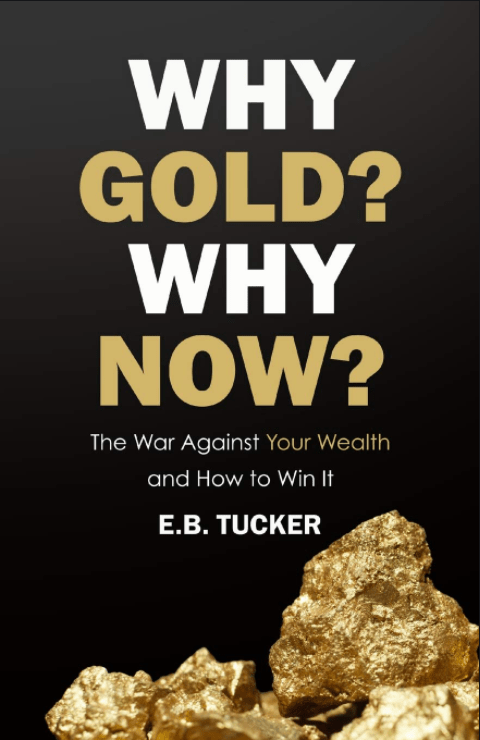
Title: Why Gold? Why Now? (The war against your wealth and How to win it)
Author: E.B. Tucker
Hi all,
In these unprecedented times we come to hear more doomsday messages that the financial system as we know it will collapse, that the government is no longer what it once was and wants to attain more and more control over our daily lives, and one way you can protect yourself is to build up some reserves outside of the system, by means of gold and silver.
Maybe we see and hear more of these messages because we take time to watch the videos on YouTube (more so than in times when the economy is not going through some difficult obstacle), or maybe there just appear more videos during difficult time. Whatever the case, whether you act on them or not, they can be entertaining, and provide you more perspective on how you can consider changing your financial planning.
I have read a few of these books, and always learnt something new in the process.
Here’s my take on this book:
- The book is split into three sections (1. Why Gold, 2. Why Now, and 3. The Ultimate Gold Handbook)
- Section 1 is split into 9 chapters and talks about some history of gold, with specific emphasis on its place in the USA history.
- Section 2 is split into 9 chapters as well and explains the current state the American government is currently in, and where the author believes it might be heading in the coming years.
- Section 3 closes of with 10 chapters to give the reader some insight into different aspects on gold that every reader should become familiar with before starting off positioning themselves in gold. Meaning, you shouldn’t just buy it because someone tells you to, but research what there is to know so you don’t pay too much, but rather position your overall portfolio to include an appropriate amount that is feasible for you.
What you will learn from the first section of the book is that whether in the ages of the Romans, or the modern day America, people seem to repeat the same mistakes over and over again. The government is formed by the people with sound money, and money is in limited supplies. Governments become stronger and want to spend more on projects, but are restricted by the limited money supply. Thus, they resort to devaluing the currency (in Roman times they achieved this by clipping the coins, und using the clippings to make more coins; or, they melted the coins, mixed another metal with it, and produced a larger volume of coins, and deemed them to be sound coins. In modern times countries simply print more pieces of paper, thus reducing the purchasing power of all the other paper money in circulation).
Today, governments have also printed a lot of currency, and with the pandemic have printed even more. This printing of money is based on the Modern Monetary Theory presented by John Maynard Keyes, who suggested that when people hoard money (due to difficult times) the rest of the economy is suffering. To alleviate this suffering the government should print money, and bring it into circulation to ease the pains.
It may work for a short period of time, and I believe the intention may have been from Keynes that the government should subsequently remove the excess currency once the economy is stimulated again. However, when the printing only continues, it actually inflicts more pain, because it makes everyone’s remaining currency worth less and less.
With gold, this is not possible, because gold cannot be manufactured as fast as currency, and therefore keeps people and governments in check so growth is stable.
In the second section the author notes that world economies are heading more and more towards cashless societies. Meaning, we won’t see paper currency or physical coins, but only make transactions via our mobile devices and cards. For the author this is quite disturbing because when we give up cash, we give over control over our funds. Those who control the network connections (governments can attain this control) will have access and control over our money, and there’s nothing we can do.
The specific topics he goes in to are negative interest rates and FedCoin.
- If all our money is electronic and we don’t spend enough money, the banks can simply charge negative interest rates (i.e. we pay the bank for holding our money and not spending it) and we cannot withdraw it to avoid these charges
- With FedCoin the government would be able to see all the transactions we make, and we would no longer have the privacy we would have with cash
- This has the upside that terrorism could much easier be traced
- However, if they can see all transactions we undertake, it could change the way taxes are levied (i.e. taxes could now be charged much more easily on all transactions, and not just those we would do in the store, which means the taxing system could be abused)
These are the worrying messages the author wishes the reader to understand, and therefore sets the argument for all of us to take up gold into our portfolio while it is still permitted.
Section three closes off by giving a lecture on different things every beginner should know about when they are considering to position themselves into raw materials. It talks about the kinds of coins he would suggest, that you can also consider mining stocks, and what to look out for, amongst other things.
Summary:
All in all, I believe it is a good intro for someone that wants to learn more about what this investment class is about, but everyone should still read up a little more themselves to learn more on the history of money to get more insight how money works, and where it is heading in modern economies. For this reason I believe a rating of 4.45/5 is the rating I would allocate to this book.
Happy reading!

