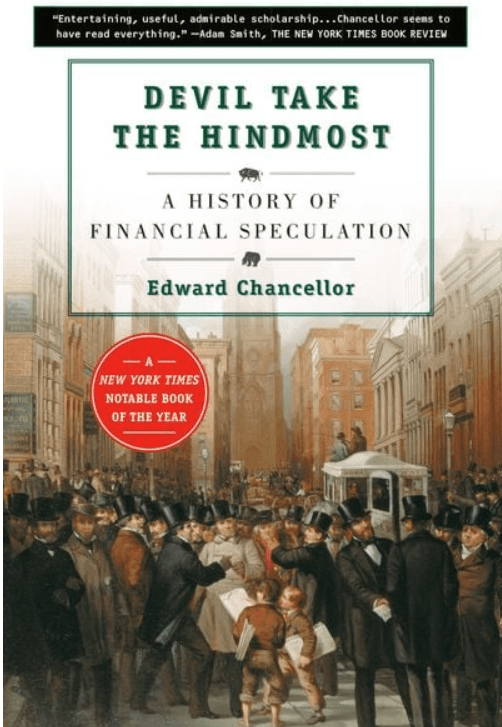
Title: Devil Take the Hindmost
Author: Edward Chancellor
Pages: 349
Genre: Investing, History
Hi all,
Today I come to you with a quite exciting read.
Since I started reading investment books (investment strategies, different forms of investing, etc) there was one topic I felt drawn to understand better, but which book never really fully addressed: bubbles. People wrote about various bubbles that have occurred, but never really discussed them in greater detail.
So I hoped to find a book that i) discussed a bubble in greater detail and ii) discussed other bubbles I might not yet have heard of. That is where the book of today comes in for you. Though I must warn in advance, it is not too difficult to read, but also not too easy since it is a technical book. Meaning, if you don’t hold onto the thread, you may get lost in the chapter. However, this should not be a problem if you are interested in learning the topic as well.
The book is broken down into the following chapters:
Preface (pg. ix)
- This chapter discusses what speculation vs investment is and what it’s purpose is in the capitalist system. It also discusses how it was seen in the past and how that viewpoint has somewhat changed (as well as remained the same) as the time has passed.
- Overall we can agree that both Investors and Speculators are willing to take up some risk to receive a somewhat greater rewards vs other classic investment products (savings account, etc) which give a lower return.
- Furthermore, the form of return between the two is slightly different.
- The speculator focuses on profiting from share price movements (mostly short-term),
- The investor focuses on profiting from dividend returns as well as capital appreciation (over the long-term)
1. “This Bubble Word”: The origins of financial speculation (pg. 3)
- The chapter briefly discusses the role of capitalistic characteristics in the Roman empire and how some forms of speculation already present as far back as then.
- Next we jump into Medieval Europe, where the pursuit of profit was both morally corrupting and dangerous to the commonwealth. However, during the later Middle Ages, the Italian city-states began issuing new innovative financial products, which gradually also attracted the interest of other European neighbours. Alongside these innovations, a speculator seeking to profit from them was not far away.
- One important development during the second half of the sixteenth century was the Wars of Religion and the Revolt of the Netherlands. Protestant and Jewish refugees from the Spanish territories fled those regions and came to Amsterdam.
- This, together with the Dutch openness to enterprise and profit led to the Dutch “economic miracle”.
Development of the bubble:
- Capital from across Europe made its way to Amsterdam to participate in the trade in various financial assets.
- Incomes of the people rose strongly. Other asset prices also rose in value.
- The nation became a nation of consumers.
- Additionally, capital loans were made widely available to individuals to become able to finance the purchase.
- A loan was made to someone so they can buy 1.000 shares, but they currently only had money to pay for 100 up front.
- Also, the government did not place too many regulatory restrictions on these financial assets, which made barriers very low.
- One of the earliest works provided from this time was a book called ‘Confusion de Confusiones’ by Joseph Penso de la Vega, an immigrant from Portugal who fled the Spanish Inquisition. He made it quite clear that the stock market was far from being rational and speculators were full of instability. As a result, their behaviour produced the undue movements in stock prices.
- During the later stages of the economic cycle, but before the bubble burst, more money became invested in financial products than in businesses (i.e. expanding the business, investing in new machines, buying new stock that might sell profitably, etc.) themselves.
- This was done, because investors and business owners saw that more profit returns were to be made in speculation rather than in classic business.
- This could be considered a vital turning point and a red flag for an economy.
Tulipomania
- The most well-known bubble that resulted during these times came to be known as the Tulip Bubble.
- The imperial ambassador to Suleiman the Magnificient (Ottoman empire) introduced the first tulip to Europe.
- The tulip was initially confined to the gardens of nobility. Thus, tulips became associated with wealth.
- Those who were not able to purchase shares in joint-stock companies were able to instead wager on tulip prices.
- The first investors took their profits and spent them on consumable goods, which raised the living standards of many, as well as asset prices.
- There was little attempt to justify the higher prices since most buyers entered the contracts solely with the intention of selling again soon for a higher price.
- In the early stages of the bubble, the quality of the tulips were good and the quantity available low. As the bubble progressed, the quantity of available tulips increased, but most of the tulips introduced to the market were of lower quality.
- Once the bubble burst, the mood of the people changed to having a phobia for investing & speculating.
Carnival
- The author cleverly compares the event of speculation with a carnival. Both a carnival and speculative mania turned the world upside down.
- The carnival offered a moment of release from the people’s rigidities and religious demands.
- The speculative mania reverses the nostrums of capitalism (such as devotion to a professional calling, honesty, and hard grind). This release is of a temporary nature, and once the collapse has come, those nostrums of capitalism are reinforced.
2. Stockjobbing in ‘Change Alley: The Projecting Age of the 1690s’ (pg. 30)
The chapter briefly summarizes how the next bubble was only made possible with the introduction of new forms of financial innovations in the seventeenth century Europe. (1) The parliamentary guarantee of government loans and (2) the establishment of the Bank of England with permission to circulate paper currency. These innovations were introduced to help the state tap the resources of the country for the costly war against France’s Louis XIV.
By this time, goldsmiths had taken on the unofficial role as bankers. People didn’t want to carry all their gold with them and therefore left it with the smith in exchange for a letter of redemption. The smith noted that people didn’t come to redeem all/most of their gold for a long time, for which reason he considered profiting from this. He would lend out gold (credit) to other people for a fee and by the time the people wished to redeem their holdings, he would have recouped the credit amount.
Additionally there were certain individuals who sought to use those new financial innovations for their personal gain to the exclusion of others, the so-called stock jobbers. From the 1690s onwards, trading in company shares became more available to the public which thus opened the doors for speculation in stocks. The trade in stocks was mainly performed in Exchange Alley.
Diving companies
- When one ship returned after seeking out sunken treasure, the ship paid out the horde to its then shareholders. This created a hype to finance other companies that sent out ships to seek treasure. However, the hype only lasted for a brief time, since most didn’t manage to salvage lost treasure, or those companies that promoted new diving techniques via patents (i.e. new innovation) didn’t manage to bring fruits from their labour.
War with France
- When war broke out with France, there was a ban of importing goods from them. Thus, people started promoting companies to produce the goods in UK that were typically imported from France. Attracting some money for those goods that usually brought in good profits.
The seventeenth century was also a time when significant advances were made in the field of mathematics, especially in the field of quantification of risk. Wagering ceased to be mere gambling and instead became a trade since more and more brokers appeared which were underwriting a variety of risk policies.
With this came also a better understanding of the concepts ‘time value of money’ and ‘intrinsic value’.
In this Financial Revolution, there was no longer a substantial economic reality… companies were floated on waves of speculative euphoria. With this euphoria, shares were also used to purchase political influence. Many of the politicians and aristocracy were given options and board seats to exert some form of confidence for the other stockholders.
Crises
- During the war with France, the UK ran into financial difficulty in financing the war. Thus it turned to an old form of ‘stealing’ money from an unsuspecting public: it debased the coinage.
- Resultantly, people and institutions providing credit withdrew from the city. Shares of companies suffered, since people were in need of liquidity. Small / hyped companies that lived on new money disappeared due to their loss of liquidity.
- Additionally, the war in France distracted the government from fulfilling its traditional role as a regulator and therefore let some financial activities go unchecked
Speculative manias summarized:
- Manias typically commence with an entirely new object or from increased profitability of established investments.
- It is followed by positive feedback, as rising share prices entice other people to join the market trade
- This results in greater euphoria and investors’ rationality is weakened.
- Speculation spreads to different classes of assets and investors start taking advantage of other money (credit, leverage, etc.) to overextend their positions
- With more money ending up in speculation and less in consumption or investment in companies (via machinery, or expansion of the business) the economy enters a period of financial distress.
3. “The Never-to-be-Forgot or Forgiven South-Sea Scheme” (pg. 58)
Mississippi bubble
- John Law had set up a company in France, which received the right to all trade with the French colonies in North America.
- In exchange for this privilege, it had taken over the full national debt of France and converted it to company shares.
- His bank had also received the right to issue the main currency of the country (and with it a license to print money).
- The company used money from new investors to pay generous dividends to existing shareholders, telling them that there were more gains awaiting from the colonies.
- These stories of riches, as well as generous dividends spurred on the share price and attracted the funds of other European investors, away from the London markets.
South Sea company
- The South Sea Company was established to take on the success of the Mississippi company.
- It was set up to take over the government debt, which it converted to company shares. In exchange it would receive a fixed annual interest from the government, as well as the monopoly of trade with the Spanish colonies.
- As the price of the shares rose other holders of government debt also started accepting the share in exchange for the government debt.
- To make the shares more attractive and credible, several members of government and court had been secretly provided with an allocation of shares and board positions.
- The maxim was to make the share prices continually rise. To make this possible they made other forms of loans and credit available to people so they could finance the acquisition.
- By the time a fourth round of issuing new shares were communicated to the public, most large finance houses became suspicious and instead started selling off their holdings. Even directors started selling their positions and instead invested in land and other asset holdings.
- Companies who had bought stock on credit were forced to sell off their holdings to liquidate their portfolio, which exerted more pressure on the share prices
Speculators did not buy stock in these companies as long-term investments; they bought them with the intention of selling them on to greater fools.
- The South Sea Company had no genuine prospect of profitable trade with South America. The value of its shares was derived entirely from the income the company received from the government.
As a result, the progress of financial capitalism in the eighteenth century was retarded and joint-stock companies contributed less than they might otherwise have done to Britain’s Industrial Revolution.
4. Fool’s Gold: The Emerging Markets of the 1820s (pg. 96)
British government bonds (known as Consuls) replaced shares as the primary object of speculation after the events of the 1720s. During the Napoleonic Wars, the British government issued millions of bonds. Fortunes were made in speculating these bonds.
The decline in British government borrowing after peace with France forced investors to look abroad for opportunities.
South America
- Various provinces of South America had been fighting for independence and British support was strong.
- After the expulsion of the Spanish, rapid economic progress was anticipated for the continent
- These countries still had large lands that held mining reserves and the British believed setting up companies to mine these resources after their independence would be a profitable venture
- The largest loans were made out for future mining companies
- The proposition was enticing and with a decline of Consuls, the investing public became ensnared.
- Again, these companies appointed politicians to make their ventures more credible and inspire confidence
Greece
- The public’s enthusiasm for the Greek struggle against Turkey was also strong
The interest on these loans were set very high and often only small initial deposits were required (with outstanding payments becoming due over time).
However, a large percentage of the money raised for these loans was retained by British contractors to pay for the high dividends and no money was ever sent from South America to service these loans.
The banks had also extended large sums of credit to consumers and institutions to finance the acquisition of shares. When those shares started falling in value, more and more people started failing their credits. Banks had borrowed more money than it held gold in reserve to back those credits. Therefore, the Bank of England tightened the issue of new credit, to protect the integrity of the little gold reserve they still held. Small over-extended banks started to collapse as bank runs had shown how little protection the bank truly had.
- Instead of acting on sound information, speculators were driven by fantasy of the mining company prospects.
- Emerging market speculation appeared when the declining yields on domestic bonds, combined with an excess of investable capital made foreign investments attractive.
5. “A ready Communication”: The Railway Mania of 1845 (pg. 122)
Once an innovation has been successfully established and produces steady returns, speculation gives way to investment. Inventions have always excited speculators.
Canal mania
- Many miles of canals were built which opened the door for more trade and commerce between more towns (especially inland). The first companies established to build new canals were genuine and did bring in proper returns for its investors.
- However, the next round of joint-stock companies set-up to build more canals included more fantasy than real efficiencies.
Railway mania
- The first steam engines appeared in the 1820s. It was met with skepticism and opposition, but over the years it proved its worth. And when it did, it caused a break-out of railway fever.
- Companies were set up with plans to build specific tracks, linking two specific destinations. Some companies utilized their success to expand and become even larger. To attract shareholders, the new companies included an attractive high dividend payment.
- The government remained impassive in the face of the growing public involvement in new railway schemes.
- The speculation was facilitated by the establishment of loans against the collateral of railway shares.
- A pamphlet posted warned of an impending crises as money was drawn from legitimate channels of commerce by tradesmen and expending their capital on railway shares.
- Banks started raising interest rates
The lessons that would be later learned from the burst bubble was that the market value does not depend on the success of the undertaking, but on the public appetite for speculation.
6. “Befooled, Bewitched and Bedeviled”: Speculation in the Gilded Age (pg. 152)
The colonial movement was in the nature of speculation. The first American colonies were established as joint-stock companies.
The speculative character of the American people derives from the colonial venture. The American settlers had forsaken their historic lands for a nation whose boundaries were limited only by their dreams. Settlement on the frontiers involved great risks and this appetite for risk has not diminished.
Civil War
- The outbreak of the American Civil War in 1861 ushered in a new ear of speculation. Initially stock prices declined. Then, Congress passed the bill to create more currency. Speculators noted that a higher supply of currency would spur inflation and then fled into stocks.
- Far and wide throughout the Northern States, almost every man who had money employed part of their capital in the purchase of stocks, gold, copper, petroleum or other domestic produce in the hope of a raise in prices.
Exchanges
- New exchanges were established to provide supply for the strong demand for shares in mining companies. Especially since the discovery of the gold in certain states
- When other bubbles cleared, new hypes were discovered, with petroleum companies enticing people with their prospectuses
- Railroads connected western and eastern territories and with it fantasies of future prosperity
7. The End of a New Era: The Crash of 1929 and its Aftermath (pg. 191)
The crash of 1929
8. Cowboy Capitalism: From Bretton Woods to Michael Milken (pg. 233)
9. Kamikaze Capitalism: The Japanese Bubble Economy of the 1980s (pg. 283)
Epilogue: The case of the Rogue Economists (pg. 328)
Summary:
Overall, it is quite detailed to give the reader a broad understanding of how the world lived at the time and how it came about that the bubble was able to grow and flourish. These patterns can be seen to repeat in the following bubbles, and therefore serve as a warning to the investor for the future.
It is a complex topic but is brought together very well and broken down easy to understand for an investor that already has some background understanding of the topic.
The book for me deserves a rating of 4.5 / 5.

