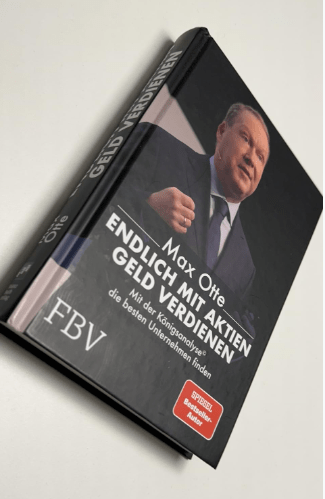
Title: Endlich mit Aktien Geld verdienen
Author: Max Otte
Pages: 280
Genre: Investment, Analysis
Hi all,
Today I come to you with another German investment book that I found in the mini library of my wife’s sister’s husband. Although his investment strategy differs a little from mine, it was interesting to read a book of an author I had previously only watched on YouTube.
It is not a book for the complete beginner that wants to learn what the topic “investing” and “shares” is about but rather for an individual that has learned these basics already and now wants to add a little strategy to his game. For the book, this is called the “kings analysis”.
The book introduces you a questionnaire that he uses to evaluate individual companies by assigning points per question. In the end, where the company has accumulated a certain number of points he will then know whether the company has:
- No investment quality (0 – 20 points)
- Critical investment quality (21 – 40 points)
- Moderate investment quality (41 – 70 points)
- High investment quality (71 – 100 points)
The questions are grouped into three sections:
Section 1 – Business model
- Criteria 1 – Does the company produce/provide everyday products/services for end consumers that are in constant demand?
- Criteria 2 – Is the business model simple and easy to understand?
- Criteria 3 – Does the company have a high profit margin?
- Criteria 4 – Does the company have sustainable competitive advantages?
- Criteria 5 – How high is the industry growth?
Section 2 – Management
- Criteria 6 – Does the company have strong and long-term oriented owners (or managers who think long-term on behalf of the owners)?
- Criteria 7 – What is the situation regarding the management’s qualifications and turnover?
- Criteria 8 – How competent (and composed) is the operational management?
Section 3 – Financial Statements and Capital Management
- Criteria 9 – What is the company’s situation regarding net liquidity, equity ratio, and debt relative to cash flow?
- Criteria 10 – What is the company’s approach regarding dividend quality, capital increases/share buybacks, and smart acquisitions?
Based on these questions and points he groups shares into one of the following asset classes:
- Rockets –> Growth companies
- Escalators –> Slow growers
- Roller coasters –> Cyclicals
- Pits –> Money pits
- Swamps –> Money drain
- Shooting stars –> Trends
The author is quite inspired by the methodology of Warren Buffett (i.e. margin of safety, circle of competence, Mr. Market, etc.) and also prefers not to sell if he holds a belief in the continued long-term success of the business.
The one topic the author does not go into too much detail is how to determine the inherent value of the company. The methodology above helps the author find companies of good value to invest in, but then the reader still needs to calculate for himself what is the inherent value so that he may determine an appropriate margin of safety and strike price at which to enter.
Summary:
The book is a very good book for investors that want to up their game and identify companies to invest in for themselves. It gives them good pointers what to look out for in companies (other than financial results only).
It is not conclusive on how to value a company for its inherent value, but it this would be a secondary step for the investor. The first would be to identify quality companies and in this, the author has given a good methodology for value investors.
Thus, the book receives a rating of 4.8 / 5.

