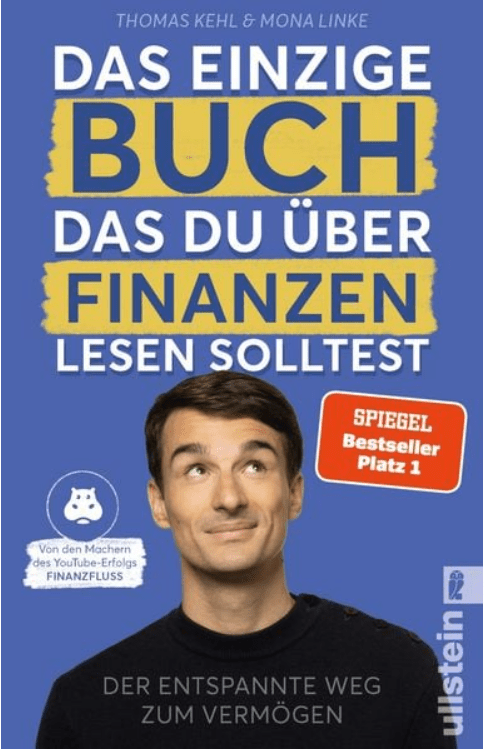
Title: Das einzige Buch das du über Finanzen lesen solltest
Author: Thomas Kehl & Mona Linke
Pages: 268
Genre: Finance
Hi all,
The book is broken down into the following chapters:
Preface (pg. 9)
Chapter 1 – Seven financial fallacies (pg. 15)
- The state pension will be sufficient
- In Germany, the employed individuals contribute monthly into the state pension system and based on the amount contributed, they collect points. There is an average salary on which the state orientates itself. The state measures how much we earn (and thus contributed) vs the average salary in Germany and you get a certain number of points.
- However, if you earn more than a specified amount you will not earn more points, since the number of points that can be earned per annum is capped.
- Once you enter retirement, you will receive 48% of the average salary that exists at the time you are in retirement. If you earned a high salary and now a high pension, you might still be required to pay taxes
- Money has made the world into a terrible place
- When the barter system was in place, it was hard for individuals to exchange one item easily for exactly the item they wanted
- Money, the medium of exchange, solved that problem.
- However, money is not terrible, it feels to be terrible when other people use it to reduce its purchasing power, which then affects you.
- Only those who learn to handle money from a young age, know how to handle it well
- Money and financial literacy is one of those topics where you don’t need a degree to become better at handling it.
- It requires time to study some literature on the topic and common sense.
- Banks and financial experts have an interest in making it sound complex so that you feel inclined to go to them and help you (for a commission)
- The politicians/state will take care of me
- The politicians in most countries make slogans and promises to become elected, but once they become elected often another agenda is taken on instead.
- Their focus is more on delivering some short term objectives so they can be elected for another 4 years, rather than addressing real and long-term issues.
- The low interest rates are at fault that my savings are not growing
- Banks give out loans for consumption (people) or for investment (commercial).
- They in turn also borrow money from the reserve bank, who lends money to them.
- The objective of the reserve bank is to keep the purchase power and inflation under check. If inflation is getting out of hand, they increase the lending rate, to reduce the amount money and companies wish to borrow, and in turn, if inflation is shrinking too much, they will reduce the interest rate to spur on spending.
- Financial planning is not possible without a financial planner
- If you are thinking of doing something complexer with your money (investing in off-shore firms, setting up a trust, investing in complex financial structures) then it is advisable to get financial advice.
- If you are thinking of doing something simpler with your money (investing in single stocks, ETFs, mutual funds) you can get advice once /twice from a professional or even read up on the topic, but you don’t necessarily need long-term financial advice
- The factor that blocks you from achieving financial success is the cost of your financial products. If you can keep this low, then there is more money to keep invested to grow for you
- What every does should likely not be incorrect
- If everyone is going into debt (due to low interest rates) then the additional consumption is justified?
- Building wealth requires discipline, even when it means doing something different from the crowd.
Chapter 2 – Set the tracks for your financial future (pg. 45)
- The best way to get started is to define some financial goals.
- You want to earn €xx additionally per month for retirement
- You want to buy a home and have it fully paid up by retirement
- You want to be able to go on holiday during retirement
- Those goals will lead you to set up strategies to follow every month
- Save €xx per month in ETFs / stocks and increase that when your salary goes up
- Setting up goals requires your goals to be SMART:
- Specific -> What is your goal?
- Measurable -> How can you measure that you achieved it?
- Achievable -> Is it achievable within your financial means?
- Realistic ->
- Timely -> By when do you want to achieve it?
- Setting goals on paper also helps you psychologically.
- It all starts by setting up a budget
- The budget will help you determine how much money you need for your goals and how much you need to cover your monthly fixed costs.
- Then you know how much is left for you to enjoy and you don’t need to feel guilty for purchasing or splashing on something.
- At the end of the day, saving money should not feel like a punishment. It should be fun, because you know you are saving for your financial goals!
- Compounding effect works in your favour the sooner you start.
- Differentiate between good debt and bad debt. Good debt goes into an asset that can work for you whilst bad debt is mostly for consumer goods which cannot be sold more more money.
Chapter 3 – The classic financial products (pg. 89)
- In Germany, only about 12% – 14% of the population is invested in Stocks, ETFs or both.
- The overwhelming majority still saves their money in a zero – meager interest earning bank account. Thus, the interest earned on those accounts do not even cover the inflation for the year, and, you are also taxed on those few interest earnings.
- Another product Germans are largely invested in is Life insurance and Property Savings Account, where the cost /premium is large in relation to the potential return.
Chapter 4 – Property as an investment (pg. 107)
Chapter 5 – Share investing (pg. 127)
- A basic intro what shares are and how you can participate in the market. Also, what types of rights you have and how you can profit from share investing (i.e. dividends, capital appreciation).
- Investing in single stocks bears market risk. To counter this you can buy other shares as well, thereby bringing in diversity in sectors, countries and branches into your personal portfolio.
- By buying stocks you have to differentiate between to items: the value of a stock and the price for a stock.
- The price is what you pay to acquire the share via your broker. The price is clearly visible to you.
- The value is less visible and highly subjective to be determined, since different people /investors value something in the same company differently.
- It is essential to try and not buy stocks far to high above their value, since the stock market works in cycles and therefore overvalued stocks undergo corrections, which means that you could have overpaid for a stock.
Chapter 6 – Investment funds & ETFs (pg. 147)
- An ETF essentially is less complicated to handle for laymen investors. A fund buys a basket of stock and sells you a share of this basket. You don’t need to buy all those stocks yourself for their own individual share price (which is more expensive), but you can buy a fraction of the fund and start participating with less capital (i.e. from €50 even).
- What you need to look out for is the type of ETF you purchase.
- A classic world ETF, which is well diversified (mostly industrial countries)
- A ETF for a specific industry (where you retain industry risk)
- A ETF for a country / continent (where you retain country / region risk)
- ETFs also charge a fee for you to participate in their fund. The objective should be to keep the costs as low as possible so you can have most of your money invested and work for you, and not pay off broker fees. Here, you need to look at the TER (total expense ratio) per ETF.
- If you invest in a classic World ETF, you can achieve classic average returns. Research has shown that the average returns p/a over periods of 15, 20 or more years end up around 8%. If you compare this with money invested in a 1% – 3% savings account, you can earn quite a bit more (even more than inflation).
- Important to remember, the money you invest should be invested for minimum of 10 years. Why? Because the stock market is subject to greater volatility. Thus, some years your stocks will end negative and others it will end positive. If you invest money you need again in the short-term, then you risk having to sell your stocks at a point when they are down in value, and thus losing money.
Chapter 7 – In four steps your first investment (pg. 177)
- Step 1 – Find the right balance between risk and safety (i.e. your risk tolerance)
- Step 2 – Set up an account and build a world portfolio (i.e. diversity mix)
- Step 3 – Find the appropriate ETF for your portfolio
- Step 4 – Open your broker account
Chapter 8 – What you always wanted to know (pg. 221)
- When is the best time to start?
- The saying on the stock market is that the best time to start is 10 years ago. The second best time is today.
- Why? Because once you start, the compounding effect can start working in your favour.
- The longer you delay, the longer you don’t make use of the compounding effect. And compounding only truly works when you give it enough time. Not money, time!
- Don’t try to time the market
- We all want to buy when the stocks are at their lowest, so we can make a bargain.
- However, when stocks have fallen and no one (the herd) is buying, you also don’t want to buy since you are afraid the price may fall further.
- Invest all in one go or systematically over a few months.
- If you invest all your money now and the stocks fall further, you feel bad.
- If you invest gradually, you might feel you are better in control.
- This choice is a matter of personal preference.
- What to do when a crash happens?
- Don’t panic sell, because that is what everyone else is doing.
- Try to understand why others are selling. If the companies are still good, but are struggling a bit, then there is no need to reduce your earnings.
- If the company is in some serious waters (fraud, solvency issues, etc.) you can consider whether reducing your position is also in your best interest.
- Simply doing what others are doing will not bring you greater financial returns.
- Sometimes crashes are the opportunities to build greater wealth! Then you need to have the courage to go against the crowd.
- Don’t panic sell, because that is what everyone else is doing.
Chapter 9 – What finances have to do with luck, freedom and a self-enabled future (pg. 253)
Glossary (pg. 269)
Summary:
Overall, the focus on the book for financial literacy starts off with getting in the correct mindset before starting to invest in financial products straight away. The book gives you tools to learn what financial goals and strategies can be, and how you can build a plan via a budget.
It then shares what the typical investment products in Germany are and why their returns are no longer optimal for wealth building. The it leans into investing via Shares and ETFs and what is important to learn about the topic before you get going.
The book is a good balance of literacy and investing “advice”. It suffices for a beginner and deserves a rating of 4.3 /5.
Have fun!
 MyBookReviews